
CRM, ERP and business systems15 min read2924 wordsRedakcja dvnt
Transport management system (TMS) — what it is and when a transport company needs one
Transport management system (TMS) in Poland: GPS vs ERP, driving time, tachograph, e-CMR and SENT, PLN price lists and when a custom driver app helps.
A transport management system (TMS) is software for planning and settling freight transport: it answers which order goes on which truck, with which driver, by which route, at what price, and whether it has arrived yet. It is not the same thing as the GPS unit in the cab or the program your accountant uses to close the books. GPS tells you where the truck is. A TMS tells you why it is there and whether the trip paid off.
This guide is for owners of haulage and freight forwarding companies in Poland with anything from a handful to a few dozen vehicles, and for companies that deliver their own goods with their own vans and trucks. It covers the line between a TMS, telematics and ERP, what the rules expect from transport planning, the signals that a dispatcher needs a system, the prices of TMS software for transport companies with public price lists, the integrations you will need, and the cases where a custom driver app makes sense. Rules and price lists are as of 28 October 2026. For the wider map of software a company runs on, see our guide to business software.
What is a TMS — and how it differs from GPS, transport software and ERP
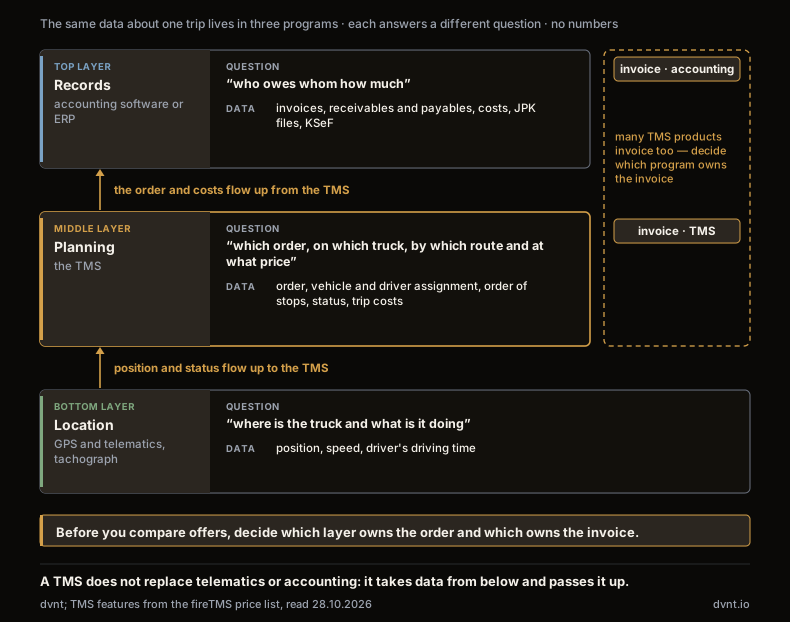
Put simply, a TMS is the planning layer between vehicle location and the accounting records. In a transport company, data about the same trip lives in three places, and you need to separate them before you start comparing offers.
The location layer — GPS and telematics. A device in the vehicle, or the driver's phone, reports position, speed, sometimes fuel consumption and tachograph data. Telematics answers the question "where is the truck and what is it doing". It does not know which order the truck is carrying, who is paying for it or what the trip cost.
The planning layer — the TMS. This is where the order is created: from whom, from where, to where, what cargo, at what price. The dispatcher assigns it to a vehicle and a driver and sets the order of the stops, and the system tracks the status and collects the trip costs: fuel, tolls, the subcontractor. A good TMS takes the position from telematics instead of asking the dispatcher to retype it.
The records layer — accounting software or ERP. Invoices, receivables and payables, cost records, SAF-T files (JPK, Jednolity Plik Kontrolny). This is where the company settles up with the tax office.
The line between the second and the third layer is not fixed. Many programs for transport companies issue invoices: the fireTMS price list (in Polish) lists invoices, JPK file export and integration with KSeF, the National e-Invoicing System (Krajowy System e-Faktur), in every plan. So "TMS or ERP?" is the wrong question. The right one is: which program owns the invoice and the receivables. If the company already has an ERP or accounting software and the TMS starts invoicing too, within a month you have two sales ledgers and two versions of who has paid. One of them has to be the source of truth, and the other receives the data through an integration. What an ERP looks like from a small company's side is covered in our article on the ERP system.
The pair "WMS and TMS" works the same way. A WMS (warehouse management system) runs the work of the warehouse — what sits on which shelf and who has to pick it. A TMS starts where the goods leave the loading dock. A company with both a warehouse and a fleet needs both, connected so that they know about the same shipment.
What the rules expect from transport planning — e-CMR, driving time, SENT
No rule requires you to have a TMS, but several rules mean that a transport plan has to know something about the driver, the vehicle and the load. This is a description of the acts as of 28 October 2026, not advice.
Driving time. Regulation (EC) No 561/2006 limits daily driving time to 9 hours (10 hours at most twice a week), weekly driving time to 56 hours and total driving time over two consecutive weeks to 90 hours (Article 6). After 4.5 hours of driving, a driver must take a break of at least 45 minutes (Article 7). Article 10(2) puts this on the company: the transport undertaking must organise its drivers' work so that they can comply, instruct them properly and check regularly. Article 8(8a) adds a duty to plan work so that a driver can return to the operational centre or home within each period of four consecutive weeks. Since 1 July 2026 the regulation also covers the international carriage of goods and cabotage with vehicles whose maximum permissible mass, including any trailer or semi-trailer, exceeds 2.5 tonnes (Article 2(1)(aa)) — which brings in some vans.
Tachographs. Regulation (EU) No 165/2014 requires a tachograph in vehicles covered by Regulation 561/2006 (Article 3(1)). A smart tachograph records the vehicle's position at the start and end of the daily working period, when it crosses a border, at loading and unloading, and after every three hours of accumulated driving (Article 8(1)). The company keeps printouts and record sheets for at least one year and is, as a rule, liable for infringements committed by its drivers (Article 33).
e-CMR. The Additional Protocol to the CMR Convention concerning the electronic consignment note entered into force for Poland on 11 September 2019 (government statement, Journal of Laws (Dziennik Ustaw) 2019 item 1488, in Polish). An electronic consignment note has the same evidential value as a paper one, is authenticated with a reliable electronic signature, and the parties to the contract agree among themselves how it is issued and delivered (Articles 2, 3 and 5 of the protocol). It is an option, not an obligation. The EU eFTI regulation works separately: according to the European Commission, from 9 July 2027 authorities in all EU member states must accept freight transport information shared electronically through certified eFTI platforms. The duty to accept such data lies with the authorities.
SENT. The Act on the System for Monitoring Road and Rail Transport of Goods and Trade in Heating Fuels (ustawa o systemie monitorowania drogowego i kolejowego przewozu towarów oraz obrotu paliwami opałowymi, in Polish) covers the transport of selected goods — among others, oils and fuels under CN heading 2710 above 500 kg or 500 litres, heating fuels regardless of quantity, and dried tobacco without excise stamps (Article 3(2)). Throughout the journey, the carrier must ensure that current geolocation data of the vehicle is transmitted — from a locator or from an external location system (Article 10a). Failure to do so carries a penalty of PLN 10,000 (Article 22(2a)).
What this means when choosing software is our conclusion, not a legal requirement: a TMS should see a driver's remaining driving time from the tachograph or telematics before the dispatcher assigns the next trip, and if you carry goods covered by SENT, the notification number should be attached to the order.
When a transport company needs a TMS — signals from the dispatcher
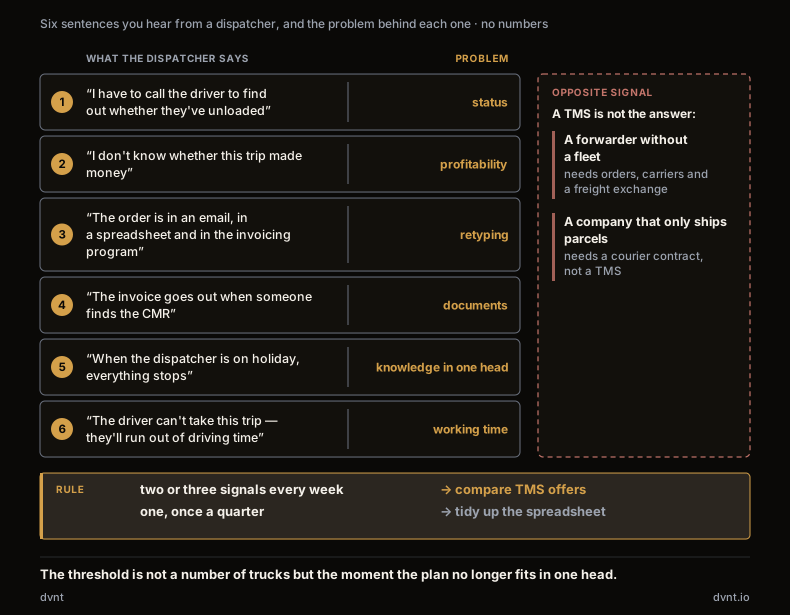
A company needs a TMS not when the fleet passes a certain number of vehicles, but when the transport plan no longer fits in one person's head and one spreadsheet. No independent study sets such a threshold in number of vehicles. The signals come from the dispatcher instead:
- "I have to call the driver to find out whether they've unloaded." The trip status lives in a phone, not in a system, so the customer phones the dispatcher too.
- "I don't know whether this trip made money." Fuel, tolls and subcontractor costs reach accounting a week later, separately from the order. Profitability is calculated once a month for the whole company, not per route and per customer.
- "The order is in an email, in a spreadsheet and in the invoicing program." The same data typed three times means three places to get an address, an amount or a registration number wrong.
- "The invoice goes out when someone finds the CMR." Documents from the road come back in the cab, and the invoice is only issued once they have been collected.
- "When the dispatcher is on holiday, everything stops." How many hours each driver has left, and which truck is coming back from a service, is known by one person only.
- "The driver can't take this trip — they'll run out of driving time." You find out after the order has been assigned, not before.
Hearing two or three of these every week is a good reason to compare offers. One, once a quarter, can usually be solved with a tidier spreadsheet and simple communication with the drivers.
There is also a signal pointing the other way. A freight forwarder without its own fleet mainly needs orders, carriers, a freight exchange and invoices — some programs make that distinction in their price list, pricing "forwarding" and "transport" separately. A company that only sends parcels by courier does not need a TMS; it needs a good contract with a carrier — more on that in our article on InPost, DPD and DHL for businesses.
How much a TMS costs — pricing models and costs beyond the subscription
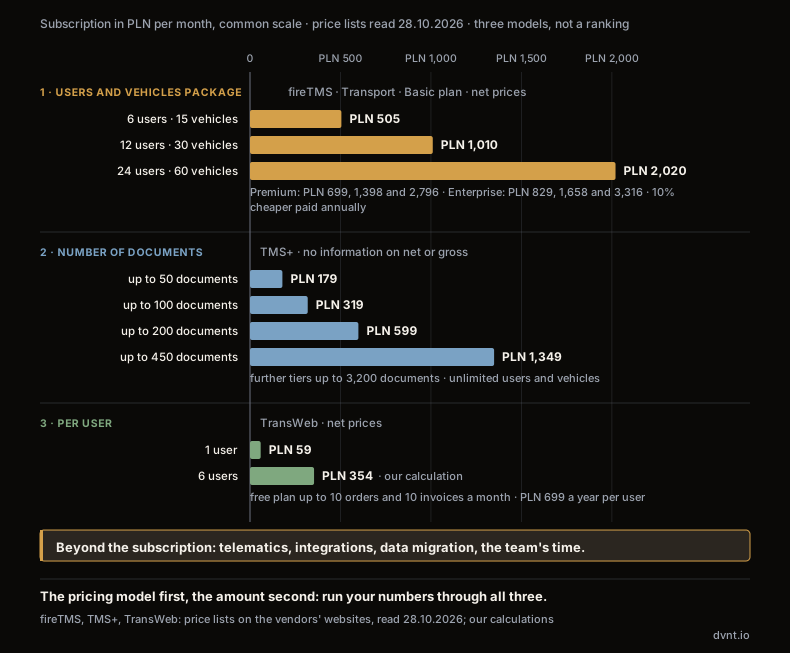
The price of a TMS depends first on the pricing model and only then on the amount: you pay for a package of users and vehicles, for the number of documents, or per user. Three examples with public price lists, not a ranking, read on 28 October 2026:
- A package of users and vehicles — [fireTMS](https://firetms.com/pl/cennik) (price list in Polish). In the "Transport" variant, the smallest package covers 6 users and 15 vehicles and costs PLN 505 net a month in the Basic plan, PLN 699 in Premium and PLN 829 in Enterprise. A package of 12 users and 30 vehicles costs PLN 1,010, PLN 1,398 and PLN 1,658 net respectively, and 24 users and 60 vehicles PLN 2,020, PLN 2,796 and PLN 3,316 net. Annual payment gets a 10% discount. With the smallest package fully used, that is about PLN 34 net per vehicle a month in the Basic plan (PLN 505 / 15 vehicles — our calculation).
- The number of documents — [TMS+](https://www.tms.plus/pl/cennik/) (in Polish). The subscription costs PLN 179 a month for up to 50 documents, PLN 319 for up to 100, PLN 599 for up to 200 and PLN 1,349 for up to 450 documents; further tiers go up to 3,200 documents. Users and vehicles are unlimited. The price list does not say whether the subscription price is net.
- Per user — [TransWeb](https://transweb.pl/) (in Polish). The free plan covers 10 orders and 10 invoices a month. The paid plan costs PLN 59 net a month per user or PLN 699 net a year, with no limit on vehicles or orders. Six people in the office come to PLN 354 net a month (our calculation).
The model matters more than the headline figure. A company with two dispatchers and thirty trucks pays very differently per user than in a package priced by vehicles. A forwarder that issues many orders with a small team pays differently again in a model based on documents. Run your own numbers through each model before you compare products.
The subscription is only part of the bill. Then there are costs the price lists do not show (our list, without amounts):
- telematics — GPS devices or a subscription with a provider, if the vehicles do not have them yet;
- integrations — with accounting software, telematics and freight exchanges, often only in higher plans (in fireTMS, for example, the API for integration is in the Enterprise plan);
- data migration — the records of customers, vehicles, drivers and rates;
- the team's time — learning a new way of working at a time of year when orders will not wait.
Implementation time and return on investment cannot be averaged honestly — the figures circulating online come from vendors' marketing material. The programs in the examples do let you try the system before you buy: fireTMS offers a 14-day trial, and TMS+ advertises 45 days free of charge. Run the test on real orders from one week, not on demo data.
Integrations: TMS, ERP, telematics and freight exchanges
Integration in transport starts with one decision: which program owns the order, and which one only receives it. An order is created in one place — in the TMS, on a freight exchange or in the customer's system — and every other program should receive it automatically, not by copy and paste.
The typical connections look like this:
- TMS ↔ telematics. Position, driving time and mileage flow into the TMS, which uses them to show the status and the estimated time of arrival. In fireTMS, GPS integration is already in the Basic plan.
- TMS ↔ freight exchange. Freight exchanges offer interfaces for companies' software: the Trans.eu API covers freights, orders, transports in progress and vehicles, and TIMOCOM describes its own interfaces for TMS and ERP systems. That way a load from the exchange is not retyped into the TMS by hand.
- TMS ↔ accounting software or ERP. The order and the trip costs go to accounting. If the TMS issues the invoices, the ERP receives the finished invoice; if the ERP does, the TMS passes on the data for the invoice. Never both.
- TMS ↔ WMS. In a company with a warehouse, the trip starts with the goods being released. When both systems know about the same shipment, the dispatcher plans the truck before the goods reach the dock.
Once there are more than two programs, point-to-point connections stop being enough and you need order: one source of truth for the customer, the order and the invoice. An example of the same problem from another industry — an online shop, ERP and WMS — is in our article on integrating ERP with ecommerce. Before you buy a TMS, ask the vendor in writing which of your programs it connects to out of the box, and which need an API in a higher plan or a custom integration.
A custom driver app — when it makes sense
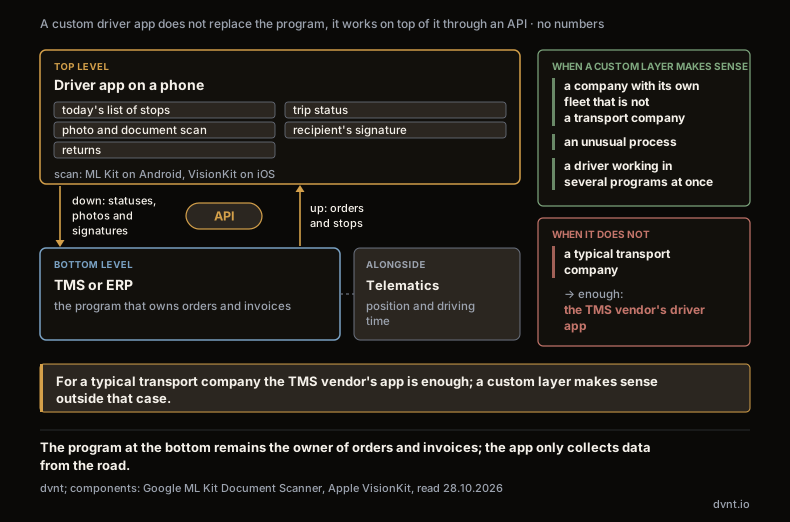
A custom driver app makes no sense as a replacement for a TMS, but it does make sense as a layer on top of the software you already have. Off-the-shelf TMS products usually come with their own mobile apps — fireTMS lists separate apps for drivers and dispatchers — and for a typical transport company that is enough.
A custom app makes sense in three situations:
- when the company has its own fleet but is not a transport company — a wholesaler or a manufacturer delivering goods to shops. A full TMS is often too big, and the drivers need today's list of stops, proof of delivery with a photo and the recipient's signature, and returns, with the data written straight into the ERP;
- when the process is unusual — service reports, waste collection with weighing, installation at the customer's site — and the off-the-shelf driver app does not have your steps;
- when the driver works in several programs at once — orders from the TMS, documents from the ERP, driving time from telematics — and one app has to put them on one screen.
A common part of such an app is scanning documents on the road, for example the signed consignment note, before the driver gets back to base. Mobile platforms have ready-made components for this: the ML Kit document scanner on Android runs entirely on the device and does not require the app to have camera permission, and on the iPhone VisionKit (from iOS 13) provides a ready-made document-scanning screen. The document then reaches the order on the day of delivery, and the invoice does not wait for the paper to come back.
The condition is the same as for every layer: the order and the invoice stay in the program that owns them. The app collects statuses, photos and signatures and passes them on through an API. How to weigh off-the-shelf against custom software — total cost, vendor dependence, maintenance — is covered in our article custom software or off-the-shelf, and what building the app itself involves, in our guide on how to make a mobile app.
How we approach it. For transport companies and companies with their own fleet we build custom mobile apps — native for iOS and Android, and in React Native — as well as web applications and integrations between programs. We do not resell or configure off-the-shelf TMS products, so we have no interest in recommending any of them. If your process is typical, we advise choosing an off-the-shelf TMS and its driver app. If it is unusual, or the fleet serves a company that is not in the transport business, we build a layer on top of the program that remains the owner of orders and invoices, and connect it through an API.
Where to start
- Establish which program owns the order and the invoice today, and write it down before you start talking to vendors.
- List the dispatcher's signals from the last month — which of the sentences above you hear in your company, and how often.
- Run your company's numbers through each of the three pricing models — the number of users, vehicles and documents a month — and test the TMS you choose on orders from one real week.
With that list, a conversation with a TMS vendor or an app developer starts from problems, not from a feature list. It also shows straight away whether you need a full TMS, an off-the-shelf driver app, or just a connection between the programs you already have.
Frequently asked questions about transport management systems
What is a TMS?
A TMS (transport management system) is software for planning and settling freight transport. It takes in an order, assigns it to a vehicle and a driver, tracks the status of the trip and collects its costs. Unlike GPS, which shows where the truck is, a TMS shows which order it is carrying and how much you earn on it.
What is the difference between a WMS and a TMS?
A WMS runs the work of the warehouse: it knows which shelf the goods are on and tells the warehouse staff what to receive or pick. A TMS starts where the goods leave the loading dock: it plans the trip, the vehicle and the driver. A company with a warehouse and its own fleet needs both, connected so that they know about the same shipment.
Is a TMS mandatory?
No. No rule requires you to have a TMS. The rules do, however, require a company to organise its drivers' work in line with the driving-time limits (Article 10(2) of Regulation 561/2006), to keep tachograph printouts and record sheets for at least one year, and, for transport covered by SENT, to transmit the vehicle's geolocation data. A TMS makes these requirements easier to meet in the transport plan, but it does not replace them.
What is e-CMR?
e-CMR is the electronic consignment note under the Additional Protocol to the CMR Convention, which has applied to Poland since 11 September 2019. It has the same evidential value as a paper note, is authenticated with a reliable electronic signature, and the parties agree among themselves how it is issued. It is an option, not an obligation. From 9 July 2027, authorities in the EU must accept freight transport information from certified eFTI platforms.
How much does a TMS for 10 vehicles cost?
It depends on the pricing model. According to the price lists of 28 October 2026, the smallest fireTMS "Transport" package (6 users, 15 vehicles) costs from PLN 505 net a month. In TransWeb you pay PLN 59 net a month per user, with no limit on vehicles. In TMS+ you pay by the number of documents: from PLN 179 a month for up to 50 documents. On top of the subscription come telematics, integrations and data migration.
Does a TMS work on the driver's phone?
Usually yes — off-the-shelf TMS products come with mobile apps in which the driver sees orders and changes statuses. A custom app makes sense when the process is unusual, when the fleet belongs to a company that is not in the transport business, or when the driver works in several programs at once. The app is then a layer on top of the TMS or ERP and passes on statuses, photos and signatures through an API.
Related articles
Web and mobile apps
Online booking system — when a free one is enough and when to build your own
When a free booking calendar is enough, what an online booking system must handle and when a custom module pays off. Vendor prices and our estimate.
CRM, ERP and business systems
CRM for small business — what it is, when you need it and how to choose
What a CRM is, when a spreadsheet is enough, what the system must do, how to square a customer database with the GDPR and how to choose one.
Web and mobile apps
Business software — which tools a company needs, function by function
Business software is chosen one function at a time: accounting, CRM, ERP, booking, your own tools. A map of situations, the order to go in and the costs.
Automation and integrations
Housing price transparency in Poland — what a developer must publish on the website and in the dane.gov.pl file
Housing price transparency in Poland: prices, change history, the dane.gov.pl file, UOKiK and fines. What developers must publish, without manual work.
CRM, ERP and business systems
KSeF integration — the KSeF API for a company with its own system: three routes and how to choose
KSeF API for a company with its own system: accounting software as a gateway, a ready-made connector or your own integration. What to handle and how to choose.
CRM, ERP and business systems
Warehouse management system (WMS) — what it is, what JPK_MAG(2) changes in 2027 and when you need one
Warehouse management system (WMS) in Poland — what it is, how it differs from stock software and ERP, what JPK_MAG(2) changes in 2027, phone or scanner, cost.