
Automation and integrations17 min read3260 wordsRedakcja dvnt
Housing price transparency in Poland — what a developer must publish on the website and in the dane.gov.pl file
Housing price transparency in Poland: prices, change history, the dane.gov.pl file, UOKiK and fines. What developers must publish, without manual work.
Housing price transparency in Poland is an obligation that, since 11 July 2025, ties together three places: your website with the price of every unit and the history of its changes, the daily transfer of the same data to the dane.gov.pl portal, and the price in the contract with the buyer. A developer who runs these three places separately (a price list in a spreadsheet, a website built by an agency, a file export, and a contract in a word processor) will sooner or later show a buyer two different prices. At that point the buyer may demand the one that is better for them. The simplest way out is for the website, the file and the contract to be generated from one price record with a date.
The rule exists because, as the authors of the bill wrote in the explanatory memorandum (Sejm print no. 1112), learning the price "requires a separate enquiry about the price or a personal visit to the developer's sales office" (our translation). This text is written for the owner, the board or the head of sales at a residential developer, including a small special-purpose company with a single project. If you are looking for housing price history as a buyer: developers' data are asking prices. Average transaction prices, or their medians, are to be published by the DOM Portal run by the Insurance Guarantee Fund (UFG), and the provisions on it enter into force in stages, mostly in April 2027.
The price transparency law — when it applies and who it covers
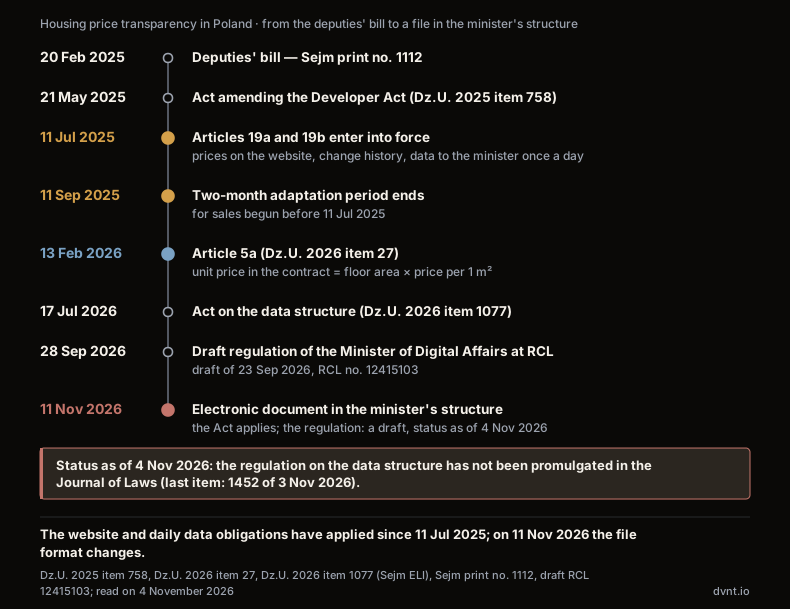
The "price transparency law" is not a separate act. It is Articles 19a and 19b of the Act on the Protection of the Rights of a Purchaser of a Residential Unit or Single-Family House and on the Developer Guarantee Fund (the "Developer Act", ustawa deweloperska), added by the [Act of 21 May 2025](https://api.sejm.gov.pl/eli/acts/DU/2025/758/text.pdf) (Journal of Laws, Dz.U., 2025 item 758). The provisions have applied since 11 July 2025. A developer who had started selling earlier had two months to adapt, that is until 11 September 2025, and publishes information on units whose ownership has not yet been transferred.
The obligation runs from the day sales begin or, if you conclude reservation agreements, from the moment before the first of them is concluded, until the day the rights under the last developer agreement are transferred. It also covers the sales referred to in Article 3(1) and Article 4(1) of the Act. In practice it applies to the entire period in which you have anything left to sell in a given project.
What changed on 13 February 2026
The amendment that entered into force on 13 February 2026 changed the way a price is calculated, not the rules on raising it. The added Article 5a (Dz.U. 2026 item 27) says that in the developer agreement, in the other agreements under Articles 2–4 and in the reservation agreement, the price of a unit "is determined as the product of the m² of its usable floor area and the price per 1 m² of usable floor area" (our translation), and the floor area is measured according to the Polish Standard in force on the day the building permit application or the notification of construction was filed. The provision applies to agreements concluded from that date. The Act does not ban changing the price in the agreement either: the model information prospectus has a field headed "Permitted indexation of the price and the principles of indexation" (our translation). Separate from all this are the proceedings of the Office of Competition and Consumer Protection (UOKiK): in March 2026 the President of the Office brought charges against three developers, among other things for making the transfer of ownership conditional on signing an annex that raised a price agreed earlier. That is a charge of an unfair practice after the contract was concluded, not a provision on price transparency.
11 November 2026 — the structure of the file
From 11 November 2026 you pass the data to the minister "in the form of an electronic document in accordance with the data structure specified by that minister" (our translation). That is Article 19b(1) as amended by the Act of 17 July 2026 (Dz.U. 2026 item 1077). The structure is to be set by a regulation of the Minister of Digital Affairs. Status as of 4 November 2026: the regulation is a draft of 23 September 2026 with the status "open" in the Government Legislation Centre (RCL) service, and it has not been promulgated in the Journal of Laws (the last item that day was item 1452 of 3 November). The draft provides for entry into force on 11 November 2026.
What a developer must show on the website — all unit prices and the full price
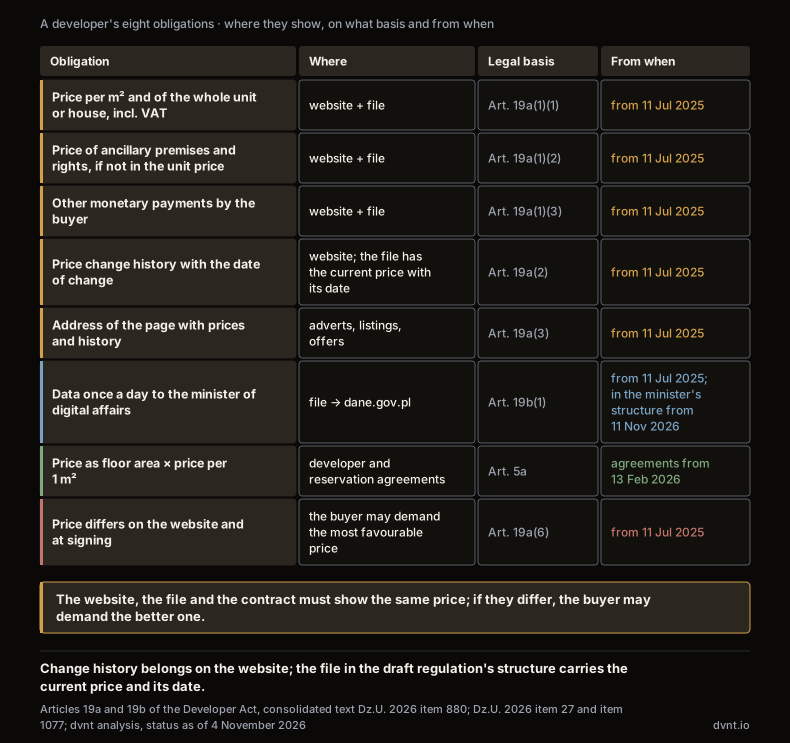
On your own website you must show the price of every unit on offer so that the buyer sees the whole amount they will pay, not only the price per square metre. Article 19a(1) of the Act (consolidated text, Dz.U. 2026 item 880) lists three components, all "including value added tax" (our translation):
- The price per m² of usable floor area of each unit or house on offer, and the price of the whole property or of the part of it that is the subject of the agreement.
- The price of ancillary premises and of the rights necessary to use the unit, such as a parking space or a storage room, if it is not included in the price from point 1.
- Other monetary payments that the buyer is to make to you in performance of the agreement transferring ownership.
On the same page you make available the general part of the information prospectus, the address of the registered office and of the sales office, how to contact you, and the location of the project. Paragraph 3 adds an obligation that is easy to forget outside the sales department: in advertisements, announcements and offers addressed to buyers you give the address of the website where the prices and their history are published. That address therefore has to reach the listings on property portals and the offers sent to clients, not only the project's own page.
What is missing most often? According to Rzeczpospolita (January 2026), UOKiK's letters to developers concerned, among other things, the absence of prices of ancillary premises or of price history. These are two elements that cannot be added once and forgotten: a parking space has its own price, which also changes, and the history grows with every change.
Housing price history — how to keep it so that it adds up
Price history is not an archive you compile on request. It is an obligation attached to every change: on the day a price changes you update the website, give the date, and keep everything you showed before, from the day sales began. That is what Article 19a(2) says. A change in additional payments is also a change: if you raise the price of a storage room, that entry goes into the history as well. If sales began before 11 July 2025, the transitional provision (Article 2 of the Act in Dz.U. 2025 item 758) requires information on units whose ownership was not transferred before that date to be given "as of the day they were made available on the website" (our translation). The history of such a project therefore starts on the day the prices appeared on the website, not on the date of the first contract years ago.
One technical rule follows from this provision: history is appended, never overwritten. A spreadsheet in which someone changes the value in a price cell loses the previous value unless somebody remembers to copy it elsewhere. A system in which a price change is a new entry with an effective date has a history by definition. The history page is then just a view of those entries.
Why does it matter beyond inspections? Article 19a(6) says: "Where the price given in the manner set out in paragraph 1 differs from the price offered at the conclusion of the agreement, the buyer has the right to demand that the agreement be concluded at the price most favourable to them" (our translation). The conclusion for the system is simple: the price in the contract should come from the same record as the price on the website, not be retyped by hand.
Article 5a gives a second validation. Since the price in the contract is the product of floor area and the price per 1 m², the system can check on every save that the total price equals that product and reject an entry that does not. Anyone who runs an online shop knows a similar logic of history: the obligation to show the lowest price from the previous 30 days there comes from a different act, which we describe in the article on the Omnibus directive.
The dane.gov.pl file — once a day, from 11 November in the minister's structure
Besides the website, you must pass the same data once a day to the minister responsible for computerisation, who publishes it on dane.gov.pl, Poland's open data portal, as "high-value data" (Article 19b(1) and (3)). The Open Data Act applies accordingly to the transfer itself (paragraph 2), and a breach of the obligation under paragraphs 1 and 2 is, as with the website, a practice infringing collective consumer interests (paragraph 4). As the portal itself reported on 21 July 2025, "Developers have been publishing housing price data on the dane.gov.pl portal since 11 July this year" (our translation).
In practice this works as shown by the sample import file provided by the portal: the developer publishes a file with the prices on its own website, with a date in the file name, and the portal downloads it every day and displays it as a dataset called "Developer's housing asking prices" ("Ceny ofertowe mieszkań dewelopera"). That is an example from the portal, not a legal provision, so for the technical details of the import you work from the dane.gov.pl documentation.
From 11 November 2026 the file is to have the structure set by the minister (Article 19b(1) and (2a), as worded in Dz.U. 2026 item 1077), and the minister makes model electronic documents available in the portal (paragraph 2b). According to the explanatory memorandum to the draft regulation, the model documents "are already available on the dane.gov.pl portal" (our translation). Until now the portal offered a model data scope as a CSV file with 58 columns, including a fax number. The draft regulation of 23 September 2026 (status as of 4 November 2026: not promulgated) organises it as follows:
- 57 fields in 10 groups (A–J): the developer's identification data, the registered office address, the address of the sales point, the project's location, the unit or house, parts of the property, ancillary premises, necessary rights, other payments, and the address of the prospectus.
- One record is one unit, house or other subject of the agreement.
- The first row is a header, and the columns follow the order of the fields in the regulation.
- A field that does not apply is filled with the character "X" in a tabular file; in other formats you leave it out.
- Dates in the format YYYY-MM-DD, amounts to two decimal places, and the tax number (NIP) and court register number (KRS) as a string of 10 digits without spaces or hyphens.
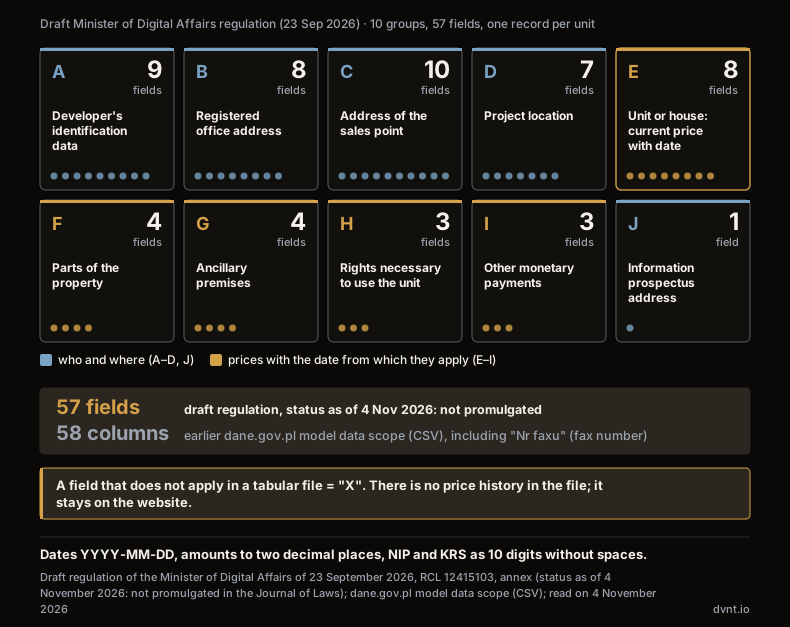
What matters most for the architecture is what the file does not contain. The regulation is to define the structure of the information from Article 19a(1) and (2), but the price fields in the draft carry only the current price and the date from which it applies. There are no fields for earlier prices, so the full history stays on the website. If you generate the file from the last export of a spreadsheet, the website and the file have two different sources and can drift apart. The file should be built automatically every day from the same record that feeds the website. Before you start sending it in the new structure, check on one day's data that the NIP has no spaces, that the dates have the right format, that empty fields carry "X", and that the number and order of the columns match the model.
Automating the file comes down to three steps the system performs on its own every day. First it reads the records of the units covered by the obligation, with the price in force that day and the date from which it applies. Then it builds the file in the order of the fields in the structure, with "X" where a field does not apply, and validates the whole file before publishing: a file that fails validation does not replace yesterday's, it raises an alert to the person responsible. Finally it publishes the file at the address the portal knows and checks that the portal has downloaded it. For people, one task remains: deciding to change a price.
Housing price reporting in numbers — what dane.gov.pl shows after a year
After a year the portal holds 13,150 datasets called "Developer's housing asking prices" from 4,565 providers, according to our reading of the [dane.gov.pl API](https://api.dane.gov.pl/1.4/datasets?title%5Bphrase%5D=Ceny%20ofertowe%20mieszka%C5%84%20dewelopera) on 4 November 2026. The biggest jump, 2,873 new datasets, came in September 2025, the month the adaptation period ended. From October 2025 to January 2026, between 1,105 and 1,909 datasets were added each month, and since June 2026 the figure has been 321–381. The portal does not give a reason for the decline. By our own calculation, of the 5,765 datasets created in 2026, 3,783, about two thirds, were set up by providers who already had a dataset from 2025.
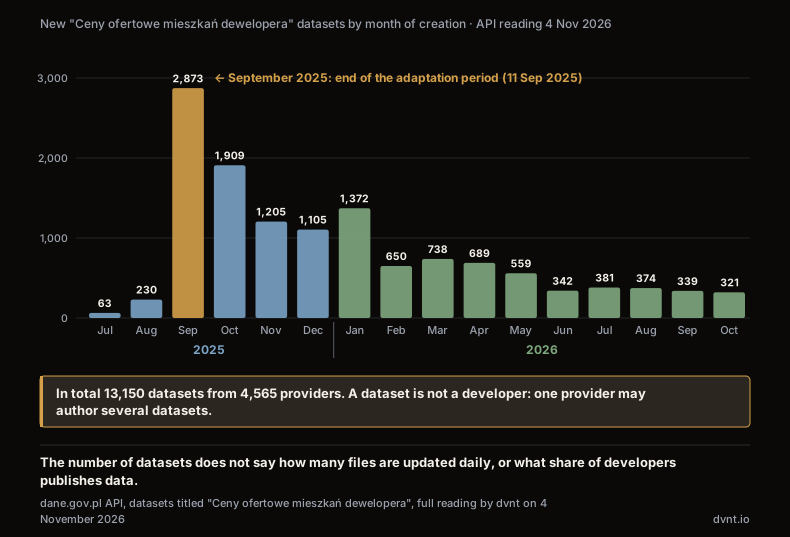
What do these figures not tell us? A dataset is not a developer: one provider may author several datasets, for example separate ones for 2025 and 2026. More than one dataset belongs to 1,886 of the 4,565 providers, which works out at almost 3 datasets per provider (our calculation). A provider is not a corporate group either, because special-purpose companies appear separately. The number of datasets does not say how many files are updated daily, and nobody publishes the number of entities under the obligation. That is why we do not calculate a "percentage of developers in compliance": that figure cannot be honestly given from these data.
Who monitors housing price transparency and what the fines are
Price transparency is supervised by the President of UOKiK, because the Act expressly names a breach of Article 19a(1)–(4) and Article 19b(1)–(2) a practice infringing collective consumer interests. For such a practice the Act on Competition and Consumer Protection (Article 106(1)(4)) allows a fine "not exceeding 10% of the turnover achieved in the financial year preceding the year in which the fine is imposed" (our translation), also where the undertaking breached the prohibition "even unintentionally" (our translation). 10% is the upper limit, not a rate.
What is known about enforcement? According to Rzeczpospolita from January 2026, the Office received more than 1,500 reports of irregularities on developers' websites, and the President of UOKiK sent 39 letters to developers. A letter is a written request to the undertaking, not a decision or a fine. We found no announcement of a fine-imposing decision for lack of price transparency on uokik.gov.pl (status as of 4 November 2026).
That the Office does fine developers over information on their websites on the same legal basis (Article 24) is shown by the announcement of 2 November 2026. A developer that in its catalogues and on its website informed buyers of the option of converting the attic received a fine of PLN 1,176,000; the decision is not final. That case is not about price transparency but about misleading buyers. Regardless of UOKiK, the buyer's own claim under Article 19a(6), described above, remains.
How to run price transparency without manual work — one source of price
Price transparency stops being manual work when a unit's price is a single record with an effective date, and the website, the file and the contract are only views of it. That is how we build a price module for developers: every change is a new entry, not a correction of the old one, so the history builds itself.
Three things come out of one record:
- The unit page and the history page: the current price, the components under Article 19a(1) and all earlier entries with their dates.
- The daily file in the minister's structure: generated automatically, with the current price and the effective date.
- The price for the contract and the reservation: pulled from the record, not retyped.
Before an entry is saved, the system checks it: whether it has an effective date, whether the total price equals the product of floor area and the price per 1 m², whether the fields required by the structure are filled in, and whether the change carries an internal note giving the reason. After the file is generated, the system checks that the portal has downloaded it and raises an alert if there was no download today. We apply the same monitoring to every system integration: we first establish which system is the source of truth for the price, and every connection has an alert for a change on the other side.
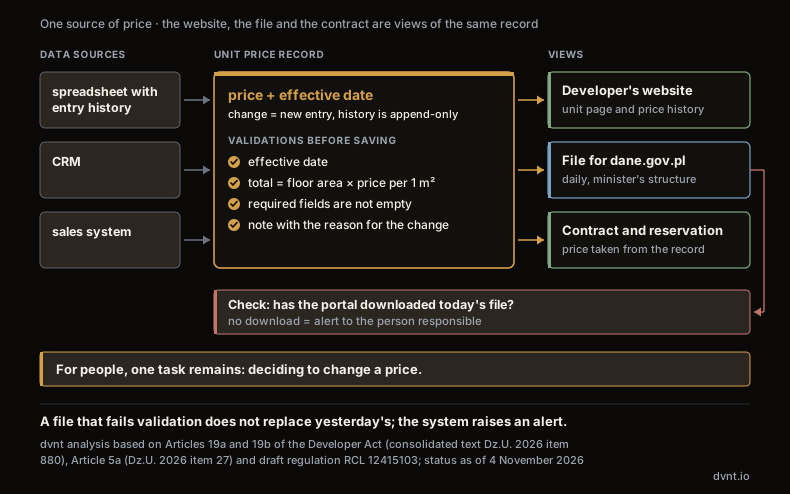
Where the data should come from depends on scale. With one project and one person who changes prices, a spreadsheet with a history of entries is enough, with the system generating the website and the file from it. With several projects and several people changing prices, the price list should live where sales already works, in a CRM or a sales system, and the website and the file pull it through an integration. When a CRM is enough and when you need a system of your own is covered in our articles on CRM for a small business and on custom software. The same pattern, a statutory obligation served by an integration rather than by manual work, is described in the article on KSeF integration and, in general terms, in our article on integrating systems in a company.
If an agency or a plugin vendor runs your website, ask three questions: is the price history appended, does the file have the structure from the regulation from 11 November, and who gets the alert when the portal does not download the file. If the answer to any of them is "by hand", that is where a discrepancy will arise. We build our own price module as part of a developer's web application or as an integration with a system you already have. You will find more examples of this kind of automation in the article on business process automation and in the guide to business software.
Where to start
Start by checking whether the three places show the same price today.
- The website: whether every unit has the price per m², the total price, the prices of ancillary premises and other payments, all including VAT, and the history from the day sales began.
- The file: whether from 11 November 2026 it has the minister's structure, that is the number and order of columns, "X" in empty fields, and the date and amount formats.
- Responsibility: who in the company makes sure the website, the file and the contract agree, and how they will find out that they have drifted apart.
If the third question has no name attached, the problem is in the process, not in the website. If one of the three answers is "by hand", start tidying up there: first the source of the price, then the website and the file that draw on it.
Frequently asked questions about housing price transparency in Poland
What is housing price transparency and when did it start to apply?
It is an obligation under Articles 19a and 19b of the Developer Act: a developer publishes on its own website the price of every unit on offer together with the price of ancillary premises and other payments, keeps a history of changes, and passes the same data once a day to the dane.gov.pl portal. It has applied since 11 July 2025; sales begun earlier had until 11 September 2025 to adapt.
Does a developer have to show the price history of apartments?
Yes. Under Article 19a(2), with every change of price or payments the developer updates the website on the day of the change, gives the date of the change and keeps the earlier information from the day sales began. The history is on the website; in the file for dane.gov.pl, according to the draft regulation, there is only the current price and the date from which it applies.
What must the price file for dane.gov.pl contain and how often must it be sent?
The data is passed once a day. From 11 November 2026 the file has the structure set by the Minister of Digital Affairs; the draft regulation of 23 September 2026 (not promulgated as of 4 November 2026) provides for 57 fields in 10 groups, one record per unit, a header row, the character "X" for a field that does not apply, dates as YYYY-MM-DD and amounts to two decimal places.
What changes on 11 November 2026?
From that day the data is passed to the minister as an electronic document in the data structure set by the minister (Dz.U. 2026 item 1077). The structure is set by a regulation, which was a draft as of 4 November 2026; the model documents are provided by the dane.gov.pl portal.
Who checks price transparency and what are the penalties?
The President of UOKiK. A breach of the obligations is a practice infringing collective consumer interests, punishable by a fine of up to 10% of the turnover of the year preceding the fine, also for an unintentional breach. According to Rzeczpospolita (January 2026), UOKiK received more than 1,500 reports and sent 39 letters to developers.
What if the price on the website differs from the price in the contract?
Article 19a(6) provides that where the price given on the website differs from the price offered at the conclusion of the agreement, the buyer has the right to demand that the agreement be concluded at the price most favourable to them. That is why the price in the contract should come from the same record as the price on the website.
Related articles
CRM, ERP and business systems
KSeF integration — the KSeF API for a company with its own system: three routes and how to choose
KSeF API for a company with its own system: accounting software as a gateway, a ready-made connector or your own integration. What to handle and how to choose.
Automation and integrations
Business process automation — examples and where to start
Business process automation: how it differs from RPA and AI, Polish data, KSeF e-invoicing, our hands-off funnel, examples by department and the first step.
CRM, ERP and business systems
Transport management system (TMS) — what it is and when a transport company needs one
Transport management system (TMS) in Poland: GPS vs ERP, driving time, tachograph, e-CMR and SENT, PLN price lists and when a custom driver app helps.
CRM, ERP and business systems
Warehouse management system (WMS) — what it is, what JPK_MAG(2) changes in 2027 and when you need one
Warehouse management system (WMS) in Poland — what it is, how it differs from stock software and ERP, what JPK_MAG(2) changes in 2027, phone or scanner, cost.
Artificial intelligence
Prompt engineering — what it is and how to write prompts at work
Prompt engineering at work: how to write prompts, templates for business processes, and when a Polish company needs RAG or an AI agent instead.
Artificial intelligence
Model Context Protocol (MCP) — what it is and what it means for a business
Model Context Protocol (MCP) connects AI assistants and agents to company systems. How an MCP server works, its risks, GDPR and when to build your own.