
Artificial intelligence28 min read5410 wordsRedakcja dvnt
Large language model (LLM) — what it is and what a business needs to know
An LLM writes text token by token. Why it errs, what a context window is, why Polish text costs more tokens, and the Polish models Bielik and PLLuM.
A large language model (LLM) is a program trained on a vast amount of text that predicts the next piece of text and, piece by piece, writes an answer. ChatGPT, Claude, Gemini and Copilot all run on models of this kind. Anthropic, the company behind the Claude models, describes LLMs in the glossary of its documentation as "AI language models with many parameters that are capable of performing a variety of surprisingly useful tasks. These models are trained on vast amounts of text data and can generate human-like text, answer questions, summarize information, and more."
Statistics Poland (Główny Urząd Statystyczny, GUS) has no separate category for LLMs in its survey. The nearest one, in our reading, is "technologies generating text or speech" (natural language generation). According to the GUS publication "Społeczeństwo informacyjne w Polsce w 2025 r." (Information society in Poland in 2025), 5.3% of enterprises with at least 10 employees used such technologies, while 8.7% used at least one AI technology of any kind. That made them the most commonly used type of AI.
A single mechanism, predicting the next piece of text, explains four things worth understanding before you decide to deploy a model. The model makes mistakes in a confident tone, and that cannot be switched off. It remembers only what fits in its context window and what you send it again every time. You pay by the number of tokens, and in our measurement Polish text took noticeably more tokens than the same text in English. And what happens to your data depends on whether you use an app, the API or a model on your own server. Model names and prices are given as of 19 October 2026, and the information on the Polish models Bielik and PLLuM as of 20 October 2026. Quotes from Polish sources are our own translation.
What is an LLM (large language model)?
A large language model is a statistical model that estimates which piece of text is most likely to come next. "Large" refers to the number of parameters, the values that are set during training. Google's Machine Learning Crash Course describes language models as models "which estimate the probability of a token or sequence of tokens occurring within a longer sequence". Large language models, Google adds, "predict sequences of tokens and outperform previous models due to their vast number of parameters and broader context gathering capabilities."
The law does not use the word "LLM". Recital 99 of the AI Act says that "Large generative AI models are a typical example for a general-purpose AI model". Recital 98 adds that models "with at least a billion of parameters and trained with a large amount of data using self-supervision at scale should be considered to display significant generality". That is a pointer in a recital, not a legal threshold and not a definition of a large model.
A model is built in three stages, which Anthropic describes in the same glossary:
- Pretraining. The model learns from a huge body of text to predict the next word from the preceding context. At this point, Anthropic writes, pretrained models "are not inherently good at answering questions or following instructions".
- Fine-tuning. Further training on additional data.
- RLHF (reinforcement learning from human feedback): training based on people's ratings of the model's answers. This stage and fine-tuning turn a model that completes text into one that is useful at work.
A model is not an app. ChatGPT, Claude or Gemini in a browser are applications with an interface, a conversation history and extra features. Underneath runs a model, and vendors offer the same models to developers through an API. Anthropic says plainly that Claude, the assistant, "is based on a large language model that has been fine-tuned and trained using RLHF." You pay differently for the app and for the API, and the data protection terms differ too, as we explain below.
"Large language model", "LLM", "LLM models" and, loosely, "language model" mean the same category in practice. A language model does not have to be large, but when people talk about AI in a business they almost always mean a large one.
How an LLM works: the answer is written token by token
ChatGPT works the same way as every other AI chat: the model receives text, calculates the probabilities of the possible next pieces, picks one, appends it to the answer and repeats the step until the answer is complete. That piece is a token.
A token is the smallest unit in which a model processes text. According to Anthropic, it "can correspond to words, subwords, characters, or even bytes". Google gives an example: a token can be a single letter such as "z" or a whole word such as "cat", and long words are split into several tokens. Vendors publish rules of thumb for converting tokens into text, but each of them is for English:
- Anthropic: on earlier Claude models a token represents about 3.5 English characters, and Claude 4.7 and later models use a newer tokenizer that produces about 30% more tokens for the same text (Glossary).
- OpenAI: a token is about 4 characters or three-quarters of a word, and 100 tokens are about 75 words. OpenAI adds: "These are estimates, not exact counts", and "other languages can have different relationships between characters, words, and tokens" (Understanding and counting tokens).
- Google: for Gemini models a token is about 4 characters, and 100 tokens are about 60–80 English words (Understand and count tokens).
Google explains the mechanism like this: you can think of a question put to an LLM as a "given" sentence followed by an imaginary mask, and "The LLM generates probabilities for various possible responses" in its place. The chosen piece becomes part of the text, and the model calculates the next probabilities on the longer text. Every sentence of the answer is produced this way.
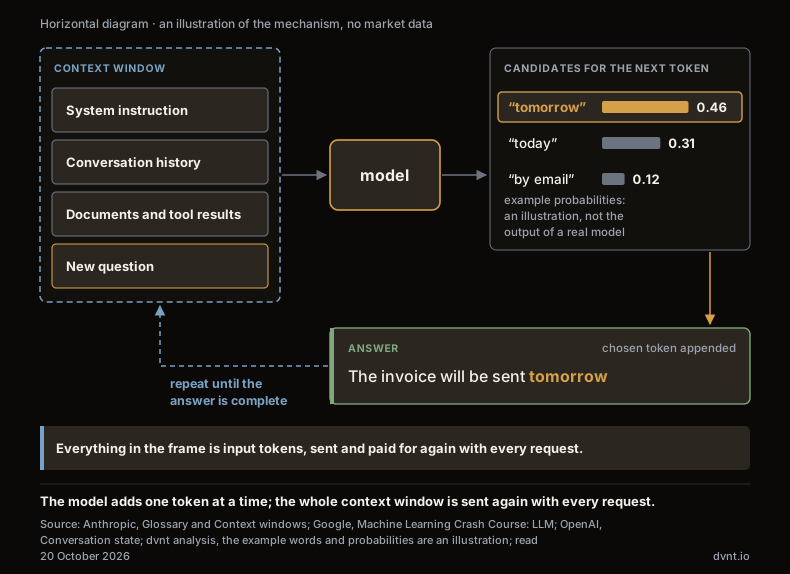
One limitation follows directly from this, and Google names it: an LLM trained on a massive number of mathematical word problems "can give the appearance of doing sophisticated mathematical reasoning. However, those LLMs are basically just autocompleting a word problem prompt." Our conclusion: let ordinary software do the arithmetic, dates and amounts, and use the model at most to prepare the inputs.
The same request does not always produce the same answer. The randomness in choosing the next token is controlled by a parameter called temperature. Lower temperatures, according to Anthropic, "result in more conservative and deterministic outputs". Anthropic also warns, however: "Even with temperature set to 0, the results will not be fully deterministic and identical inputs may produce different outputs across API calls." Our conclusion for deployments: test a model on many runs of the same task, not on one conversation that happened to go well.
How many tokens Polish text takes – our measurement
None of the three vendors gives a rule of thumb for Polish, so we checked it ourselves on one text: recitals 97–99 of the AI Act in the official Polish and English versions, taken from the EU Publications Office. The Polish version has 3,377 characters and 465 words, the English one 3,075 characters and 492 words. We counted the tokens on 3 October 2026, and again with identical results on 19 October, using OpenAI's open library tiktoken, version 0.14.0, which OpenAI recommends for counting tokens in code ("For programmatic plain-text tokenization, use tiktoken."), in two encodings. The library assigns o200k_base to models including GPT-4o, GPT-5 and the o-series, and cl100k_base to GPT-4 and GPT-3.5.
Encoding | Tokens, Polish | Tokens, English | Polish / English | Characters per token, PL / EN | Tokens per word, PL / EN |
|---|---|---|---|---|---|
o200k_base | 942 | 564 | 1.67 | 3.6 / 5.5 | 2.03 / 1.15 |
cl100k_base | 1,133 | 566 | 2.00 | 3.0 / 5.4 | 2.44 / 1.15 |
In our measurement the Polish version of the same text took 1.67 times as many tokens with the newer encoding and 2.00 times as many with the older one. As a control we also counted the whole of Article 53 of the AI Act: the ratios came out at about 1.6 and 1.9 (the exact result shifts by a few hundredths depending on how the text is extracted from the page). The direction holds, but the size depends on the text. English legal text gave about 5.5 characters per token, clearly more than the general "about 4 characters" in OpenAI's help pages. Rules of thumb like these are very rough. When we later ran the same recitals in eight official EU languages, Polish needed the most tokens of all of them: Dutch, Spanish, French, German, Swedish and Italian came in at 1.22 to 1.41 times English with o200k_base.
Caveats: this is one legal text plus one control text and two OpenAI encodings. In this version the library maps no encoding to the current GPT-6 models, so we do not know which one they use. Claude and Gemini have their own tokenizers, and Anthropic says that Claude models from version 4.7 onwards count the same text as about 30% more tokens than earlier ones. The practical conclusion: before you estimate a cost or check whether your documents fit in the context window, run a sample of your own Polish texts through the token counter of the vendor you intend to use. At Anthropic, token counting "is free to use but subject to requests per minute rate limits", and it counts for the model you specify.
Why an LLM gets things wrong – and why you cannot switch it off
A model that predicts a likely continuation of a text will sometimes pick a continuation that is likely but untrue. That is not a fault in a particular product but a feature of the technology. The US National Institute of Standards and Technology (NIST), in its risk profile for generative AI (NIST AI 600-1, July 2024), calls this confabulation: "The production of confidently stated but erroneous or false content (known colloquially as "hallucinations" or "fabrications") by which users may be misled or deceived." NIST describes confabulations as "a natural result of the way generative models are designed: they generate outputs that approximate the statistical distribution of their training data". Such prediction "can produce factually accurate and consistent outputs", NIST writes, but "it can also produce outputs that are factually inaccurate or internally inconsistent."
OpenAI, in "Why language models hallucinate" (5 September 2025), defines hallucinations as "plausible but false statements generated by language models" and gives two causes:
- Training does not know true from false. In pretraining the model learns to predict the next word in huge amounts of text, and, as OpenAI puts it, "there are no "true/false" labels attached to each statement."
- Evaluations reward guessing. "Standard training and evaluation procedures reward guessing over acknowledging uncertainty." When models are graded only on the share of questions they get exactly right, "they are encouraged to guess rather than say "I don't know.""
OpenAI adds that "on more challenging evaluations and in real use, accuracy is capped below 100%", because the answer to some questions cannot be determined: the information is unavailable, a small model has limited thinking abilities, or the question is ambiguous.
A model's knowledge has a use-by date. It knows only what was in its training data and nothing about later events until you give it that information. For each model Anthropic lists a "reliable knowledge cutoff" separately from the training data cutoff. According to Anthropic's models overview, both dates are June 2026 for its four current models, Claude Sonnet 5.5 among them. OpenAI gives 30 April 2026 as the knowledge cutoff for GPT-6.1 Sol (Models). These dates change with every new model version.
A model's mistake does not exempt you from the GDPR. In the report of its ChatGPT taskforce (23 May 2024), the European Data Protection Board notes that "the outputs provided by ChatGPT are likely to be taken as factually accurate by end users, including information relating to individuals, regardless of their actual accuracy. In any case, the principle of data accuracy must be complied with."
Nothing guarantees a result, but some things help. In its guide "Reduce hallucinations" Anthropic suggests two simple things: explicitly allow the model to say "I don't know", and, for long documents (over 20,000 tokens), ask it to extract word-for-word quotes first and only then perform the task. In our view, though, the way the work is organised matters most: the model gets the sources it must rely on, and a person checks the result before it reaches a customer. Our article on AI hallucinations covers where fabrications come from, where they cost a business most and how to set up a process that catches them.
Context window – the model's "working memory"
The context window is all the text a model can take into account while writing an answer. Outside it the model has only what it learned in training: it does not remember earlier conversations or anything you have not sent it. Anthropic's glossary calls the context window a "working memory" for the model and distinguishes it from the large body of data the model was trained on. Google, in its documentation on long context, offers an analogy: "An analogy for the context window is short term memory", which can hold only a limited amount of information.
Everything that makes up a request goes into the window. According to Anthropic (Context windows), "Everything in the request counts toward the context window: the system prompt, every message in messages (including tool results, images, and documents), and your tool definitions." The output the model generates counts too.
Window sizes as of 19 October 2026: all four current Claude models, from Claude Haiku 5.5 to Claude Fable 5.1, have 1 million tokens, and GPT-6.1 Sol has 1.05 million. Google writes that "Many Gemini models come with large context windows of 1 million or more tokens" and gives a sense of scale: a million tokens is, for example, 50,000 lines of code or 8 average-length English novels. Anthropic puts it another way: on its current tokenizer, 1 million tokens is roughly 555,000 words or 2.5 million characters. Google's comparison is explicitly about English novels, and in our measurement Polish text took noticeably more tokens than English, so the same window holds less Polish text.
The model does not remember the conversation. In its API documentation OpenAI writes that "each text generation request is independent and stateless". A conversation is carried on by sending the model the history so far with every request. Even when you use the feature that links responses on OpenAI's side, "all previous input tokens for responses in the chain are billed as input tokens in the API." As long as the history keeps growing, each new exchange costs more than the one before.
Chat apps handle long conversations in their own way. Anthropic notes that chat interfaces such as claude.ai "can also manage the context window on a rolling "first in, first out" basis", dropping the oldest messages. If a model has "forgotten" something agreed at the start of a long conversation, one possible reason is simple: that message has fallen out of the window. In the API, exceeding the window risks, as OpenAI warns, "truncated outputs".
A bigger window is not automatically better. Anthropic writes: "As token count grows, accuracy and recall degrade, a phenomenon known as context rot." What you put into the window is therefore as important as how large it is. The strategy of "let's give the model all the company's documents" costs you twice: in quality and, as the calculation below shows, in money.
The same document in every request multiplies the bill
Because the model does not remember, a document needed for the answer has to go into the window with every question, and you pay for it every time. Our calculation on Anthropic's price list, read on 19 October 2026: Claude Sonnet 5.5 costs $2 per million input tokens. Anthropic publishes prices in US dollars; we leave them in dollars rather than convert. The document and excerpt sizes are our assumptions, not market averages.
- One question about a 100,000-token document, for example terms and conditions with their annexes: 100,000 × $2 / 1,000,000 = $0.20 for the document alone, before you add the question and the answer.
- A conversation with 10 questions about that document: the document travels in the history with every request, so that is at least 1,000,000 input tokens and at least $2 for the document alone.
- 1,000 separate questions a month: $200 in input. If the system sent the model only the matching excerpts instead of the whole document, say 5,000 tokens, it would be $0.01 per question and $10 per thousand questions, twenty times less.
The calculation leaves out caching, discounts and output tokens, and two things can change it. The first is prompt caching. At Anthropic, a cache hit on Claude Sonnet 5.5 costs 5% of the standard input price, that is $0.10 per million tokens, while writing to the cache costs 1.25 or 2 times the normal input price ($2.50 or $4 per million), depending on whether the cache lasts five minutes or an hour. Anthropic points out, however, that "Cached prompt prefixes still occupy the context window", so the loss of accuracy remains. The second is long context at OpenAI: in its API pricing GPT-6.1 Sol costs $2 per million input tokens for requests of up to 272,000 input tokens and $4 above that limit, with output at $15 instead of $10.
The approach in which a system first searches the company's documents for passages that match the question and passes only those to the model is called RAG (retrieval-augmented generation). It eases both problems at once: fewer tokens in the window mean a lower bill and less noise for the model to get lost in. The quality of the answers then depends on the quality of the search and of the documents themselves.
How much an LLM costs – what drives the bill
You pay for an LLM in one of two ways: a per-user subscription to an app, or per token when the model works through an API inside your own system. A subscription is predictable and includes a ready-made interface. Our article Google Workspace or Microsoft 365 compares Copilot and Gemini in the office suites. With an API you pay for every token processed, and Anthropic, OpenAI and Google publish prices in US dollars per million tokens (Anthropic, OpenAI, Google; read 19 October 2026).
Four levers decide the size of an API bill.
1. The choice of model. At a single vendor, the cheapest and the most expensive current model are far apart (our arithmetic on the price lists). At OpenAI, GPT-6 Luna costs $0.10 per million input tokens and GPT-6 Astra $10, a hundred times more. At Anthropic, Claude Haiku 5.5 starts at $0.10 and Claude Fable 5.1 costs $10, also a hundred times more. That is a price spread, not a quality ranking. For many simple tasks, such as classifying support tickets or extracting data from a form, it is worth starting with a cheaper model and testing it on your own examples.
2. Output costs five times as much as input. That holds for the standard prices of every model we quote (our arithmetic): Claude Sonnet 5.5 $2 and $10, Claude Haiku 5.5 $0.10 and $0.50 for prompts of up to 100,000 tokens ($0.50 and $2.50 above that), GPT-6.1 Sol $2 and $10, GPT-6 Luna $0.10 and $0.50. Gemini 3.8 Flash costs $0.75 for input and $3.75 for output through 31 December 2026, and from 1 January 2027 Google doubles those prices to $1.50 and $7.50. Long answers therefore cost more than long questions. Reasoning adds to this: according to OpenAI, reasoning models use tokens for internal reasoning that does not appear in the answer, and those tokens are billed as output tokens.
3. History and documents in every request. Everything that returns to the window with the next question is paid for again. In long conversations and with large documents this is often the biggest item.
4. The tokenizer. The same price per million tokens does not mean the same cost per page of text. Anthropic says in its price list that Claude models from version 4.7 use a new tokenizer that "produces approximately 30% more tokens for the same text", and its token-counting documentation advises against reusing counts measured on older models. Language adds to this, as our measurement of Polish text showed. Compare model prices on your own text, not in a table.
Batch processing, for tasks where you can wait for the result, costs half as much at Anthropic, OpenAI and Google. On the other hand, US-only processing at Anthropic costs 1.1 times the standard rate.
The article on the AI agent works out what a chat reply and a multi-step task cost, in US dollars and in zloty. Tokens, though, are only the running cost. The cost of implementation, meaning integration with your systems, data preparation and testing, depends on the project, and we found no independent studies of these costs in Poland.
App, API or your own model – three ways to use an LLM
You can use a language model in three ways, and each means a different bill, a different responsibility for data and a different party looking after updates. In our view this choice should come before the choice of a specific model.
Table-style diagram · three ways to use a language model
| App on a business plan | Vendor’s API | Your own model on a server | |
|---|---|---|---|
| What you pay for | App on a business planA per-user subscription | Vendor’s APIInput and output tokens | Your own model on a serverHardware, electricity and people |
| Does the vendor train on your data | App on a business planDepends on the plan’s terms | Vendor’s APIOpenAI and Anthropic do not by default; the free tier of the Gemini API uses content to improve Google’s products, the paid tier does not | Your own model on a serverData does not leave your server |
| Where the data is processed | App on a business planDepends on the plan | Vendor’s APIA region of your choice, usually at extra cost, or through a cloud platform | Your own model on a serverYour server |
| Who updates and moderates | App on a business planThe vendor | Vendor’s APIThe vendor for the model, you for your application | Your own model on a serverYou |
An app (ChatGPT, Claude, Gemini or Copilot on a business plan). You pay a subscription per user and get a ready-made tool. What happens to the data depends on the terms of the specific plan, and a personal plan and a business plan are two different contracts. Before employees start pasting customer documents into a chat, someone in the company should read the terms of the plan you pay for and set rules for using it. Our article ChatGPT Business, Copilot or Gemini for business compares the business plans of the three assistants, their prices and their data processing agreements.
A vendor's API. The model works inside your system and you pay for tokens. The vendors describe their data terms explicitly:
- OpenAI: "As of March 1, 2023, data sent to the OpenAI API is not used to train or improve OpenAI models (unless you explicitly opt in to share data with us)." By default, abuse monitoring logs are "retained for up to 30 days, unless longer retention is required by law". To use data residency controls you contact the sales team; for any region other than the United States, the EU included, the company must also be approved for OpenAI's abuse monitoring controls and sign a Modified Retention amendment. For models released on or after 5 March 2026, data residency endpoints carry a 10% uplift (Data controls).
- Anthropic: "By default, we will not use your inputs or outputs from our commercial products (e.g. Claude for Work, Anthropic API, Claude Gov, etc.) to train our models" (Privacy Center). Under its Commercial Terms the customer "(a) retains all rights to its Inputs, and (b) owns its Outputs." In the API you choose where inference runs with a parameter for which the documentation lists two values, "global" and "us". The second works on models from Claude 4.6 onwards and costs 1.1 times the standard rate (Data residency). On Amazon Bedrock and Google Cloud the region is set by the endpoint URL or inference profile, and the cloud provider is the data processor.
- Google: in the free tier of the Gemini API, content is used to improve Google's products; in the paid tier it is not (Gemini API pricing). Free access is paid for with data.
Our article on data security in the cloud collects the questions to ask a cloud provider about where data is stored and who is responsible for what.
Your own model on a server (an open source or local LLM). You download a model with an open licence and run it on your own hardware. The data does not leave your server, but everything a vendor does for you with an API, you now do yourself: you buy or rent hardware with a graphics card, update the model, look after security and moderate the content. The makers of Bielik say plainly on the model card: "It does not have any moderation mechanisms." For the scale of hardware, the Bielik guide (23 August 2025) gives figures for the 11B model (version 2.6 in its example): a model trained in 16-bit precision needs at least 22 GB of memory to load, and a quantised, that is compressed, Q8 version 11 GB. On a graphics card it reaches about 50 tokens per second, in ordinary RAM about 1–5. That is the publisher's rule of thumb for one model, not a general standard. The guide names LM Studio as a tool for running it. Another such tool is Ollama, but the versions of Bielik in its catalogue are published by different accounts, so check who uploaded the file before you download it. What such a server costs in zloty and at how many requests a local model becomes cheaper than an API cannot be stated reliably without a specific project; we found no trustworthy source on it.
Polish language models: Bielik and PLLuM
The Polish models are open and free to download, and some of them may be used commercially, but in a business that usually means running them yourself on your own hardware, not a ready-made service with a contract. Three questions matter for a company: what the licence allows, how much hardware you need and whether the model can handle your task.
Bielik is a family of open models developed by the SpeakLeash Foundation (Fundacja SpeakLeash) and the Bielik community. According to its model card, Bielik-11B-v3.0-Instruct has 11 billion parameters, was developed by SpeakLeash together with the Academic Computer Centre Cyfronet of AGH University of Krakow (ACK Cyfronet AGH) and was trained on the Athena and Helios supercomputers. It covers 32 European languages and is "optimized for Polish". Its Apache 2.0 licence allows commercial use, which bielik.ai states explicitly. The same family includes smaller 1.5B, 4.5B and 7B models, also under Apache 2.0. Watch out for older versions: Bielik-7B-Instruct-v0.1 is licensed under CC BY-NC 4.0, that is for non-commercial use only. Downloading Bielik-11B-v3.0-Instruct from Hugging Face requires accepting its conditions.
PLLuM (Polish Large Language Model) is, according to pllum.org.pl, a set of open Polish language models that "were created with Poland's digital sovereignty in mind". In 2024 they were developed by a consortium of Polish research institutions, and since 2025 by the HIVE AI alliance. According to the publisher, the models from the first project are owned by the Ministry of Digital Affairs (Ministerstwo Cyfryzacji), and the minister is funding the continuation (HIVE 2) with a grant of PLN 5,999,102.67. The 2512 family on the model card comprises 4B, 8B, 12B and 70B models built on Gemma 3, Llama 3.1 and Mistral Nemo. Models labelled "Non-commercial" are for non-commercial use only; the publisher releases the others under the Apache 2.0 or Llama 3.1 licence, commercial use included. The Llama 3.1 licence carries Meta's own terms, so read them before you deploy.
PLLuM runs locally on a server with a graphics card. For a document-search (RAG) deployment the publisher lists the graphics memory per component: about 34 GB for the 8B model as the answer generator, about 48 GB for 12B and about 168 GB for 70B, plus 24–48 GB for the search and reranking components. Those are the publisher's figures for running the model in such a system, not the size of the model file, so do not compare them directly with Bielik's 22 GB. The model card warns: "Like other LLMs, PLLuM may occasionally produce factually incorrect or fabricated content."
"Polish" does not automatically mean "better at your task". Benchmark results on model pages are their creators' claims, not an independent comparison. Test a model on your own documents and questions.
LLMs and the AI Act – who has the obligations
The AI Act obligations that concern models themselves fall on their provider, the party that developed the model and places it on the market. A company that uses a ready-made model through an API does not become its provider by doing so. A large language model is usually a "general-purpose AI model" within the meaning of Article 3(63): an AI model, "including where such an AI model is trained with a large amount of data using self-supervision at scale, that displays significant generality" and "can be integrated into a variety of downstream systems or applications". In its questions and answers the European Commission gives an indicative criterion: a model is considered general-purpose if "its training compute is greater than 10^23 FLOP and it can generate language (whether in the form of text or audio), text-to-image, or text-to-video."
Since 2 August 2025, providers of such models have been bound by Article 53: technical documentation, information for companies that integrate the model into their own AI systems, a copyright policy and a sufficiently detailed summary of the content used for training. The first two obligations do not apply to models released under a free and open-source licence with publicly available weights (Article 53(2)), unless the model carries systemic risk.
A company that builds a model into its own system has obligations as a provider or a deployer of an AI system, and, as the Commission puts it, "Regardless of whether a downstream entity that incorporates a general-purpose AI model into an AI system is deemed to be a provider of the general-purpose AI model, that entity must comply with the relevant AI Act requirements and obligations for AI systems." One example is Article 50: from 2 August 2026, the provider of a chat that talks to people must ensure that they know they are dealing with AI, unless that is obvious. The article EU AI Act for business explains the roles of provider and deployer, the deadlines and the penalties; the article on the AI agent covers the obligations around agents; and the section AI in business has the calendar of all the provisions.
Fine-tuning is a grey area. A company that fine-tunes or otherwise modifies an existing model may become the provider of a new model, and the Commission calls the question of when that happens "a difficult question with potentially large economic implications". According to the non-binding guidelines for providers of general-purpose AI models, "only those making significant modifications to AI models need to comply with the obligations for providers of GPAI models, not those making minor changes." Where the line falls in a specific project is for a lawyer to decide; this is a description of the rules, not legal advice.
How to choose an LLM for a business task – six questions
Instead of asking which model is the best, ask which one is good enough for your task at an acceptable risk and cost. The list below is our own framework, built on the sources cited above:
- What is the task, and what error is acceptable? A summary of a meeting note for the team tolerates more mistakes than an answer sent to a customer or the figures on an invoice.
- What data will go to the model, and may it be sent outside the company? Personal data, trade secrets and customer documents are different categories. Start by establishing where your company's data really lives.
- Where does the model process the data, and does the vendor train on it? Check the terms of the plan or the API, not the marketing page: the free tier of the Gemini API uses content to improve Google's products, while the OpenAI and Anthropic APIs do not train on customer data by default.
- How many tokens does one task use? Count them on your own text with the vendor's counter, including the history and documents you will actually send, and multiply by the number of tasks a month. Count Polish texts on Polish samples, not on an English rule of thumb.
- How does the model handle your examples? Prepare a few dozen real cases with the expected result and run them through two or three models, each several times. That will tell you more than public rankings.
- Who checks the result before it goes any further? The model makes mistakes, so the process needs a point where a person or a rule catches the error.
In our projects we use OpenAI and Anthropic models through the API. We always work through questions 1–3 before choosing a specific model, because they decide whether a model through an API is an option at all or whether a model on your own server is needed.
Frequently asked questions about LLMs
What does LLM stand for?
LLM stands for "large language model" (in Polish, "duży model językowy"): a program trained on a vast amount of text that predicts the next piece of text and writes its answer that way. The same letters also stand for the LL.M. (Master of Laws), a law degree, which is why some search results for "LLM" are about universities rather than AI.
Is ChatGPT an LLM?
Not exactly. ChatGPT is an application: an interface, a conversation history and extra features. The answers in it are written by OpenAI's large language model. In the same way, Claude is an assistant that, as Anthropic puts it, is based on a large language model. Vendors also offer the same models through an API, with a different price list and different data terms.
How many tokens does a Polish word take?
It depends on the model and the text. The vendors' rules of thumb, for example "1 token is approximately 4 characters", are for English. In our measurement with OpenAI's open library tiktoken on recitals 97–99 of the AI Act, the Polish text averaged 2.03 tokens per word with the o200k_base encoding and the English text 1.15, so the Polish passage as a whole took 1.67 times as many tokens as its English version. With the older cl100k_base encoding it was 2.00 times. Other models, including Claude and Gemini, tokenize differently, so the cost is best counted on your own text with your chosen vendor's counter.
Does the model learn from the data I send it?
Not during the conversation: the model uses only what is in the context window and remembers nothing between requests by itself. The app or your own system decides what to include in the next request. Whether the vendor uses your data to train future models depends on how you use it. The OpenAI API (since 1 March 2023) and the Anthropic API do not train on customer data by default, while in the free tier of the Gemini API content is used to improve Google's products. In apps, the terms of the specific plan decide.
Can I run an LLM on my own server?
Yes, if the model has an open licence, like the Polish models Bielik and PLLuM. You need the hardware: according to the Bielik guide, the 11B model needs at least 22 GB of memory in 16-bit precision or 11 GB after Q8 quantisation, and the PLLuM publisher gives about 48 GB of graphics memory for the 12B model as the answer generator in a RAG system, plus memory for the search components. Check the licence, because some models are for non-commercial use only, and remember that updates, security and content moderation are then your responsibility.
How is the context window different from the model's knowledge?
The model's knowledge comes from its training data and ends at a cutoff date, for example June 2026 for Claude Sonnet 5.5 according to Anthropic. The context window is the text you send in a specific request: the instruction, the conversation history, the documents. The model uses both, but about your company and about events after the cutoff date it knows only what ends up in the window.
Related articles
Artificial intelligence
RAG AI — how AI answers from your company's own documents
RAG AI lets a language model answer from your company documents. How it works, what breaks the answers, what it costs in PLN and how to start safely.
Artificial intelligence
ChatGPT Business, Copilot or Gemini for business — plans, prices and data
ChatGPT Business, Copilot or Gemini for a Polish company: what a business plan changes, price per user in PLN, the GDPR processing agreement and your suite.
Artificial intelligence
AI hallucinations — why AI makes things up and how a business can catch it
AI hallucinations are confident but false answers from a language model. Why they happen, where they cost a business in Poland and how a process catches them.
Artificial intelligence
EU AI Act for business — duties, deadlines and fines after the 2026 changes
EU AI Act for business in Poland: what you must do if you use AI, when the rules apply, what the Polish AI act adds and what fines can reach.
Artificial intelligence
How to build an AI agent for your business — from process to first working version
How to build an AI agent for your company step by step: process, tools and permissions, human in the loop, cost limits, evaluation and prompt injection.
Automation and integrations
What is n8n — and when does it make sense for a business
What is n8n? An automation tool with AI nodes, in the cloud or on your own server. Licence, prices with a PLN guide, GDPR, and n8n vs Make and Zapier.
Where would AI really pay off for you?
Tell us which tasks take up most of your time today. We will check whether an off-the-shelf assistant is enough or whether you need an implementation on your own data. If ChatGPT on a business plan will do, we will say so plainly.