
Artificial intelligence23 min read4438 wordsRedakcja dvnt
RAG AI — how AI answers from your company's own documents
RAG AI lets a language model answer from your company documents. How it works, what breaks the answers, what it costs in PLN and how to start safely.
RAG AI (retrieval-augmented generation) is an approach in which, before an AI model answers, a system searches the company's documents for matching passages and gives them to the model together with the question. The model answers on that basis and can show which document it used. That is how Anthropic, the company behind the Claude models, describes it in "Introducing Contextual Retrieval" (19 September 2024): "RAG is a method that retrieves relevant information from a knowledge base and appends it to the user's prompt".
Why would a business need it? A language model does not know your procedures, contracts, price list or product documentation, and its knowledge ends with the data it was trained on. In its guide "Optimizing LLM accuracy" OpenAI lists three situations in which a model lacks knowledge: the information "wasn't in its training set", "its knowledge is out of date", or the task "requires knowledge of proprietary information". RAG answers all three, and you update the knowledge by replacing documents rather than retraining the model.
Three things are worth knowing before you decide. The quality of the answers depends more on the documents and the permissions than on the model itself. The API cost is small compared with the cost of preparation. Hallucinations become less frequent, but they do not disappear. Documentation and prices are as read in October 2026; the prices were re-read on 19 October 2026.
RAG AI – what it is (retrieval-augmented generation)
The term "RAG" comes from a 2020 research paper, and today it means a pattern for building a system, not a specific product. A team of researchers (Lewis et al.) described it in the paper "Retrieval-Augmented Generation for Knowledge-Intensive NLP Tasks", accepted at NeurIPS 2020. The authors started from this observation: large pre-trained language models store factual knowledge in their parameters, but "their ability to access and precisely manipulate knowledge is still limited", and "providing provenance for their decisions and updating their world knowledge remain open research problems." Such a model "cannot easily expand or revise" its memory and may produce "hallucinations", that is, state untrue things as fact.
The authors' solution was to combine the memory stored in the model's parameters with an external memory: an index of documents that is searched with every question. In the paper it was Wikipedia. This external memory can be read and replaced: the authors write that it is "human-writable, enabling us to dynamically update the model's memory by editing the document index." In their tests, the model with retrieval produced "more specific, diverse and factual language" than the model without it. More factual, not error-free; that distinction comes back in the section on hallucinations.
Besides Anthropic's definition at the start of this article, here are two more, from cloud providers:
- Google Cloud uses the term grounding: "the ability to connect model output to verifiable sources of information", which "reduces the chances of inventing content" ("Grounding overview", updated 15 October 2026).
- Microsoft: "Retrieval-augmented generation (RAG) is a pattern that extends LLM capabilities by grounding responses in your proprietary content. While conceptually simple, RAG implementations face significant challenges." ("RAG and generative AI — Azure AI Search", updated 4 August 2026).
For a business this means a choice: you either buy RAG as a feature of a ready-made product (an assistant in your office suite that searches your files, or a retrieval tool from the model vendor) or you build it as your own system on your own data. The mechanism is the same in both cases, and the same things break it.
How RAG works: chunks, embeddings, semantic search and an answer with its source
RAG has two stages: preparing the knowledge base, which you repeat whenever the documents change, and handling a question, which happens every time someone asks.
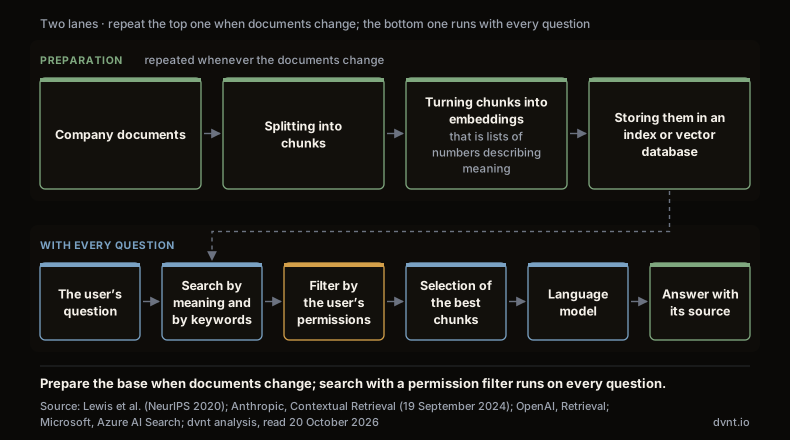
Preparation. The documents are split into pieces. This is called chunking. Anthropic writes that chunks are "usually no more than a few hundred tokens" (a token is the unit of text in which models and price lists measure the length of what you send to the model and what it returns). In its own tool, OpenAI by default splits files into 800-token chunks, with a 400-token overlap between consecutive chunks ("Retrieval", read 19 October 2026). The 2020 paper split Wikipedia into 100-word chunks. In the design of the knowledge base for the chat on digitalvantage.pl we chose about 800 tokens with an overlap of 100. There is no single right size: Anthropic notes that "The choice of chunk size, chunk boundary, and chunk overlap can affect retrieval performance", and advises checking it with tests.
Each chunk is then turned into an embedding, a list of numbers that describes the meaning of the text. OpenAI defines it as "a vector (list) of floating point numbers. The distance between two vectors measures their relatedness. Small distances suggest high relatedness and large distances suggest low relatedness." ("Vector embeddings"). The embeddings go into an index, often a vector database, which lets you search by similarity of meaning. Anthropic does not offer its own embedding model; in its documentation it names Voyage AI as one provider and advises that "you should assess a variety of embeddings vendors to find the best fit for your specific use case."
Handling a question. The question is also turned into an embedding, and the system looks for the chunks closest in meaning. This is semantic search: search by meaning rather than by words. OpenAI illustrates it with an example: for the query "When did we go to the moon?" the best match is "The first lunar landing occurred in July of 1969.", and, as OpenAI notes, "the most relevant result contains none of the words in the search query."
Searching by meaning has a weak spot: exact strings of characters. Anthropic gives the example of the error code "TS-999": an embedding model "might find content about error codes in general, but could miss the exact "TS-999" match." That is why good RAG systems combine search by meaning with keyword search. It matters for contract numbers, product codes and case references. A further step is often reranking, which re-sorts the chunks that were found and passes only the most relevant ones to the model. Anthropic notes that it "inevitably adds a small amount of latency".
The selected chunks go into the prompt together with the question, and the model answers from them and can cite its source. In the documentation for its Citations feature, Anthropic states that citations "are guaranteed to contain valid pointers to the provided documents." That is a guarantee of provenance, not of truth: a citation proves that the passage exists in the document, not that the model understood it correctly or that the document is up to date.
The diagram has one more step that is easy to overlook: the permissions filter before the chunks are selected. We return to it below.
RAG, fine-tuning or the whole document in the prompt – when to use which
RAG, fine-tuning and long context are not successive rungs of one ladder but tools for different problems. In "Optimizing LLM accuracy" OpenAI writes that "Many "how-to" guides on optimization paint it as a simple linear flow - you start with prompt engineering, then you move on to retrieval-augmented generation, then fine-tuning. However, this is often not the case - these are all levers that solve different things".
Decision matrix · three tools for different problems
| RAG | Fine-tuning the model | The whole knowledge base in the prompt | |
|---|---|---|---|
| What it solves | RAGMissing knowledge | Fine-tuning the modelBehaviour, style and format | The whole knowledge base in the promptMissing knowledge with a small base, below about 200,000 tokens according to Anthropic in 2024, with context windows of up to 1 million tokens |
| Updating knowledge | RAGReplace documents | Fine-tuning the modelRetrain | The whole knowledge base in the promptSwap the content of the prompt |
| Source in the answer | RAGYes | Fine-tuning the modelNo | The whole knowledge base in the promptYes |
| Per-user permissions | RAGFilter in the search | Fine-tuning the modelNone | The whole knowledge base in the promptThe prompt has to be assembled separately for each group |
| Cost of one question | RAGLow | Fine-tuning the modelLow after training | The whole knowledge base in the promptGrows with the size of the base |
Missing knowledge calls for context. When the model does not know something because it was not in the training data, is out of date or is proprietary, you have to give it that information: in the prompt or through RAG. OpenAI adds that "many of our largest customer deployments at OpenAI were done using only prompt engineering and RAG."
Wrong format, tone or inconsistent reasoning calls for fine-tuning. Fine-tuning means training the model further on examples from your field. OpenAI recommends it when "the model is producing inconsistent results with incorrect formatting", when "the tone or style of speech is not correct", or when "the reasoning is not being followed consistently". It advises starting with 50 or more carefully chosen examples, because "Quality of training data is more important than quantity". Of RAG, the same guide says that it "only solves our in-context learning issues".
RAG gives the model knowledge (facts, price lists, procedures), while fine-tuning teaches it behaviour: the style, tone and format of its answers. The two can complement each other. OpenAI writes that "These techniques stack on top of each other - if your early evals show issues with both context and behavior, then it's likely you may end up with fine-tuning + RAG in your production solution", with RAG used "to inject context, more recent content or any other specialized context". Neither technique guarantees error-free answers.
A small knowledge base can go into the prompt in full. Sometimes you do not need RAG at all. In September 2024 Anthropic wrote: "If your knowledge base is smaller than 200,000 tokens (about 500 pages of material), you can just include the entire knowledge base in the prompt that you give the model, with no need for RAG or similar methods." Context windows, the amount of text a model accepts in one call, are larger today: Anthropic's documentation gives up to 1 million tokens, depending on the model. The same documentation warns, however, that "more context isn't automatically better. As token count grows, accuracy and recall degrade". What counts is choosing the content, not just capacity. Our article on large language models (LLMs) explains what tokens and the context window are, and why a document pasted into every request multiplies the bill.
A practical rule: put the whole content into the prompt when the base is small, rarely changes and receives few questions. Choose RAG when the base is large and changes often, when users have different permissions and when there are many questions. That is where the cost difference becomes clear, as the calculation below shows.
You usually do not need an agent to answer from documents, either. In "Building effective agents" (19 December 2024) Anthropic writes: "For many applications, however, optimizing single LLM calls with retrieval and in-context examples is usually enough." Our article on the AI agent in business covers when an agent makes sense and when it is overkill.
What breaks RAG answers – five causes
Most bad RAG answers start before the model: in the documents and in retrieval. OpenAI divides the failures into two areas. Retrieval: "You can supply the wrong context, so the model can't possibly answer, or you can supply too much irrelevant context". The model: it "can also get the right context and do the wrong thing with it." That is why each area is tested separately. The five most common causes:
1. Outdated documents. The model answers with what it was given. The 2020 paper's experiment shows this best: the system was asked about 82 world leaders who changed between 2016 and 2018. With the 2016 Wikipedia index it answered 70% of the questions about 2016 leaders correctly, and with the 2018 index 68% of the questions about 2018 leaders. When the index did not match the year, the share of correct answers fell to 12% and 4%. That is one research experiment, not a measure of how well a company's RAG performs, but the principle is general: outdated terms and conditions in the base will produce an outdated answer. The base has to change together with the documents. In the design of our chat, every publication and every deletion of content in the CMS will update the knowledge base automatically. Drafts have to be kept out of the base; OpenAI's documentation shows a filter that excludes drafts by file name.
2. Retrieval missed. A chunk taken out of a document loses its context. Anthropic gives the example of the chunk "The company's revenue grew by 3% over the previous quarter.", which "doesn't specify which company it's referring to or the relevant time period". Codes and numbers, which search by meaning tends to lose, add to the problem. Anthropic described a technique of adding a short context from the whole document to each chunk. In its tests, the top-20-chunk retrieval failure rate fell by 35%, by 49% when combined with keyword search, and by 67% with reranking on top. These are the vendor's tests on its own datasets (code, fiction, scientific papers), and they measure whether the right chunk was among the top 20 results, not whether the answer was correct.
3. Too much, or the wrong thing. According to OpenAI, the wrong context means the model "can't possibly answer", while too much irrelevant context "drowns out the real information and causes hallucinations." Microsoft, describing the challenges of RAG, writes that "Your retrieval system must return highly relevant, concise results - not exhaustive document dumps."
4. Conflicting sources. Two versions of the price list, or a procedure worded one way in sales and another way in customer service. OWASP, the application security community project, lists in its description of risk LLM08:2025 the "knowledge conflict errors" that "can occur when data from multiple sources contradict each other". If the documents do not say which version applies, the model will not work it out either.
5. Poisoned documents and hidden instructions. A document in the base can contain text that the model will treat as an instruction. OWASP describes the scenario of a CV with hidden text, white on a white background, in which the candidate tells the system to ignore its previous instructions and recommend them; a RAG-based screening system processes that text along with the rest of the CV. This is indirect prompt injection, and in its description of risk LLM01:2025 OWASP writes that RAG and fine-tuning "do not fully mitigate prompt injection vulnerabilities." OWASP's recommendation: "all input documents must be validated before they are added to the RAG knowledge base", using text extraction tools that "detect hidden content". In our design, content from the knowledge base is data for the model, not instructions.
Permissions: the assistant sees what you let it retrieve
RAG will show a user everything it finds in the index, unless the search itself filters by permissions. In the assistants built into office suites this principle is built in. Microsoft writes in its Copilot documentation: "Microsoft Copilot only surfaces organizational data to which individual users have at least view permissions." Google states in its Generative AI in Google Workspace Privacy Hub (updated 13 October 2026) that Gemini does not access Workspace content you do not have permission to access. The risk there lies in folders that are shared too widely; we cover that in the cost section of our guide to AI in business.
With your own RAG you have to build this principle yourself. An example of our own: a company connects a drive with HR documents to its chat, and the indexing system reads the files from a technical account that can see everything. On the drive, the salary spreadsheet is open only to HR, but in the index it sits next to the holiday policy. An intern asks the chat how much their manager earns and gets an answer with a quote from the spreadsheet. Nobody broke anything; the search simply did not know who was asking. OWASP describes the same risk in general terms: with "Inadequate or misaligned access controls", "the model could retrieve and disclose personal data, proprietary information, or other sensitive content." In its scenario where several groups of users share one vector database, "embeddings from one group might be inadvertently retrieved in response to queries from another group's LLM".
Microsoft's Azure AI Search documentation puts the problem this way: "Finance data should only be accessible to finance team, even when an executive asks the chatbot." It describes the solution as document-level security trimming: the index inherits permissions from the system where the files are stored, or the search filters results by permissions at query time. OWASP recommends "fine-grained access controls and permission-aware vector and embedding stores", with data of different user groups strictly separated. In our design, every query to the knowledge base passes through a tenant filter before anything reaches the model.
Two consequences follow. First, an instruction to the model such as "do not show confidential data" is not a safeguard. Once the chunk from the spreadsheet is in the context, everything depends on the model, and according to OWASP RAG does not fully remove the vulnerability to prompt injection. The filter has to work before the chunk reaches the model. Second, OWASP warns that attackers can "invert embeddings and recover significant amounts of source information". Protect the index as you protect the documents it was built from. Our article on protecting company data covers who in the company should have access to what, and the article on data security in the cloud collects the questions to ask a cloud provider.
Does RAG eliminate hallucinations?
No. RAG lowers the risk that the model will make something up, but it does not remove it; that is what the model vendors' own documentation says. Google: grounding "reduces the chances of inventing content". OpenAI, in its accuracy guide: models "are unlikely to get to 99.999% accuracy using off-the-shelf methods." Anthropic, in "Reduce hallucinations", lists techniques for reducing hallucinations and adds: "while these techniques significantly reduce hallucinations, they don't eliminate them entirely. Always validate critical information, especially for high-stakes decisions."
These techniques are worth writing into the specification of any RAG system:
- let the model say "I don't know": Anthropic advises giving the model explicit permission to admit uncertainty;
- tell it to answer only from the documents provided, not from its general knowledge;
- require a citation for every claim, and have the model retract any claim it cannot support with a quote;
- hand the case to a person when the base has no answer. That is how we are designing our chat: no answer in the knowledge base, or low confidence, is one of the conditions for handing the conversation over to a member of staff.
How much checking you need depends on the cost of an error. OpenAI advises entering "any discussion on LLM accuracy with a rough picture of how much a failure by the LLM costs you, and how much a success saves or earns you", and gives the example of the difference between "producing a bad copy that a human needs to fix vs. refunding a customer $1000 rather than $100." An assistant that searches technical documentation for the team can occasionally be wrong. An answer about contract terms for a customer cannot go out unchecked. Our article on AI hallucinations covers why models make things up at all and how to match the checks to the cost of an error.
A wrong answer about a specific person is also a GDPR (in Polish, RODO) matter. In the report of its ChatGPT taskforce (23 May 2024), the European Data Protection Board notes that outputs are "likely to be taken as factually accurate by end users, including information relating to individuals, regardless of their actual accuracy", and adds: "In any case, the principle of data accuracy must be complied with." This describes the EDPB's position; it is not legal advice.
How much RAG costs
The API cost of RAG is small; you pay mainly for preparing the documents, the permissions and the tests, and for maintenance. The components of the bill, from the price lists read on 19 October 2026:
- embeddings: in OpenAI's API pricing, text-embedding-3-small costs $0.02 and text-embedding-3-large $0.13 per million tokens; Voyage AI, named in Anthropic's documentation, lists prices of $0.02 to $0.12 per million tokens for the voyage-4 family, with the first 200 million tokens free for every account;
- storage in OpenAI's ready-made tool: 1 GB free, $0.10 per GB per day above that;
- calls to the ready-made file search tool at OpenAI: $2.50 per 1,000 calls, about PLN 9.72 (our conversion);
- tokens of the model that writes the answer, which in our example below are almost the entire running cost.
We built an example on the Claude API price list: Claude Sonnet 5.5 costs $2 per million input tokens and $10 per million output tokens, and a cache hit costs 5% of the standard input price, $0.10 per million tokens. We convert dollars at the mid rate of the National Bank of Poland (Narodowy Bank Polski, NBP) of 2 October 2026: PLN 3.8881 to the dollar. The knowledge base is 200 pages of about 800 tokens each (the figure OpenAI assumes per page in its embeddings documentation), 160,000 tokens in total. For each question we add 500 tokens of instruction and the question itself, and the answer is 300 tokens. The token counts are our assumptions, not a market average.
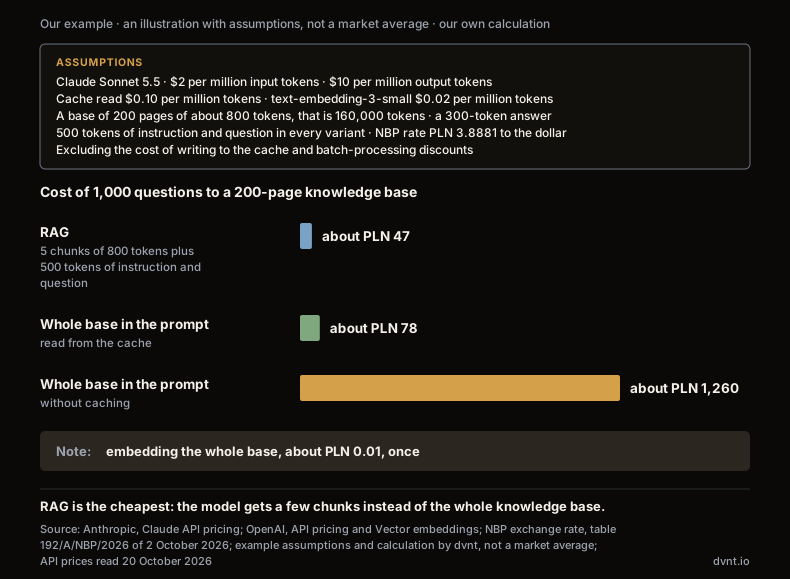
The calculation step by step (our arithmetic):
- The whole base in the prompt, no caching: 160,000 tokens of the base plus 500 tokens of instruction and question, 160,500 tokens × $2 per million = $0.321, plus 300 answer tokens × $10 per million = $0.003. In total $0.324, about PLN 1.26 per question; 1,000 questions come to $324, that is PLN 1,259.74, about PLN 1,260.
- The whole base in the prompt, read from the cache: 160,000 tokens × $0.10 per million = $0.016, plus 500 tokens of instruction and question at the normal price ($0.001) and $0.003 for the answer. In total $0.020, about PLN 0.08 per question; 1,000 questions come to $20, that is PLN 77.76, about PLN 78. This variant assumes every question hits the cache. Writing to the cache is charged separately: $2.50 per million tokens for a five-minute cache, that is $0.40 (about PLN 1.56) every time the whole base is written, and if questions are infrequent the write keeps being repeated.
- RAG: 5 chunks of 800 tokens plus 500 tokens of instruction and question, 4,500 tokens × $2 per million = $0.009, plus $0.003 for the answer. In total $0.012, about PLN 0.05 per question; 1,000 questions come to $12, that is PLN 46.66, about PLN 47. Embedding the questions themselves costs a negligible fraction of a grosz (a hundredth of a zloty) here.
- One-off: embedding the whole base, 160,000 tokens × $0.02 per million = $0.0032, about PLN 0.01. With OpenAI's default chunk overlap the number of tokens to embed roughly doubles, which is still a fraction of a grosz.
In this example RAG is about 27 times cheaper than sending the whole base without caching and about 1.7 times cheaper than the cached variant. The gap grows with the base: the cost of a RAG question depends on the number of chunks selected, while with the whole base in the prompt it depends on the size of the base.
The more important point is a different one: for a thousand questions, the API bill for RAG is a few dozen zloty. The expensive part is what the price list does not show: tidying up the documents, setting up permissions, building a set of test questions, integrating the data sources and reviewing the answers after launch. We did not find an independent study of RAG implementation prices in Poland, so we give no market figure. Our article on the AI agent shows how to calculate the token cost of agents, which call the model many times within one task.
How to start: RAG in a business in six steps
Start with one business question and one set of documents, not with "all of the company's knowledge". Microsoft writes in its guide to deploying Copilot: "When your organization's data is well governed, current, and appropriately shared, Copilot can deliver accurate, relevant, and secure responses." That applies to any RAG. In practice it comes down to six steps:
- Choose one use and one set of documents, for example the procedures for handling orders or the documentation of your offer. Write down who will be asking and about what.
- Tidy up the documents. Each should have a current version, an owner and a date. Remove duplicates and drafts, and resolve conflicting versions before they reach the base.
- Set the permissions before you connect anything. In Microsoft's guide, the first step is to remediate oversharing: find sites and files that are "overshared, ownerless, inactive, or contain sensitive data", and fix the access. With your own RAG, decide where the search will take each user's permissions from.
- Prepare a set of real questions with the expected answers. Assess separately whether retrieval found the right chunk and whether the model used it well. Anthropic's advice is blunt: "Always run evals".
- Decide: ready-made or your own. If the documents live in Microsoft 365 or Google Workspace, start with the assistant in the suite; we compare the plans in the article Google Workspace or Microsoft 365. Your own system makes sense when the data sits in a CMS, an ERP and several other sources, when the answers are meant for customers, or when you need control over permissions and cost. Examples of ready-made building blocks from vendors (read October 2026): file search in the OpenAI API, a tool in which the vendor handles the retrieval itself; RAG Engine in Google's Gemini Enterprise Agent Platform (formerly Vertex AI), which is generally available in Frankfurt and the Netherlands, although the documentation states that "Data residency and AXT security controls aren't supported"; and Azure AI Search from Microsoft. These are examples, not a ranking.
- Plan an observation period. Review the "I don't know" answers and the wrong ones, fill the gaps in the documents and update the base. Questions the base cannot answer show what is missing from the company's documentation.
This is how we are designing the knowledge base for the AI chat on digitalvantage.pl. The chat is not live yet and there are no results, so we describe the design, not its effects. The base covers articles, pages and a glossary. Every publication and every deletion of content in the CMS will send the change to the base, so that the chat does not answer from withdrawn text. Chunks are about 800 tokens with an overlap of 100. Every query passes through a tenant filter, content from the base is data for the model, not instructions, and the answer includes a link to the source where that makes sense. When the base has no answer, a person takes over the conversation. After launch we will check every week, for at least four weeks, where the bot made things up.
The same mechanism works in a customer chat on a website, but there it comes with the duty to tell people they are talking to AI. Our article EU AI Act for business explains who carries that duty and from when it applies, and the article on customer service in e-commerce covers chatbots in online shops.
Frequently asked questions about RAG
How is RAG different from training (fine-tuning) a model on company data?
RAG gives the model knowledge at the moment of the question: the system searches for passages in the documents and adds them to the prompt. Fine-tuning changes the model itself by training it further on examples. OpenAI's guide on model accuracy separates the two uses: missing, outdated or proprietary knowledge is a job for context, that is the prompt or RAG, while wrong formatting, tone and inconsistent behaviour are a job for fine-tuning. With RAG you update knowledge by replacing documents; a fine-tuned model has to be trained again. The two techniques can be combined.
Does RAG need a vector database?
Not always. Anthropic writes that a knowledge base smaller than about 200,000 tokens can be included in the prompt in full, without RAG. Keyword search is also part of good RAG, because search by meaning tends to miss codes and numbers. When you do use embeddings, they have to be stored and searched somewhere: a dedicated vector database is one option, a ready-made tool such as the vector stores behind OpenAI's file search or a search service such as Azure AI Search is another. Decide on the basis of scale, the permissions you need and the tools you already use.
Can RAG show an employee a document they have no access to?
Yes, if the search itself does not filter by permissions. A system that indexes files from an account that can see everything will find, for everyone, whatever is in the index. Microsoft describes the solution as document-level security trimming based on the user's permissions, and OWASP recommends permission-aware vector stores. According to their vendors' documentation, ready-made assistants such as Microsoft Copilot and Gemini in Google Workspace show only content the user has access to, so the risk there lies in files that are shared too widely.
When is it enough to paste the documents into the context window instead of building RAG?
When the base is small, rarely changes, receives few questions and everyone asking may see all of it. In 2024 Anthropic gave a threshold of about 200,000 tokens. With many questions the cost adds up: in our example, 1,000 questions to a 200-page base cost about PLN 1,260 ($324) without caching, about PLN 78 ($20) with it and about PLN 47 ($12) with RAG, at the NBP rate of 2 October 2026. Anthropic also warns that with very long context, accuracy and recall degrade.
Does RAG work with documents in Polish?
The mechanism does not depend on the language, but retrieval quality depends on the embedding model. OpenAI says its text-embedding-3 models offer "higher multilingual performance", and Voyage AI also lists a multilingual model. These are vendors' own claims, and we found no independent assessment of quality for Polish, so the only reliable test is your own set of real questions in Polish with the expected answers.
How often should a RAG knowledge base be updated?
With every change to a document, ideally automatically. In the experiment in the 2020 RAG paper, the same system with an index from the wrong year answered 12% and 4% of the questions correctly instead of 70% and 68%. Keep drafts out of the base; OpenAI's documentation shows a filter that excludes them. In the design of the chat on our website, publishing or deleting content in the CMS will update the knowledge base straight away; the chat is not live yet.
Related articles
Artificial intelligence
Local AI in a Polish company — your own server, an EU cloud or an API? Costs, law and quality
Local AI for a Polish company: when your own server or an EU cloud pays off, GPU cost vs an API in PLN, what an EU region changes and which open models to use.
Automation and integrations
API — what is it? REST API, webhooks and OpenAPI explained for business
API explained with NBP, KSeF and VIES as examples: REST API, webhooks, OpenAPI, API keys and integration security for business.
SaaS and your own product
Multi-tenant — what it is and how to choose a SaaS architecture for many customers
Multi-tenant SaaS: single tenant vs multi-tenant, the silo/pool/bridge models, Row Level Security, GDPR and choosing a model for an MVP.
Cloud and security
On premise — what it means and when your own server beats the cloud
On premise, your own server: the full cost beyond hardware, the end of Windows Server 2016 support, and when the cloud or VPS wins instead.
Cloud and security
SLA — what it is and what to check in an SLA with a cloud provider
SLA meaning: how much downtime fits in 99.9%, how AWS, Microsoft and Google SLAs compare, SLO, RPO, RTO and 10 things to check before signing.
Cloud and security
Cloud computing — what it is and how IaaS, PaaS and SaaS differ
Cloud computing by the NIST definition: five traits, IaaS, PaaS and SaaS, public, private and hybrid cloud, and how Polish businesses actually use the cloud.
Where would AI really pay off for you?
Tell us which tasks take up most of your time today. We will check whether an off-the-shelf assistant is enough or whether you need an implementation on your own data. If ChatGPT on a business plan will do, we will say so plainly.