
Artificial intelligence18 min read3408 wordsRedakcja dvnt
Local AI in a Polish company — your own server, an EU cloud or an API? Costs, law and quality
Local AI for a Polish company: when your own server or an EU cloud pays off, GPU cost vs an API in PLN, what an EU region changes and which open models to use.
Local AI is a language model running on a server you control — in your company or at a European provider — so that contracts, quotes and technical documentation never reach the model's maker or fall under a foreign jurisdiction. It makes sense when you are protecting the information your business is built on, not when you want to save on tokens. For a company with a few dozen employees, a large provider's API usually costs less than a server with a graphics card, and the best models are closed anyway. That is why a hybrid usually wins: the most valuable data goes to a model on your own hardware or at an EU provider, and everything else to a cloud model under a data processing agreement and in an EU region.
This article is for owners of Polish businesses who do not want to paste contracts or customer data into a chatbot and are asking whether AI can run "in-house", what it costs and whether it will be worse. Prices, licences and provider documentation were read on 28 October 2026. For the wider map of decisions about artificial intelligence in a company, see our guide to AI in business.
Local AI — what it means: four levels of control over your data
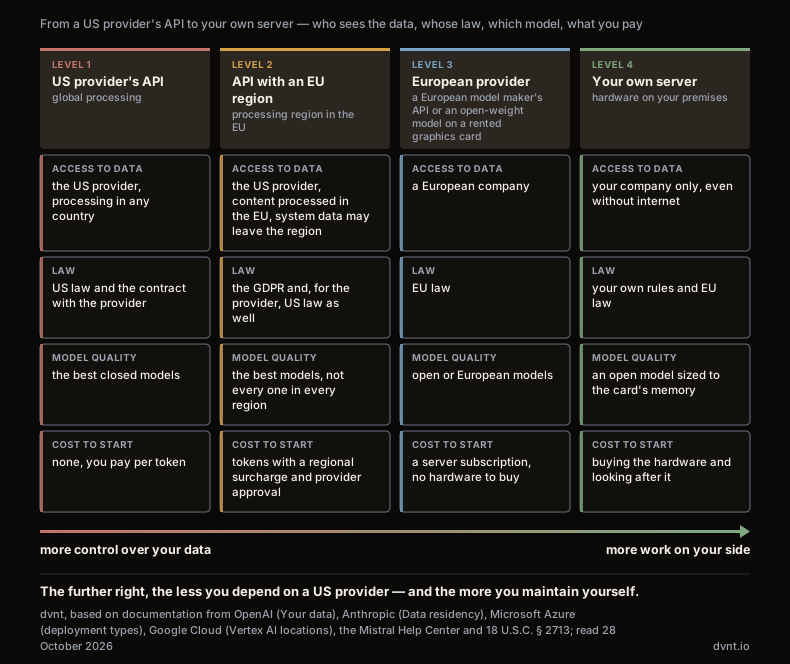
"Local AI" is not one product but the far end of a scale: the closer you get to it, the fewer companies and states can reach your data — and the more work falls on you. A local AI model, also called a local LLM, is a language model with publicly available weights (open-weight) running on infrastructure you control. Questions and documents never reach the model's maker, because the maker plays no part in processing them.
The levels look like this:
- A US provider's API with global processing. This is how most integrations work by default. In its data residency documentation, Anthropic describes the "global" default: inference may run in any available geography.
- An API with an EU region. OpenAI offers a "Europe (EEA + Switzerland)" region, but according to its documentation you have to contact sales, be approved and pay 10% more for models released on or after 5 March 2026; system data — account details, metadata, usage data — may be processed outside the region. Anthropic's own API has no EU region: only "us" and "global" are available. Claude in the EU is available through partner platforms: Google Cloud offers it in the "eu" multi-region (and a Vertex AI region in Warsaw for other models), Amazon Bedrock through inference profiles tied to the EU. In Azure, Microsoft offers Data Zone deployments in which the service processes data only within the zone — US, EU or Asia Pacific. Check the documentation to see whether a specific model is available in a region.
- A European provider. Either the API of a European model maker — Mistral says that your data is hosted in the EU by default unless you explicitly use its US endpoint — or an open-weight model on a graphics card rented from a European company: OVHcloud, Germany's Hetzner or CloudFerro, which has regions in Warsaw.
- Your own server on your premises, if necessary cut off from the internet.
The hobby version, "local AI on a laptop", is level four in miniature: programs such as Ollama or LM Studio run a small model on a computer. It is a good way to try things out, but not a service for the whole company: a laptop cannot serve a few dozen people at once. LM Studio's terms allow both personal and internal business use.
Is ChatGPT safe for business data?
It depends on the account and the contract, not on the brand: a company API and business plans work on different terms from an employee's personal account. For its API, OpenAI says that since 1 March 2023 data sent to the API is not used to train or improve its models unless you explicitly opt in, and that abuse monitoring logs are kept for up to 30 days. Anthropic deletes API inputs and outputs within 30 days, with exceptions — it keeps them for up to two years when its automated systems flag a conversation as violating its usage policy. If your staff need a chatbot for writing and summarising, a business plan with clear rules usually solves the problem without a server of your own — we compare the data terms of the ChatGPT, Copilot and Gemini plans in our comparison of business plans.
The real risk lies elsewhere: in personal accounts the company does not control. According to Economist Korea of 30 March 2023, there were three leaks in under 20 days after Samsung allowed ChatGPT in its semiconductor division. One employee copied the entire source code of a program he was debugging into the chatbot, another pasted code to be optimised, and a third pasted a meeting transcript he wanted turned into minutes. The company limited the size of prompts and, more importantly, began considering building its own internal AI service.
According to the Cyberhaven 2026 report, 39.7% of interactions with AI tools involve sensitive data — a report by a vendor of data loss prevention systems, based on data from 222 companies and on its own definition of "sensitive".
AI security in Polish companies starts with awareness. The Polish data protection authority, the Personal Data Protection Office (UODO), reports that in a survey by the Social Team of Experts at the President of UODO, 95.9% of organisations do not consider themselves ready to deploy AI in line with the GDPR, and that the compliance question "usually comes up when the tool is already running" (our translation). So the order is: rules for staff and a business plan first, the question of your own infrastructure second.
An EU region is not digital sovereignty: US AI providers and the CLOUD Act
An EU region decides where your data is stored; whose law can reach it is decided by where the provider is based. The US CLOUD Act of 2018 added 18 U.S.C. § 2713 to the US Code. It requires a provider of electronic communication service or remote computing service to "preserve, backup, or disclose" a customer's data "within such provider's possession, custody, or control, regardless of whether such communication, record, or other information is located within or outside of the United States". The obligation is triggered by a warrant or other legal process under those provisions; it is not free access to everything.
A hearing in the French Senate on 10 June 2025 showed what this means in practice. Asked under oath whether he could guarantee that citizens' data entrusted to Microsoft would never be handed over on a US government order without the consent of the French authorities, Anton Carniaux, director of public and legal affairs at Microsoft France, replied: "No, I cannot guarantee that, but, again, it has never happened" (Senate committee record, our translation). A moment earlier he had said: "When we are obliged to hand it over, we hand it over", adding that none of the European companies among its customers had been affected so far. The risk is real, then, but not an everyday one.
Transferring personal data to the US remains lawful. On 3 September 2025, the EU General Court dismissed the action against the Commission's decision of 10 July 2023 on the EU-US Data Privacy Framework. According to the law firm WilmerHale, the applicant lodged an appeal with the Court of Justice on 31 October 2025. The Court of Justice has already struck down two earlier decisions on the US (Schrems I in 2015, Schrems II in 2020). We describe the history of these transfer frameworks in our article on cloud security.
For customers' personal data, a data processing agreement and an EU region at a large provider are usually enough. For the information your business is built on — formulas, tender bids, code, strategy — what counts is the provider's jurisdiction, which means level three or four.
The law: the GDPR, trade secrets and the AI Act with local AI
A local model does not exempt you from the GDPR or the AI Act — it only changes the list of companies you entrust your data to. A cloud model provider is your processor: Article 28 of the GDPR (RODO in Polish) requires a contract and a processor "providing sufficient guarantees to implement appropriate technical and organisational measures", and a transfer outside the European Economic Area needs a basis under Chapter V, such as the safeguards in Article 46. With a model on your own server that item disappears, but your duties as controller remain.
Trade secrets are less obvious. Article 11(2) of the Polish Act on Combating Unfair Competition (ustawa o zwalczaniu nieuczciwej konkurencji) treats information as a trade secret only if the entitled person "has taken, with due diligence, steps to keep it confidential" (consolidated text, Journal of Laws 2026, item 85, our translation). Our interpretation, not legal advice: if employees paste quotes into personal chatbots without any rules, it is harder to show that diligence in a dispute; written rules and a tool under the company's control strengthen your position.
The third issue is fine-tuning. In its Opinion 28/2024, the European Data Protection Board says that a model can be considered anonymous only if it is very unlikely both to identify the individuals whose data was used to train it and to extract that personal data from the model through queries. A model fine-tuned on personal data may therefore contain it, and you cannot remove it from the weights the way you delete a record from a database. That is why RAG works better for answers based on company documents: the model receives passages from a database from which you can delete data with a single command.
The AI Act: a company that runs a ready-made model in-house is, as a rule, a deployer (Article 3(4)), not a provider of a general-purpose AI model. Even fine-tuning usually does not change that — according to the Commission's guidelines, the indicative threshold is a modification using more than a third of the compute used to train the original model, and few modifications meet it today. The obligations for high-risk uses, such as recruitment, apply wherever the model runs. We cover roles, deadlines and penalties in our article on the AI Act.
Open-weight models in 2026: which ones an EU company may run
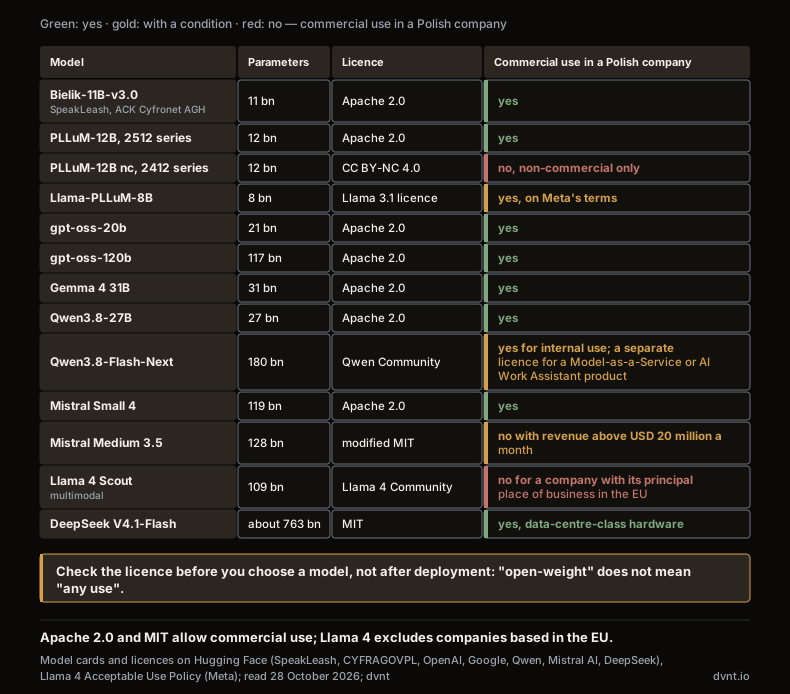
"Open" does not mean "anything goes": read the licence of the specific version before you choose a model, because terms can differ within the same family. Most models in the matrix below are under Apache 2.0, which allows commercial use. There are four traps.
- Multimodal Llama 4. The Llama 4 Acceptable Use Policy states that the licence rights for multimodal models are not granted to "a company with a principal place of business in, the European Union". The restriction does not apply to end users of a finished product, but a Polish company cannot run such a model itself.
- Mistral Medium 3.5. Its modified MIT licence excludes companies whose consolidated revenue exceeded USD 20 million in the previous month. Mistral Small 4 is under Apache 2.0.
- Qwen3.8-Flash-Next. The Qwen Community licence requires a separate licence if the company offers a "Model as a Service" product, that is, makes the model available to others through an API, or an "AI Work Assistant" product — a stand-alone assistant for programming or office work. Internal use is permitted as long as neither the model nor its outputs are made available to third parties. Qwen3.8-27B is under Apache 2.0.
- PLLuM "nc". Older variants of the Polish PLLuM model marked "nc" are licensed under CC BY-NC 4.0, which means non-commercial use only. For business use, take PLLuM-12B or PLLuM-4B from the 2512 series (Apache 2.0); we tell the story of Bielik and PLLuM in our article on LLMs.
Chinese open-weight models are a separate matter: the weights of DeepSeek V4.1-Flash are under the MIT licence, and when they run on your server they send no data to China — unlike the DeepSeek app, for which the Italian data protection authority restricted the processing of data of users in Italy on 30 January 2025.
The same care applies to software. Ollama and llama.cpp are under the MIT licence, vLLM under Apache 2.0. The popular Open WebUI interface has its own licence: you may remove its branding only if no more than 50 users use the application in any 30-day period, or with permission or an enterprise licence.
Is a local model worse than ChatGPT?
Yes, usually — but the gap depends on the model's size and on the task. Epoch AI calculated that since January 2026 the best open-weight models have trailed the best closed models on its aggregate capabilities index by four months on average. That compares the best open models, which are large and run on multi-GPU servers — it does not apply to an 11-billion-parameter model on a single card that fits a small company's budget.
In our assessment, a model of 8–14 billion parameters summarises, classifies and answers questions from supplied documents well. It does worse with multi-step reasoning and with longer writing on complex tasks. Before buying hardware, test the model on 30–50 of your own questions drawn from real documents, with the correct answers agreed in advance — that costs a few hours of a rented card, not a server purchase.
AI server: how much memory a model needs and what the hardware costs
The model you can run depends above all on the graphics card's memory. A practical rule from the file sizes in the Ollama library: a model stored in 4 bits takes about 0.6 GB per billion parameters, in 8 bits about 1.06 GB. On top of that you need headroom for the conversation context — the accelerate library's documentation suggests adding up to 20% for inference. Examples from the Ollama library: an 8-billion-parameter model takes 4.9 GB in 4 bits and 8.5 GB in 8 bits; a 70-billion one 43 and 75 GB. gpt-oss-120b takes 65 GB and, according to its model card, fits on a single 80 GB card. By the same rule, Bielik 11B in 4 bits comes to about 7 GB (our estimate).
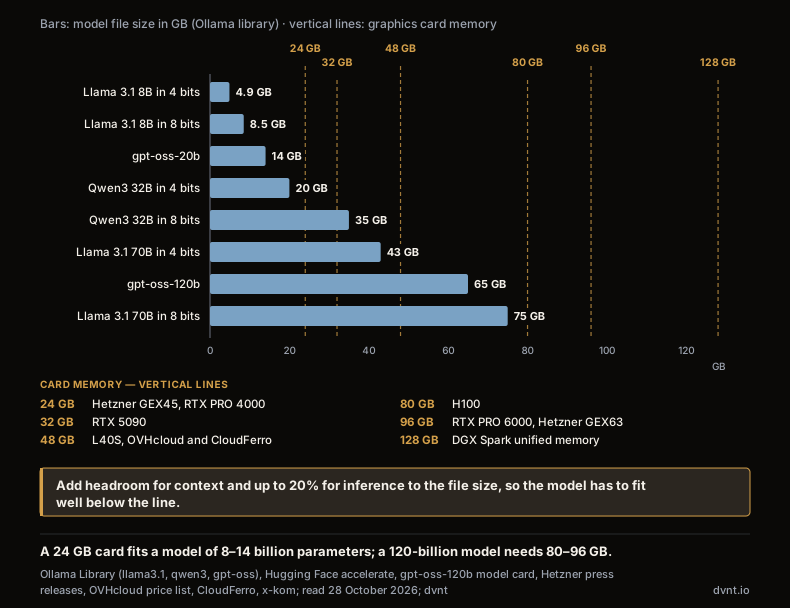
If you buy, gross retail prices at the Polish electronics retailer x-kom on 28 October 2026 are as follows: a computer with the NVIDIA GB10 chip and 128 GB of unified memory (DGX Spark and its equivalents) from PLN 25,849; an RTX 5090 card with 32 GB at PLN 43,999–45,999 for the card alone; an RTX PRO 6000 with 96 GB at PLN 74,999–76,999 for the card alone, and ready-made workstations with one such card from PLN 124,000. Card prices change quickly.
Renting in the EU, net monthly prices: a Hetzner GEX45 with a 24 GB card costs EUR 214, about PLN 944, plus a one-off EUR 209; a GEX63 with a 96 GB card EUR 999, about PLN 4,405, plus the same again to set up. At OVHcloud, an instance with an L40S 48 GB costs PLN 4,608 and one with an H100 80 GB PLN 8,930. The Polish provider CloudFerro quotes prices in EUR: an L40S comes to about PLN 5,860 on a monthly contract and about PLN 3,915 on an annual one, an H100 to about PLN 18,711 and PLN 12,239 (our conversions at the National Bank of Poland (NBP) rate of 28 October 2026: PLN 4.4090 per euro).
We describe the full cost of your own server — depreciation, power, people — in our article on on-premise, and rental models in our article on cloud computing.
What local AI costs compared with an API — the calculation
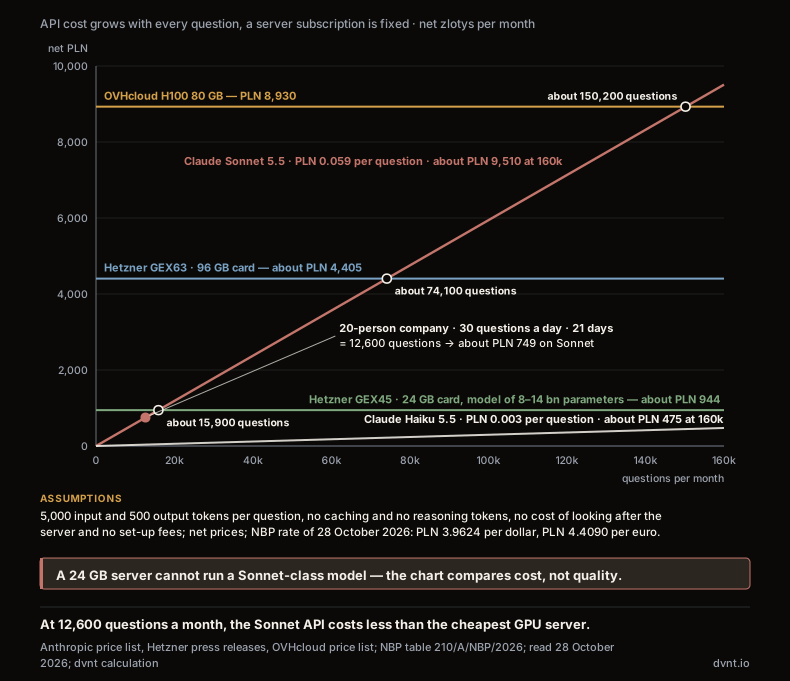
In a small or medium-sized company, the token bill rarely justifies your own server; the value of the data does. Our calculation, an illustration with stated assumptions: an employee's question to a document assistant is 5,000 input tokens (the instructions and a few passages from documents) and 500 output tokens, with no caching and no reasoning tokens. At Anthropic's prices — Claude Sonnet 5.5 at USD 2 per million input tokens and USD 10 per million output tokens — one question costs about PLN 0.06, and on the cheapest model, Claude Haiku 5.5, about PLN 0.003 (NBP rate of 28 October 2026: PLN 3.9624 per US dollar).
A company in which 20 people ask 30 questions a day over 21 working days sends 12,600 questions a month. On Sonnet that comes to about PLN 749, on Haiku about PLN 37. The cheapest server from the previous section, the GEX45, costs about PLN 944 net a month — and runs a model of 8–14 billion parameters, not a Sonnet-class model. The server subscription alone matches the cost of Sonnet at about 15,900 questions a month for the GEX45, about 74,100 for the GEX63 and about 150,200 for an H100 at OVHcloud. At Haiku prices the thresholds are twenty times higher.
On top of the server you have to add deployment and upkeep. Polish providers that publish prices (read on 28 October 2026, in no particular order, not a ranking):
- Droptica quotes an audit with a pilot deployment at EUR 1,200–3,500 (2–3 weeks), a production deployment at EUR 7,000–25,000 (4–12 weeks) and maintenance at EUR 700–2,000 a month; the client buys the hardware.
- RSMobile writes that a complete private chatbot deployment usually comes to PLN 45,000–95,000 net, and that a test on the client's data takes 2–4 weeks and costs PLN 10,000–25,000 net.
- WebyJuice quotes (article of 23 April 2026) PLN 20,000–200,000 one-off plus PLN 800–3,500 a month for hosting and maintenance, without saying whether the amounts are net or gross.
These are providers' own figures, not market averages. But even Droptica's lower bound, about PLN 30,900, is more than three years of Sonnet tokens for the company in the example (about PLN 27,000, our calculation).
Architecture: a local LLM, RAG on company documents and a hybrid
A working assistant for company documents is made of four building blocks, and the model is only one of them. The other three are document search that respects permissions (RAG — an intern should not receive a passage from the board's contract), an interface for staff, and conversation logging with access control. We explain the mechanism and the permission pitfalls in our article on RAG.
The hybrid we usually recommend looks like this:
- You list which data is strategic. Trade secrets, tenders, code, medical or legal documentation.
- That data goes to a model on your own hardware or at an EU provider — level three or four.
- Everything else goes to the best cloud model, through an API with an EU region and a data processing agreement.
- One application, the model chosen in configuration. Where a question goes is decided by a rule in the system, not by an employee's memory.
With your own server, you take on what the provider does in the cloud: updating models and software, server security, content filtering, backups and monitoring. The automations around the assistant can also stay in-house — for example in a self-hosted n8n.
Our own chat assistant "Vi" on this site works this way: it answers from our published content, and we switch its model in configuration between cloud providers and a model on our own server.
When your own AI infrastructure pays off, and when it doesn't
Your own AI server answers the question "who can see this data", not "how can I pay less". It pays off when you meet at least one of the first two conditions and none of the four "no" cases.
Yes, when:
- you process the data your business is built on: trade secrets, tender bids, code, medical or legal documentation;
- a customer or a contract requires processing in the EU by an EU company;
- you have a large, steady volume of queries — tens of thousands a month;
- the system has to work without internet access, for example in a plant or a laboratory;
- a small model handles the task well: summaries, classification, answers from documents.
No, when: there are few queries; the task needs the best model available; nobody will look after the server; the data is public anyway.
The first step needs no hardware: list which data in your company is strategic and who has access to it — we explain how in our article on protecting company data. The second: test your chosen open-weight model on 30–50 of your own questions on a rented card before you buy a server.
Frequently asked questions about local AI
Does local AI work without internet access?
Yes. The model, the document database and the interface can run on a server in the company network with no internet connection. The price is manual work: new versions of models and software, and security patches, have to be installed by hand.
Can a whole company have its own "private ChatGPT"?
Yes: an open-weight model on your own server or on a card rented in the EU, plus a chat interface and document search. Check the interface licence — Open WebUI lets you remove its branding only with no more than 50 users in 30 days or with an enterprise licence. Also expect a small model to be weaker than the best cloud models.
Is an EU region in Azure, Google Cloud or AWS enough?
For customers' personal data, with a data processing agreement, usually yes. For the information your business is built on, a region does not change the jurisdiction: the CLOUD Act covers data in a US provider's possession wherever it is stored. In that case, consider an EU provider or your own server.
How long does it take to deploy a local model?
According to Polish providers' price lists of 28 October 2026, a test on the client's data takes 2–4 weeks and a production deployment 4–12 weeks. Most of the time usually goes into preparing the documents and permissions, not into starting the model.
Should we fine-tune a model on company documents?
Usually not. The European Data Protection Board points out that a model trained on personal data may contain it, and you cannot remove it from the weights the way you delete a record from a database. For answers based on documents, RAG works better: the model receives passages from a database from which you can delete data at any time.
Is the Polish Bielik model good enough?
For many office tasks in Polish, possibly. Bielik-11B-v3.0 has 11 billion parameters and an Apache 2.0 licence that allows commercial use, and in 4 bits it takes about 7 GB by our estimate, so it fits on a 24 GB card. Before you decide, test it on 30–50 of your own questions.
Related articles
Artificial intelligence
RAG AI — how AI answers from your company's own documents
RAG AI lets a language model answer from your company documents. How it works, what breaks the answers, what it costs in PLN and how to start safely.
Automation and integrations
API — what is it? REST API, webhooks and OpenAPI explained for business
API explained with NBP, KSeF and VIES as examples: REST API, webhooks, OpenAPI, API keys and integration security for business.
SaaS and your own product
Multi-tenant — what it is and how to choose a SaaS architecture for many customers
Multi-tenant SaaS: single tenant vs multi-tenant, the silo/pool/bridge models, Row Level Security, GDPR and choosing a model for an MVP.
Cloud and security
On premise — what it means and when your own server beats the cloud
On premise, your own server: the full cost beyond hardware, the end of Windows Server 2016 support, and when the cloud or VPS wins instead.
Cloud and security
SLA — what it is and what to check in an SLA with a cloud provider
SLA meaning: how much downtime fits in 99.9%, how AWS, Microsoft and Google SLAs compare, SLO, RPO, RTO and 10 things to check before signing.
Cloud and security
Cloud computing — what it is and how IaaS, PaaS and SaaS differ
Cloud computing by the NIST definition: five traits, IaaS, PaaS and SaaS, public, private and hybrid cloud, and how Polish businesses actually use the cloud.