
Costs and working with a vendor20 min read3809 wordsRedakcja dvnt
How to choose a software development company — checks, contract and rights to the code
How to choose a software development company in Poland: reading reviews and rankings, checking KRS filings, fixed price vs time and material, and code rights.
A software development company — in Poland usually called a software house — builds software to order for outside clients, from analysis and design to deployment and maintenance. How do you choose one? Not by portfolio and directory stars, but by three things you can check before you sign: whether the company is on solid ground, how the two of you will handle changes of scope, and what exactly you get besides the files with the code.
When you commission custom software development for the first time, three proposals for the same application tend to look alike. What separates them is what you do not see at first glance: how changes are paid for, what the contract says about the code, and how much work the contractor expects from you. Quotations from Polish legal acts and official documents in this article are our own translation.
Software development company, freelancer or staff augmentation — what is the difference
A software development company is responsible for delivering working software, a freelancer for their own part of the work, and with staff augmentation the responsibility for the result is yours. No Polish act defines these forms; it is a market distinction, but behind a similar price sit very different obligations.
- Software development company (software house, development agency). A team: an analyst, a designer, developers, a tester, someone for infrastructure. It takes on delivery of the whole — the work plan, coordinating people, testing and deployment. You decide what is to be built; the contractor decides how to build it.
- Freelancer. One person, usually running a sole proprietorship entered in CEIDG, the Polish register of sole traders (Centralna Ewidencja i Informacja o Działalności Gospodarczej). Often cheaper at the start, but all the knowledge about the system sits in one head: an illness or another project puts yours on hold.
- Staff augmentation (body leasing, one form of software development outsourcing). You hire people by the hour and add them to your own team. You manage their work and you answer for whether the whole thing works. A good fit when you have a team and someone who runs it; a poor fit when you are looking for someone to take a project from idea to launch.
One question settles what you are dealing with, whatever the contractor calls itself on its website: who on the contractor's side is responsible for the whole thing working? If the answer is "you — we provide the people", it is staff augmentation.
A digital or web agency starts from marketing — a website, a campaign, an online shop — rather than from a product that has to work and evolve for years. For a website that is often the right choice; the questions to put to such an agency are collected in our web agency selection checklist.
Before you start looking: what the contractor will need from you
The condition for success that is skipped most often is the time of the person on your side. A contractor builds what it understands, and it understands what somebody on your side explains, checks and approves.
In Scrum, a popular way of working in sprints, one person decides the order of the work. The Scrum Guide (November 2020 version, read 19 October 2026) puts it plainly: "The Product Owner is one person, not a committee." The guide does not say on which side of a contract that person works. In an outsourced project you settle it yourself: does someone from your company set the priorities, or someone from the contractor — and how many hours a week do they really have for it?
The Polish Public Procurement Office (Urząd Zamówień Publicznych, UZP), advising public bodies that buy IT systems, writes in its recommendations on public procurement of IT systems (Volume I, June 2020) that agile methods assume "the active and direct participation of the contracting authority's representatives in the project work". A contracting authority that has no people able to test and accept the system should, according to UZP, bring in an adviser. That is advice for the public sector, but the reasoning fits a company of any size.
The Polish Civil Code attaches a specific consequence to a lack of cooperation. Article 640 of the Civil Code (Kodeks cywilny, consolidated text in the Journal of Laws (Dziennik Ustaw) 2026 item 795): "If the cooperation of the client is needed to perform the work and that cooperation is lacking, the contractor may set the client an appropriate deadline, warning that once it expires without effect the contractor will be entitled to withdraw from the contract." Whether the provision covers your contract depends on its wording, but the direction is clear: a lack of input from you is not only a delay, it is also the contractor's argument.
A one-page brief is enough for the first conversation: the goal, the users, the most important features and the one condition that must not be missed. You can work out an indicative cost for the scope in our web application cost calculator — and then judge whether the proposals are in the same order of magnitude.
Software development company reviews and rankings — how to read them
A ranking in a company directory mainly measures the number, quality and recency of reviews, not whether the contractor fits your project.
Clutch describes five ranking criteria in its help centre (undated page, read 19 October 2026): "Number, quality, and recency of client reviews", "Work experience", "Market Presence and Industry Recognition", "Services offered", and "Presence in a location (only on location-specific directories)". For a buyer, two other points in the same documentation matter more:
- Sponsors are listed higher. Companies that have bought a sponsorship package are displayed above non-sponsors on directory pages. Clutch says they "do not receive preferential treatment in Clutch rankings", that "Sponsorship does not affect rankings in the Leaders Matrix", and that visitors can filter a directory page by Clutch Rank. So the default order is not a ranking.
- Reviews are collected, among other ways, at the contractor's invitation. Clutch shows companies how to invite clients to leave a review and gives them a ready-made message template. Every review goes through verification of the reviewer's identity and work history; one that cannot be verified may still be published, marked "Not Verified".
Verification confirms that a real client wrote the review. It does not change the fact that the contractor chooses whom to invite, so part of the sample comes from projects it considers successful. That is our conclusion, not an accusation against the platform.
GoodFirms states its weights openly in its research methodology ("Last reviewed: May 13, 2026"): on one of its two ranking axes, client reviews carry 50%, and within the review component the star rating carries 50%, review volume 30% and recency 20% (the share of reviews from the last 18 months). Our reading of both methodologies: a large company that collects reviews actively comes out ahead of a small one that does a few projects a year very well.
How to use them: switch the sorting to the ranking, read the text of reviews about projects similar to yours rather than the average star rating, and ask for a reference client you can call. Ask that client what reviews tend to leave out: how changes of scope were paid for, what acceptance looked like and what happened after launch.
How to check a software development company in Polish registers — free of charge
You can check a company's financial health free of charge and without creating an account, because the financial statements of companies in the register of entrepreneurs of the National Court Register (Krajowy Rejestr Sądowy, KRS) are public. The Ministry of Justice writes on the page of its financial documents browser (read 13 October 2026): "Anyone can search for and download, free of charge, a financial document of an entity entered in the register of entrepreneurs of the National Court Register." All you need is the contractor's KRS number and the financial documents search that the ministry's page links to.
From the financial statements you can read three things without an accountant's help: whether the company files them at all, how revenue and profit move from year to year, and whether equity is negative — that is, whether liabilities exceed assets. We give no thresholds, because a sensible revenue depends on the size of the team and the scale of the project. The point is not to sign a contract running for months with a company that is barely keeping afloat.
A freelancer, or any sole proprietorship — including one that presents itself as a software house — is entered in CEIDG and does not file financial statements with the KRS. You can check only that the business exists and is active; about its stability you ask directly and through references.
Before the first transfer, check the contractor's bank account on the white list (biała lista), the register of VAT payers kept by the Head of the National Revenue Administration (you can check the status on any chosen day within the last five years). If your company pays corporate income tax and a transaction with another business exceeds PLN 15,000, a payment by transfer to the account of an active VAT payer that is not on the list generally cannot be counted as a tax-deductible cost (Article 15d of the Corporate Income Tax Act (ustawa o podatku dochodowym od osób prawnych), Journal of Laws 2026 item 554) — settle the details with your accountant.
If you are considering a contractor registered in another EU country, its basic data and status can be looked up through the EU's "Find a company" service on the European e-Justice Portal, and its VAT number in the Commission's VIES tool.
Fixed price vs time and material: what the pricing model means for your budget
Under a fixed price, the contractor takes on the risk that there will be more work — and prices that risk in. Under time and material, the risk is yours. Neither model is cheaper by nature; they differ in who pays for the unknowns.
Three ways to set the price · who pays for the unknowns
| Lump sum fixed price | Estimate-based fee list of planned work and costs | Time and material time actually worked | |
|---|---|---|---|
| Who carries the risk if the work turns out larger | Lump sum fixed priceContractor — may not demand a higher fee (Art. 632 § 1) | Estimate-based fee list of planned work and costsContractor — if it prepared the estimate — unless despite due diligence it could not have foreseen the extra work (Art. 630 § 1) | Time and material time actually workedClient — pays for the time actually worked at the rate in the contract (UZP definition) |
| What happens when the scope changes | Lump sum fixed priceAn annex and a separate quote | Estimate-based fee list of planned work and costsExtra work done without the client’s consent does not raise the fee (Art. 630 § 2) | Time and material time actually workedPriorities change in the next sprints |
| What you need on your side | Lump sum fixed priceA closed, precise description of the scope | Estimate-based fee list of planned work and costsA list of the planned work and expected costs | Time and material time actually workedA person who sets priorities and checks the time reports |
| When it fits | Lump sum fixed priceA scope both sides understand the same way | Estimate-based fee list of planned work and costsA known scope with some unknowns | Time and material time actually workedA product that will keep changing |
This describes the mechanism, not legal advice; the contract can change it.
Time and material (T&M). UZP, in Volume II of its recommendations (December 2021), defines it as a model "in which the fee is settled on the basis of the actual time spent on the work and the rate stated in the contract". You pay for the hours worked and can change direction between sprints, but the risk that the scope grows is yours. A time and material contract therefore needs someone on your side who sets the priorities, and regular time reports broken down by task.
Fixed price. In the language of the Polish Civil Code, the closest equivalent is a lump-sum fee (wynagrodzenie ryczałtowe) — that is our mapping of the terms, not a statutory definition. Article 632 § 1: "If the parties have agreed on a lump-sum fee, the contractor may not demand an increase of the fee, even if at the time the contract was concluded the scope or cost of the work could not be foreseen." (Where an unforeseeable change of circumstances threatens the contractor with a gross loss, a court may increase the lump sum or dissolve the contract — § 2.) As a result, the contractor prices the risk in with a margin and will want to quote every change of scope separately. A lump sum works well only when the scope is described so precisely that both sides understand it the same way.
Estimate-based fee, a third way. An estimate-based fee (wynagrodzenie kosztorysowe, Article 629) is set "on the basis of a list of planned work and expected costs". If the contractor prepared the list, it may demand a higher fee for unforeseen work only if, despite due diligence, it could not have foreseen the need for it (Article 630 § 1). And Article 630 § 2 protects you from surprises: "The contractor may not demand an increase of the fee if it performed additional work without obtaining the client's consent."
You will often meet a mixed model: a lump sum for a well-described core and time-based billing for the rest. We explain which assumptions and exclusions such a quote should contain in the article on app development cost. What the name of the model does not tell you is the legal type of the contract: "fixed price" does not automatically mean a contract for specific work (umowa o dzieło), nor "time and material" a contract for the provision of services (umowa o świadczenie usług). That depends on what the contract says, and it is a question for a lawyer.
Copyright in the code — full rights or a licence
Demanding "full copyright in the code" does not by itself make you independent of the contractor. Whether you can one day hand the system to someone else depends on the scope of the rights, including the right to alter, on the source code, the documentation and the transfer of knowledge.
The mechanism in brief: from an outside contractor, the economic rights pass to you only under a written contract that lists the fields of exploitation (pola eksploatacji), and without an express clause on transfer the law presumes that you received a licence. We describe the details in the article on custom software. Less well known is Article 52(1) of the Act on Copyright and Related Rights (ustawa o prawie autorskim i prawach pokrewnych, consolidated text in the Journal of Laws 2025 item 24): "Unless the contract provides otherwise, the transfer of ownership of a copy of a work does not result in the transfer of the economic rights to the work." Having the code files on your server is not yet having the rights to that code.
For software, the right that matters is the right to change the program. The Act reserves to the rightholder the "translation, adaptation, rearrangement or any other changes in a computer program" (Article 74(4)(2)). A person who has lawfully obtained the program may do what is necessary to use it for its intended purpose, including correcting errors, unless the contract says otherwise (Article 75(1)). Developing the system further, adding features or handing it to another firm to rework is something else: to develop the system further or hand it to another contractor, you need the right to alter it.
Should you then demand a transfer of all the rights? UZP, advising public bodies that buy IT systems, writes in recommendation 14.3 (Volume II) that "the contracting authority should not strive at all costs to acquire the full economic copyright in the IT system it orders". A contractor that transfers the rights loses the ability to keep using the software and to license it to other clients. A requirement to transfer them can therefore narrow the circle of bidders, and offers "may be considerably more expensive" than with a licence.
The key sentence of that recommendation: independence from the contractor "is not decided by the mere fact of whether the contracting authority acquired the economic rights to the software or obtained a licence", but by the scope of the rights — for example, whether they include the right to make any modifications with the right to authorise derivative works, and whether they come with delivery of the source code. UZP adds that rights and source code are "only one of the elements" of independence, and in recommendation 15 that dependence on a supplier (vendor lock-in) can also result from a lack of knowledge transfer.
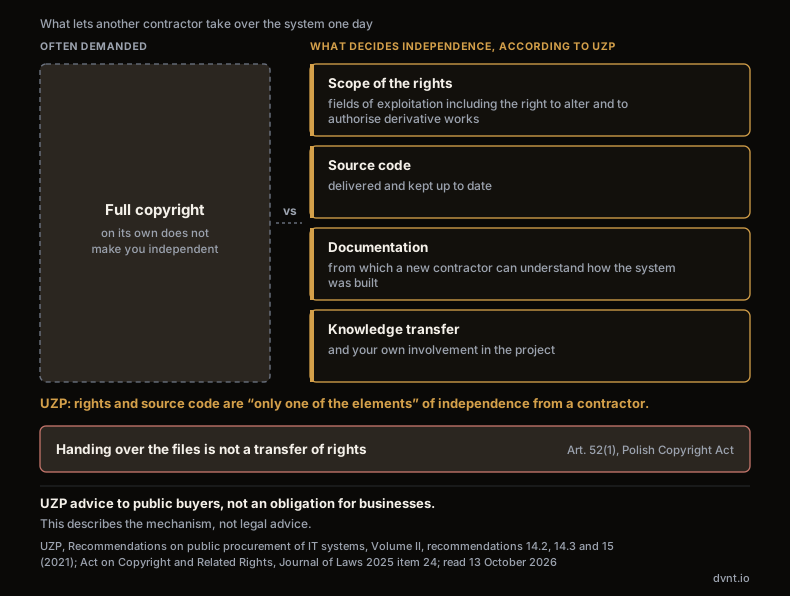
UZP suggests three questions to settle before you decide. Translated to a business:
- Does what you need already exist as a standard solution, in whole or in part? If the contractor assembles the system from its own ready-made modules, a licence for those modules is the natural arrangement.
- How critical is the system to the business? The more critical, the more it matters that another contractor can take it over.
- How long will you use it, and will you keep changing it? If the answer is "for years, and yes", you need the right to alter it and the code, whatever you call the form of the contract.
And one question for the contractor: does it hold the rights from everyone who will write the code? The Act gives the employer the economic rights in a program created by an employee in the course of their duties under an employment relationship, unless the contract says otherwise (Article 74(3)). A developer on a B2B contract (self-employed, invoicing the contractor) or on a civil-law contract is not an employee, however — and a contractor cannot pass to you rights it never acquired.
Software development contract — six clauses to check before you sign
The contract has to describe how you will work together, because contractual penalties and the right to withdraw cannot replace that. UZP warns public buyers in Volume I: if a draft contract concentrates on "formal instruments such as penalties, the allocation of liability, the possibility of withdrawing from the contract" but does not properly describe how the work will be carried out, then "instead of helping the parties, it may become a source of disputes".
Six clauses to check in every IT implementation contract:
- Subject and way of working — what is being built and at what cadence: stages with acceptance, or sprints with a review after each one. The pricing model has to fit it.
- Acceptance — the criteria, the procedure and who tests. The Civil Code obliges the client to accept work delivered in accordance with the contractor's obligation (Article 643), so what "in accordance" means has to be written down before work starts. We cover acceptance testing in the article on how to make an app.
- Changes of scope — who raises them, who approves them in writing, how they are priced and how they move the deadline.
- Payment for accepted parts — when the work is delivered in parts with a fee for each, the fee is due "on performance of each partial delivery" (Article 642 § 2).
- Rights, code, documentation and access — fields of exploitation including the right to alter, delivery of the source code, documentation for a successor, and the repository, servers and domain in your name.
- Exit and maintenance — the client may withdraw from a contract for specific work at any time before the work is completed, but "paying the agreed fee", less what the contractor saved by not finishing (Article 644); unless the contract changes this, it is not a free exit. The Code also gives you tools when the delay is so great that the work is unlikely to be finished on time (Article 635), when the work is being done defectively or contrary to the contract — including having another person correct it at the contractor's cost and risk (Article 636) — and for defects in the work (Article 638). Who fixes bugs after launch, and how fast, belongs in a maintenance agreement; the article on SLAs explains how to read the clauses on response times and availability.
First meeting with a software development company — questions that test the process
The portfolio shows what the contractor has built; the conversation has to show what working together will look like for several months. Ask every contractor you are comparing the same questions.
The same order for every contractor you compare · left to right
1 · Registers
The company’s financial statements from the KRS
CEIDG entry for a sole proprietorship
Bank account on the VAT white list
2 · Reviews
Sort by ranking, not by default
A sponsor is not a ranking
Read the text of reviews, not the average
A reference from a similar project
3 · Conversation
A sprint of one month or less, a working piece after each
Definition of Done
Who exactly writes the code
A test environment and a repository from the start
Rights from every developer
4 · Contract
Way of working
Acceptance
Changes of scope
Payment for accepted parts
Rights, code and documentation
Exit and maintenance
- How often will I see a working piece? The Scrum Guide describes sprints as "fixed length events of one month or less", and the increment "must be usable". "We'll show you when we're done" is the wrong answer.
- Who on your side runs the project, and who will write the code? Named people you meet before you sign — the team in the sales presentation is not always the project team.
- Will I get a test environment from the first sprint, and the code in my own repository after every stage? If not, the first time you see the application and the code will be at acceptance.
- How do you define "done", and how do you write down the acceptance criteria? In Scrum this is the Definition of Done, "a formal description of the state of the Increment when it meets the quality measures required for the product". Ask what is in it: tests, code review, documentation.
- What will you do if we change priorities halfway through? The answer shows whether the contractor understands the pricing model it is proposing.
- Do you hold the rights from everyone who writes the code, and in whose name will the repository, servers, domain and accounts be? All of it should be yours, or handed over to you in writing.
- What happens after launch? Who fixes bugs, how fast and on what terms.
- What would you leave out of the first version? A contractor that can talk you out of part of the scope is thinking about your budget. We explain how to define a first version in the article on the MVP.
Our advice: before the whole project, order a smaller, paid piece of work — a workshop or an analysis. For a fraction of the budget, you learn how the contractor works.
This is how we work ourselves: in two-week sprints with a review after each one, and with the client's access to a test environment from the first sprint. The source code goes into the client's repository on GitHub or GitLab after every stage of the project, and at handover the client receives technical documentation (README, ADR). We start a web application project with a paid discovery and specification stage that takes two to three weeks. What we build, and how, is described on our software development page.
Warning signs in a software development proposal
None of these signs rules a proposal out, but each one is a question you have to ask before you sign. This is our assessment based on the mechanisms described above, not a statistic:
- a quote without assumptions and exclusions — you do not know what is in the price and what will turn out to be a change of scope;
- a lump sum without a change procedure — every change becomes an argument about whether it was in the price;
- "full copyright" without fields of exploitation, the right to alter, the code and the documentation — an empty promise;
- access to the repository only "once everything is paid" — throughout the project you do not know what is really being built;
- no questions about your time and about acceptance — the contractor is not planning for the cooperation it will need;
- one person without whom nothing happens, in a company that presents itself as a team.
How to choose a software development company — where to start
Pick two or three companies, check them the same way and compare the answers, not the presentations. Registers and reviews first, the reviews read for their content. Then the same questions to every company. Finally the draft contract to a lawyer — especially the clauses on changes of scope, acceptance, rights, code and exit.
Frequently asked questions about choosing a software development company
What is a software house?
A software house is a software development company that builds software to order for outside clients (custom or bespoke software development) and is responsible for delivering a working whole, from analysis to deployment and maintenance. It differs from a digital agency in its starting point (a product, not marketing), and from a freelancer in that it works as a team.
Freelancer or software house — which should I choose?
A freelancer works well for a small, well-described task or as support for your own team. For an application that is to run your business processes, what matters more is who is responsible for the whole and what happens when one person drops out of the project. A sole proprietorship is entered in CEIDG and does not file financial statements with the KRS, so you cannot check its financial health the way you check a company.
Do I need full copyright in the code?
Not always. The Polish Public Procurement Office (UZP) advises public bodies buying IT systems not to strive at all costs for the full economic copyright, because it narrows the circle of contractors and raises prices. Independence depends on the scope of the rights including the right to alter, on delivery of the source code, documentation and knowledge transfer. Handing over the files does not transfer the rights (Article 52 of the Act on Copyright and Related Rights). Read the contract clauses with a lawyer.
What is a time and material contract?
Time and material (T&M) is a pricing model in which — according to the definition of the Polish Public Procurement Office — the fee is calculated on the basis of the actual time spent on the work and the rate in the contract. You can change the direction of the work, but the risk that the scope grows is on your side, so you need someone who sets priorities and regular time reports.
Does the Clutch ranking show the best companies?
Mainly it shows activity in the directory: the ranking rests, among other things, on the number, quality and recency of reviews. On directory pages sponsors are listed above non-sponsors, so switch the sorting to Clutch Rank and read the reviews of projects similar to yours.
How much does it cost to have a software house build an application?
As much as follows from the scope, the pricing model and the assumptions behind the quote. The article on app development cost explains what a price is made of and how to read a quote, and you can work out an indicative cost for your own scope in the web application cost calculator.
Related articles
Web and mobile apps
Flutter vs React Native — which to choose for a business app, and when to stay native
Flutter vs React Native: how they differ, what they cost in Polish quotes, what Apple and Google force you to update every year, and when native is better.
Costs and working with a vendor
Software audit and application audit — what the diagnosis checks, what the report contains and how long it takes
Software audit of an app or SaaS: what it checks, what the report should contain, how long it takes and how to read the result. How it differs from code review.
Web and mobile apps
Progressive web app (PWA): what it is, how it works and when it replaces a native app
What a PWA is, how the manifest and service worker work, installing it on Android and iPhone, push notifications since iOS 16.4, and what a PWA still cannot do.
Costs and working with a vendor
How to make an app for your business: six stages and what you decide at each one
How to make an app for your business with a contractor: brief, prototype, sprint development, UAT and go-live. How long each stage takes and where you decide.
Web and mobile apps
How to make a mobile app for your business — from choosing a platform to publishing it
How to make a mobile app for a business: Android vs iOS in Poland, native or cross-platform, a DUNS number, closed testing and app review.
Web and mobile apps
Custom software or off-the-shelf — how to decide in a company
Off-the-shelf or custom software is decided one function at a time. Four questions, a five-year TCO with our own prices, and vendor lock-in both ways.
Looking for a vendor for a web application?
Tell us what the application should do and for whom. We start a project with a paid discovery and specification stage, so the quote covers a written scope, not guesswork.