
Costs and working with a vendor16 min read3132 wordsRedakcja dvnt
Software audit and application audit — what the diagnosis checks, what the report contains and how long it takes
Software audit of an app or SaaS: what it checks, what the report should contain, how long it takes and how to read the result. How it differs from code review.
A software audit, in the technical sense, is a one-off diagnosis of an application that has to settle one decision: fix it point by point, fix it in stages, rewrite a part of it, or buy it or not. The result is a report of findings, each with evidence, a severity and an effort estimate, which you can take to any contractor. A verdict on "code quality" settles nothing on its own — what matters is what follows from it for your budget and your plans.
This article is for the owner of a business or a product whose web, mobile or SaaS application is slow, breaks with every change, or was left behind by a contractor you no longer work with. It is also for anyone about to buy an application or invest in one. If you are looking for a software licence audit (a check of the licences for the programs a company uses) or for audit management software (the tools auditors run their own audits in), those are different things; the first section below separates them. An audit of a company's whole IT, including security and regulation, is covered in our article on the IT audit, and building and developing applications from scratch in the guide to web and mobile applications.
Software audit — four different services under one name
Under the name "software audit" sit four services that differ in the question they ask, in who carries them out and in what they produce: a licence audit, code review, an application security audit and a technical diagnosis. Before you ask for a quote, establish which one you mean, or you will be comparing four different products. The same words also name audit management software, a category of tools for auditors rather than a service, which this article does not cover.
A software licence audit answers the question of whether a company holds licences for all the programs it uses and uses them within their terms. The result is a list of programs and licensing gaps. It is a separate specialism that we do not offer, and this article does not return to it.
Code review is an ongoing process inside a development team: before a change reaches the application, someone other than its author reads it. The result is a corrected change, not a report. More on it in the next section.
An application security audit answers the question of whether the application can be attacked. It usually combines a review of the code with tests of the running application, and it is ordered against a standard. For web applications the reference point is the OWASP ASVS, version 5.0.0, published on 30 May 2025. Among the uses of the standard, OWASP lists procurement: "Provide a basis for specifying application security verification requirements in contracts". Name the standard in the order, and two audits of the same application become comparable. We do not carry out penetration tests or security audits; for those we recommend specialist partners.
A technical diagnosis of an application is what most owners mean when they say "application audit" or "code audit". It answers the question of whether the application can be developed further, what is slowing it down and what the repair would cost. It is ordered by a product owner, a board, an investor or a buyer, and the result is a report with findings and a plan. A source code review can therefore belong to either a security audit or a technical diagnosis, depending on the question you ask. We carry out the diagnosis as part of technology consulting.
One name, four services · establish which one you mean before you ask for a quote
| Service | The question | When it is ordered | Result | Carried out by |
|---|---|---|---|---|
| Software licence auditoutside our scope | The questiondo we hold licences for the programs we use? | When it is ordereda licence inspection, putting affairs in order | Resulta list of programs and licensing gaps | Carried out bylicensing specialists |
| Code review | The questionis this one change good? | When it is orderedwith every change to the code | Resulta corrected change, no report | Carried out bya programmer on the team other than the author |
| Application security auditpartners | The questioncan the application be attacked? | When it is orderedbefore launch, at a client's request, after an incident | Resulta list of vulnerabilities with severity | Carried out bypenetration testers and security auditors against a standard, e.g. OWASP ASVS 5.0.0 |
| Technical diagnosistechnology consulting | The questioncan the application be developed, what slows it down, what does the repair cost? | When it is orderedslow performance, failures after changes, a change of contractor, a purchase or investment | Resulta report with findings, decisions and an action plan | Carried out bya technology consultant or architect |
CONCLUSIONA source code audit is a scope, not a separate service: it belongs to a security audit or to a diagnosis.
What is code review — and why it does not replace a code audit
Code review is a review of every single change to the code before it is accepted; a code audit is a one-off look at the whole application and its history. One does not replace the other (the distinction is ours). Google, which sets out its rules in the public Engineering Practices guide, defines code review like this: "A code review is a process where someone other than the author(s) of a piece of code examines that code". The reviewer looks, among other things, at the design of the change, how it works, its complexity, tests, naming, comments, style and documentation.
The aim is not perfection. According to Google's standard of code review, "the primary purpose of code review is to make sure that the overall code health of Google's code base is improving over time". The same document describes a mechanism that every owner of an application knows after a few years of development: "codebases degrade through small decreases in code health over time, especially when a team is under significant time constraints". Code does not break overnight. It degrades in small steps, whenever a team under deadline pressure accepts a change "for now".
The practical conclusion: if your application was built without code review, nobody stopped those small steps, and an audit has more to find. Code review prevents; an audit diagnoses a state that has already been reached. The Google guide also reminds us that "there is no such thing as “perfect” code—there is only better code". A good audit therefore assesses direction and risk, not flawlessness — a report that lists every imperfection confuses the quality of the code with its usefulness to the business.
Before you choose a new contractor, ask whether they do code review, who does it, and whether it is part of their definition of "done". Other questions that test a contractor's process are collected in our article on how to choose a software development company.
When to order an application audit — four situations and four questions
An application audit makes sense when you are facing a decision, and each of the four typical situations has its own question that the report has to answer. An audit without a question ends in a report without a decision: a long list of remarks and no indication of what to do about them.
- The application is slow. The question: where is the bottleneck and what does it cost to remove it. Sometimes it is a single inefficient database query, sometimes an architecture that did not foresee today's number of users. The scale of the repair depends on which it is.
- Every change breaks something. The question: why are changes risky — because of missing tests, manual deployment, tangled code, or all of them at once.
- The application was left behind by a contractor. The question: can what I have be developed with a different team, and is it even mine. How to take over a project step by step is described in our article on taking over an IT project, and whether you may change the code after a contractor in the section on rights to the code. If the project got stuck before acceptance, start with the article on a delayed IT project.
- You are buying an application or investing in one. The question: which risks and costs do you buy along with it. This is technical due diligence. In our offer its result is a report on the state of the technology, the risks, the cost of maintenance and a modernisation plan — material for an investor or a buyer.
A fifth, rarer situation is an incident: a serious failure or a leak. Once the event itself is contained, the question is what failed in the architecture and the processes, and what to change so that it does not happen again.
Write your question down in one sentence before the first conversation with an auditor. The scope, the time and the areas from the next section that get the most attention all depend on it.
What a technical diagnosis of an application checks
A technical diagnosis checks nine areas and in each looks for evidence, not opinion: whether what is in the repository is what runs in production, whether a change can be deployed safely, and what it costs to maintain what exists. The list comes from our practice. There is no single mandatory list of areas for a technical audit of an application, which is why you should write the scope into the order.
- Repository versus production. Whether the code in the repository is what actually runs for your users. If not, every further analysis assesses a different application from yours.
- Build and deployment. Whether the application can be built and deployed from instructions, or only from one person's memory.
- Tests. Not only whether they exist, but whether they catch anything. Google's guide asks a question worth borrowing: "Will the tests actually fail when the code is broken?" Tests that always pass give a false sense of safety.
- Code complexity. In the same guide, “Too complex” usually means “can’t be understood quickly by code readers.” It can also mean “developers are likely to introduce bugs when they try to call or modify this code.” For you these are the places where every change takes a long time and often breaks something.
- Dependencies and their age. Which libraries and frameworks the application is made of, which of them are out of support, and what it costs to update them. In the OWASP Top 10:2025 the software supply chain (A03 Software Supply Chain Failures) is a risk category of its own. The diagnosis shows what is out of date; hunting for specific vulnerabilities in dependencies is already a security audit. How to count the cost of maintaining an application is described in our article on how much it costs to build an application.
- Architecture and data. What parts the system consists of, where and how it stores data, and what will happen under higher traffic or a feature nobody foresaw.
- Performance — measured. Response times and load measured on real data or a copy of it, not the impression from a single click.
- Errors and logs. Whether the application records errors, whether anyone reads them, and whether you learn about a failure from monitoring or from a customer. What to promise customers about this in a contract is covered in our article on the SLA.
- Access, ownership and documentation. Whose name the hosting, domain and repository accounts are registered in and, in a mobile app, the developer accounts in the app stores and the keys used to sign each new version. Whether there is documentation from which another team can understand why something was built the way it was. Gaps in this area are a typical source of vendor dependence, which we describe in our article on vendor lock-in.
Not every area weighs the same in every situation. For a slow application, measurement and data say the most; for failures after changes, tests and deployment; after a contractor, the match between repository and production, and access; and before a purchase, dependencies, ownership and maintenance costs.
Nine areas of the diagnosis · dot = the area that weighs most in that situation
| Area of the diagnosis | The application is slow | Every change breaks something | Left by a contractor | Purchase or investment |
|---|---|---|---|---|
| 1Repository versus production | The application is slow | Every change breaks something | Left by a contractor | Purchase or investment |
| 2Build and deployment | The application is slow | Every change breaks something | Left by a contractor | Purchase or investment |
| 3Tests | The application is slow | Every change breaks something | Left by a contractor | Purchase or investment |
| 4Code complexity | The application is slow | Every change breaks something | Left by a contractor | Purchase or investment |
| 5Dependencies | The application is slow | Every change breaks something | Left by a contractor | Purchase or investment |
| 6Architecture and data | The application is slow | Every change breaks something | Left by a contractor | Purchase or investment |
| 7Performance | The application is slow | Every change breaks something | Left by a contractor | Purchase or investment |
| 8Errors and logs | The application is slow | Every change breaks something | Left by a contractor | Purchase or investment |
| 9Access, ownership, documentation | The application is slow | Every change breaks something | Left by a contractor | Purchase or investment |
CONCLUSIONOur practice, not a measurement. Areas without a dot are checked too, they just get less time.
Part of the diagnosis does not require reading code. The DORA research programme (not to be confused with the EU's Digital Operational Resilience Act, which shares the acronym) describes five software delivery performance metrics, among them deployment frequency and change fail rate, that is "the ratio of deployments that require immediate intervention following a deployment". For you these are two simple questions to the team: how often do you deploy changes, and after how many deployments in the last quarter did something have to be fixed immediately. The symptom "every change breaks something" then becomes a number you can track before the audit and after the repair. DORA also writes that, according to its research, "speed and stability are not tradeoffs" — so deploying less often is not in itself a way to have fewer failures (our reading). How to collect such numbers from invoices, tickets and one conversation with the team, without access to the code, is described in our article on technical debt.
What an application audit report should contain
The report from an application audit is meant to be a tool for making a decision: it starts with a summary and a recommendation, and every finding has evidence, a consequence, a severity and an effort estimate. Length is not a measure of quality. What matters is whether, on the basis of the report, you can set the order of the work and commission it from any contractor.
A good report has five parts.
- An executive summary of one or two pages. The answer to the question from the order, the recommended decision and the three to five most important risks. If you do not know what to do after reading the summary, the report has not done its job.
- Findings in one pattern. Each has six fields: the observation, the evidence (a fragment of code, a log, a measurement result, a description of the configuration), the consequence for the business, the severity, the recommendation and the effort estimate. A finding without evidence is an opinion, and a finding without a consequence for the business is a curiosity for a programmer.
- A staged plan. The order of the work with dependencies: what has to be done first so that the next steps are safe, and what can wait.
- Scope and limitations. What was not checked and why, for example for lack of access to production or to part of the code. A report without this part suggests that everything was checked.
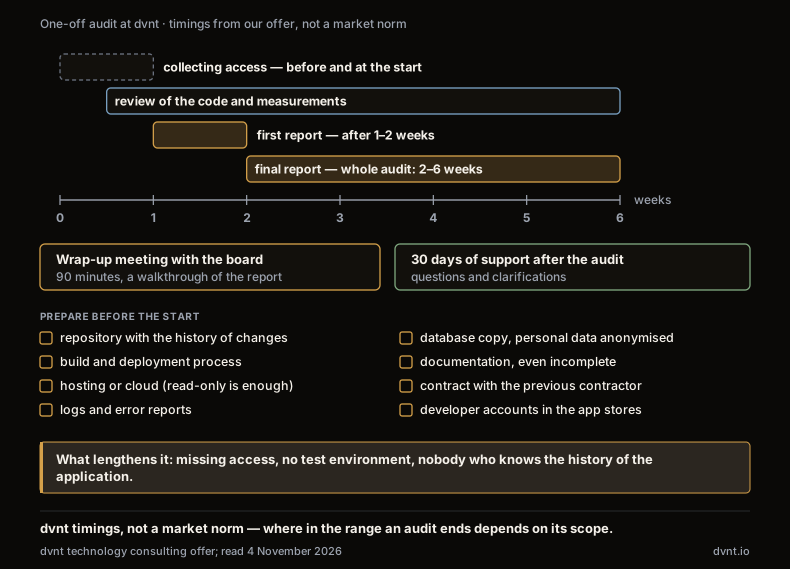
- What remains after the report. In our offer these are the documented architectural decisions, an action plan with concrete steps, a wrap-up meeting with the board (90 minutes) and 30 days of support after the audit for questions and clarifications.
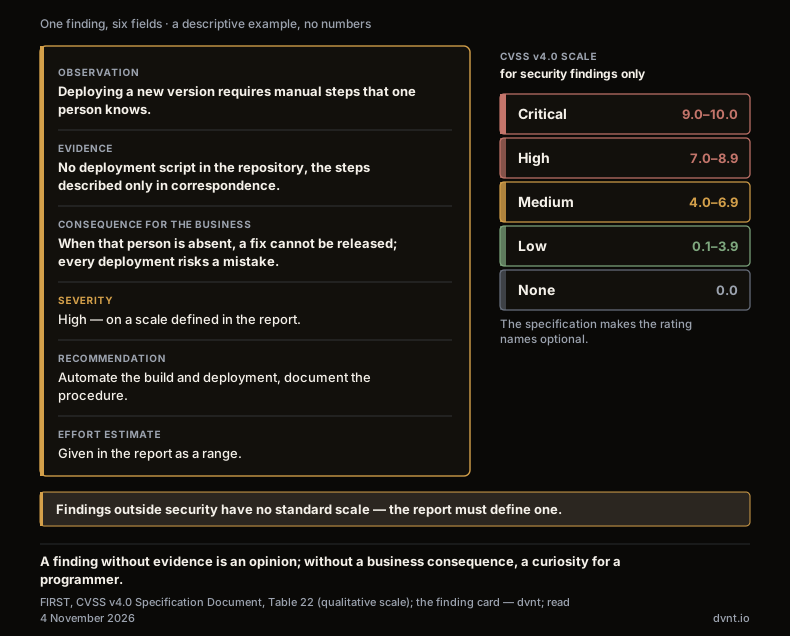
Severity is where reports diverge most often. For security findings there is a recognised scale: CVSS v4.0, from the organisation FIRST, described by its authors as "an open framework for communicating the characteristics and severity of software vulnerabilities". Its qualitative scale has five ranges: None (0.0), Low (0.1–3.9), Medium (4.0–6.9), High (7.0–8.9) and Critical (9.0–10.0), and the specification notes that the use of these names is optional. For performance, debt or architecture there is no such standard scale. That is why the report has to define its own at the start: what "critical" means and what "to be planned" means (our conclusion). Without a definition, "high severity" means two different things from one auditor and another, and you can neither compare two reports nor check a year later whether the situation has improved.
How long an application audit takes and what to prepare before it starts
A one-off audit with us takes 2–6 weeks, and you receive the first report after 1–2 weeks. In our experience, collecting access usually takes more time than reading the code. These are the timings from our technology consulting offer, not a market norm. Where within that range your audit lands depends on the scope and on three things you can put in order before the start.
The first is access: the repository, the hosting and the logs are often on the accounts of different people, and each has to be obtained separately. The second is the lack of a test environment in which the application can be run and measured without risk to users. The third is the lack of a person who knows the history of the application and can explain why something was done the way it was. Each of them can be removed before the audit starts.
Prepare:
- access to the code repository with the full history of changes (read-only is enough),
- access to the build and deployment process, or a description of how deployment looks today,
- access to the hosting or the cloud, even if only read-only,
- logs and error reports from the last months,
- a copy of the database, preferably with personal data anonymised,
- whatever documentation exists, even if incomplete,
- the contract with the previous contractor, if the application was left behind by one — it determines what you may do with the code; what such a contract should contain is covered in our article on choosing a software development company,
- for a mobile application: access to the developer accounts in the app stores.
How to read the result of an audit — three verdicts and three red flags
The result of an audit comes down to one of three verdicts. A report that points to none of them should be sent back with questions.
- Keep and fix point by point. The application is in good shape and the problems are local: one bottleneck, missing tests in one module, an outdated library.
- Fix in stages. The problems are systemic, but the foundation will hold. The report sets the order: first what reduces the risk of every following change, that is tests and deployment, then the rest.
- Rewrite a part. A chosen module is no longer worth repairing. When a rewrite makes sense and when it is an escape from the problem is covered in our article on refactoring or rewriting.
Three red flags say that a report is not fit for a decision:
- A list without priorities. Dozens of remarks in the order in which they were found, without severities and without a plan. You do not know where to start, so you do not start.
- Findings without evidence. "The code is of low quality" without saying where and with what consequence. Such a sentence can be neither checked nor priced.
- "Everything must be rewritten" without a calculation of the cheaper option. A rewrite is sometimes the right answer, but the report has to show why repair in stages will cost more or will not work.
There is also a conflict of interest that has to be named plainly. The diagnosis is often done by a firm that could then do the repair — us included. That is why in our offer the report is yours: you may use it regardless of any further collaboration, hand it to another contractor, use it in due diligence or show it to investors. You can commission the repair from anyone. If you commission it from us, we take it on as a project — from analysis through implementation to long-term care — not as one-off hourly fixes in another agency's application. How a price for the repair emerges from the report is described in our article on pre-implementation analysis.
Where to start
Start with one sentence: which question the audit has to answer and who will read the report. Then gather the access from the list above and check whose name the accounts are registered in. Ask the team or the current contractor for two numbers: how often you deploy, and how many deployments in the last quarter needed an immediate fix. With these three things, the first conversation about an audit ends in a concrete scope, not a generic quote. If you do not know whether you need a technical diagnosis or a security audit, let us talk — we will tell you which service fits your question and, if it is the other one, what kind of auditor to look for.
Frequently asked questions about application audits
What is a software audit?
In the technical sense it is a one-off diagnosis of an application that has to settle a specific decision: fix it point by point, fix it in stages, rewrite a part of it, or buy it or not. The result is a report of findings, each with evidence, a severity and an effort estimate. The same name is also used for a software licence audit, which checks the licences for the programs in a company — a different service.
How does a code audit differ from code review?
Code review is an ongoing process: every change to the code is read by someone other than its author before it is accepted, and according to Google the aim is for the overall health of the code to improve over time. A code audit is a one-off look at the whole application and its history, ending in a report. Code review prevents the code from deteriorating; an audit diagnoses a state that has already been reached.
How long does an application audit take?
With us a one-off audit takes 2–6 weeks, and the first report is ready after 1–2 weeks. These are our timings, not a market norm. They are lengthened most by missing access, the lack of a test environment and the lack of a person who knows the history of the application.
Does an application audit cover security?
A technical diagnosis checks, among other things, which dependencies are out of date, but it is not an application security audit. That is ordered separately, against a standard such as OWASP ASVS 5.0.0, and carried out by penetration testers and security auditors. We do not carry out such audits — we recommend partners.
Can I commission the repair from a different firm than the one that did the audit?
Yes, and a good report should make that possible: findings with evidence, severities and effort estimates, a plan of stages and a description of what was not checked. In our offer you may use the report regardless of any further collaboration.
What should I prepare before an application audit?
One sentence with the question the audit has to answer, and access: the repository with the history of changes, the deployment process, hosting or cloud, error logs, a copy of the database with anonymised personal data, documentation, the contract with the previous contractor and, for a mobile application, the developer accounts in the app stores.
Related articles
Web and mobile apps
Flutter vs React Native — which to choose for a business app, and when to stay native
Flutter vs React Native: how they differ, what they cost in Polish quotes, what Apple and Google force you to update every year, and when native is better.
Costs and working with a vendor
How to choose a software development company — checks, contract and rights to the code
How to choose a software development company in Poland: reading reviews and rankings, checking KRS filings, fixed price vs time and material, and code rights.
Web and mobile apps
Progressive web app (PWA): what it is, how it works and when it replaces a native app
What a PWA is, how the manifest and service worker work, installing it on Android and iPhone, push notifications since iOS 16.4, and what a PWA still cannot do.
Costs and working with a vendor
How to make an app for your business: six stages and what you decide at each one
How to make an app for your business with a contractor: brief, prototype, sprint development, UAT and go-live. How long each stage takes and where you decide.
Web and mobile apps
How to make a mobile app for your business — from choosing a platform to publishing it
How to make a mobile app for a business: Android vs iOS in Poland, native or cross-platform, a DUNS number, closed testing and app review.
Web and mobile apps
Custom software or off-the-shelf — how to decide in a company
Off-the-shelf or custom software is decided one function at a time. Four questions, a five-year TCO with our own prices, and vendor lock-in both ways.
Not sure what state your application is in?
Tell us what is happening with it and what decision you face. We will agree on one question the diagnosis is to answer. If a simpler route will do, we will say so plainly.