
Costs and working with a vendor15 min read2973 wordsRedakcja dvnt
Legacy software after the vendor is gone — rewrite, wrap or leave it
The vendor is gone, the system stays. What to do in 30 days, what Polish law lets you change in the code, and when to wrap or rewrite — a 36-month comparison.
Legacy software becomes a problem not when it turns ten, but when nobody except the system itself knows how it works. Most often that happens on the day the vendor disappears: the company that built it stops answering the phone, is wound up or "no longer does that technology". At that point "should we rewrite it?" is only the third question. First you recover access and knowledge, then you check whether the system can be split into parts at all, and only then do you compare three roads: leave it, wrap it or rewrite it.
This article belongs to our section on technical debt and legacy system modernisation. The general question of whether and when to pay down debt in any system, and the four roads for old software, are covered in the article on technical debt. Here we deal with one specific case: the system that stays when the contractor is gone.
Legacy software in a business — when it is a problem and when it is just old
Age on its own is not a reason to change a system. The reasons are three signals, and each of them can be checked without reading any code.
- Nobody inside or outside the company can explain how the system calculates what it calculates. Discounts, stock levels, payment terms: they work, but only the code knows the rules. If the only person who understood them was the contractor's developer, that knowledge left the company with them.
- The vendor of the system, or of the platform it runs on, no longer releases security patches. The system keeps running, but every new vulnerability stays open for good.
- Every change happens next to the system rather than in it. A spreadsheet someone retypes data into every week, emails sent by hand, an export to a file that another person uploads somewhere else. A workaround is a sign that changing the system itself has become too expensive or impossible.
A ten-year-old system without these three signals is simply a mature system. One of them is enough for age to start costing money. The scale of that cost is easy to see in data published by the US federal government. According to GAO-25-107795 of 17 July 2025, federal agencies "have typically reported spending about 80 percent" of their IT budgets on operating and maintaining existing systems. Of the 69 systems it reviewed, the GAO named the 11 most in need of modernisation: eight of them use outdated programming languages, and four run on unsupported hardware or software. These are figures from the US federal administration, not from Polish companies, so we carry over only the mechanism: as systems age, most of the budget goes to keeping what exists running rather than to change.
The same signal appears in the criteria of our technology consulting offer: the current system is 5–15 years old, with no support and no documentation. That is a typical starting point for a conversation, not an exception.
The vendor is gone — what to do in the first 30 days
For the first 30 days after the vendor disappears, you are not deciding what to do with the system. You are collecting everything without which no decision will be possible, before something stops working. The order matters: access expires faster than knowledge, and knowledge faster than documents.
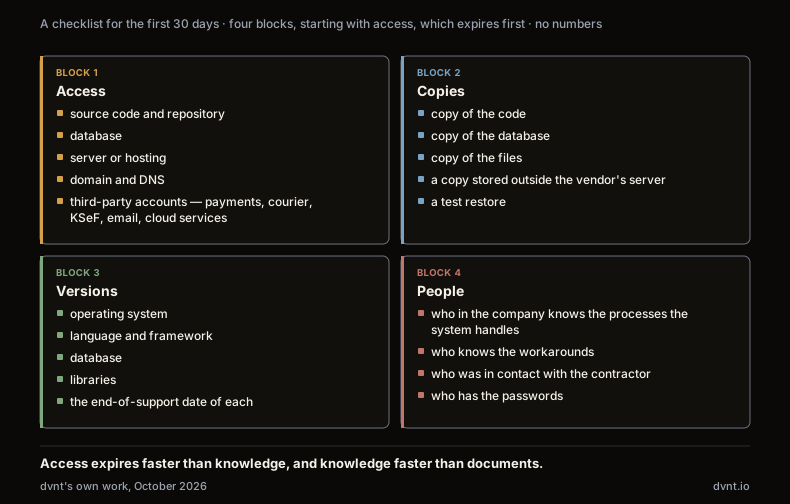
Access. Check whether you have the source code and access to the repository, or only a running installation. Find out whose account the server, the hosting and the domain are registered to. If they are on the contractor's account, the system will disappear together with it once the payments lapse. The same applies to the third-party accounts through which the system talks to the outside world: the payment provider, the courier, outgoing email, the National e-Invoicing System (KSeF). Move every account to the company and change the passwords.
Copies. Make a copy of the code, the database and the files, somewhere that does not depend on the former contractor. A backup that nobody has ever restored is only an assumption, so restore it once on a separate server. How to organise that is covered in our article on backups and recovery.
Versions. Write down what the system runs on: the operating system, the programming language and its version, the framework, the database, the main libraries. Next to each item, note the date on which the vendor ends support. This list shows how much time you have, and whether you have more than a few months at all.
People. Write down who in the company knows the processes the system handles, who knows the workarounds and who dealt with the contractor. That knowledge is the only documentation you have. If it leaves the company with one person, every road that follows, including leaving the system as it is, becomes more expensive.
Can you change the code after the contractor has gone — rights to the code
Polish copyright law lets you do more with a program than is usually assumed, but less than you need to keep developing it. The rest is decided by your contract with the contractor. We quote the provisions below from the consolidated text of the Copyright and Related Rights Act (ustawa o prawie autorskim i prawach pokrewnych) (Journal of Laws (Dziennik Ustaw) 2025, item 24, read in the Sejm API on 28 October 2026). The quotations are our translation; only the Polish text is binding.
The starting point: the economic rights to a program written by an employee as part of their duties belong to the employer, unless the contract provides otherwise (Article 74(3)). Code from an outside contractor is a different situation: here the contract decides. Protection covers the form in which a program is expressed, not the ideas and principles on which it is based (Article 74(2)). The author's economic rights to a program include the right to "translate, adapt, rearrange or make any other changes to the computer program" (Article 74(4)(2)). Without an assignment of rights or a licence that covers changes, developing the system further requires the rightholder's consent.
The Act does, however, provide exceptions. Under Article 75(1), unless the contract provides otherwise, reproducing and changing the program does not require the rightholder's consent where it is necessary to use the program in accordance with its intended purpose, "including to correct errors by a person who has lawfully come into possession of it". Under Article 75(2), consent is also not needed for: making a backup copy, where it is necessary to use the program; observing, studying and testing how the program works in order to learn its ideas and principles, by a person entitled to use it; and reproducing the code or translating its form (that is, decompilation) to the extent necessary to achieve interoperability with other programs, provided the three conditions in points (a) to (c) are met. Information obtained in this way may not be used for purposes other than interoperability, nor to create a program substantially similar in form (Article 75(3)). Article 76 states that contractual provisions contrary to Article 75(2) and (3) are void.
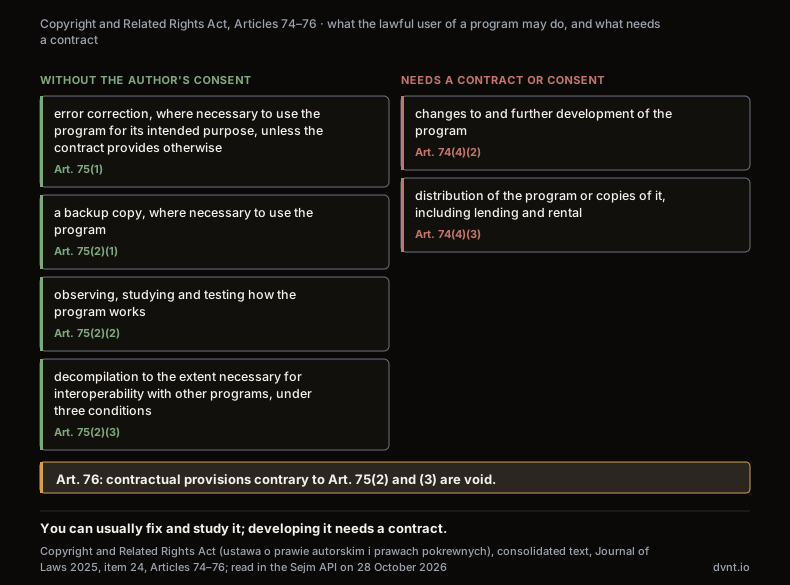
In practice this means: you can usually fix a bug that prevents you from using the system, unless the contract rules it out. You can also study how the system works and read the structure of its data in order to connect a new program to it. What you cannot do without an assignment of rights or a licence is develop it with new features. That is why the first document you look for after the vendor disappears is the contract: does it assign the economic rights, for which fields of exploitation (pola eksploatacji), and does it cover the source code? What the contract should contain is covered in our guide to choosing a software development company.
End of support 2026–2027 — the dates that closed the loopholes
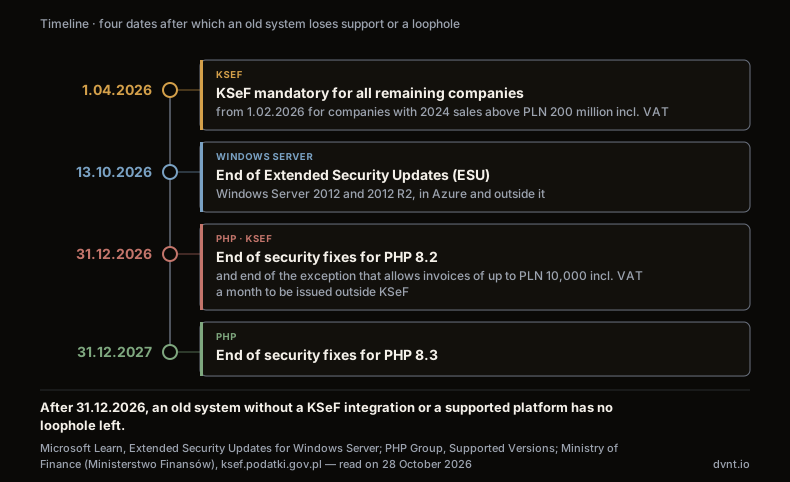
The turn of 2026 and 2027 closed several loopholes that let old systems keep running unchanged. If your system depends on any of these components, the deadline for a decision has already passed.
- Windows Server 2012 and 2012 R2. Microsoft describes the Extended Security Update (ESU) program as "a last resort option for customers who need to run certain legacy Microsoft products past the end of support". According to Microsoft's documentation, the three-year ESU program for both versions ended on 13 October 2026, both in Azure and outside it. After that date Microsoft stops providing updates.
- PHP 8.2. According to the PHP Group, each PHP branch gets two years of full support and two years of security fixes only. For PHP 8.2, security fixes were released until 31 December 2026. The next limit is 31 December 2027, when PHP 8.3 loses support.
- KSeF. According to the Ministry of Finance (Ministerstwo Finansów), the obligation to issue invoices in the National e-Invoicing System (Krajowy System e-Faktur, KSeF) applied from 1 February 2026 to companies whose sales exceeded PLN 200 million (including VAT) in 2024, and from 1 April 2026 to all others. Until 31 December 2026, invoices could still be issued outside KSeF if their total including VAT did not exceed PLN 10,000 in a month. An old sales system without a KSeF integration has therefore lost its last loophole.
How to connect your own system to KSeF, and which of the routes to choose, will be covered in a separate article on KSeF integration. Why debt can no longer be paid off in instalments once support ends is covered in more depth in the article on technical debt. For a system without a vendor, the dates have one more meaning: nobody but you is keeping track of them on your behalf.
Leaving the old system as it is — what it really costs
Leaving an old system in place is a decision, not inaction, and like any decision it has a cost and a review date. Leaving it makes sense when the process the system supports does not change, the system is not reachable from the internet, and its platform is still supported or the system can be cut off from the network. The classification of migration strategies published by AWS lists "retain" and "retire" alongside moving and rebuilding. Retiring makes sense when there is no business value in keeping the application, and the aim is to eliminate the cost of maintaining and hosting it. It is a classification written for migrating to the AWS cloud, not an industry standard, but it is a reminder that "do nothing" and "switch it off" are roads too.
The cost of leaving it consists of five items, and you can put your own number against each one:
- Maintenance. Hosting, licences and someone who responds to failures. Without a vendor the question is: who does that now, and for how many hours a month?
- Risk without patches. Once support ends, every new vulnerability stays open. You do not see the cost until an incident, but you can estimate it: what does a day of downtime cost, and what does a leak of customer data cost?
- Workarounds. Who spends how many hours a month retyping data, stitching reports together in a spreadsheet or sending by hand what the system should do itself?
- The single point of knowledge. If only one person understands the system, their holiday, illness or departure stops part of the company.
- Every new integration. A new online shop, a new courier, a new payment provider: with an old system, each connection like that is a separate, expensive project.
If the total of these items grows from year to year, leaving the system stops being the cheapest road, even when nothing has to be paid up front. Record what you are leaving, why, and when you will revisit the decision.
Wrapping it — an API and an anti-corruption layer instead of a rewrite
Wrapping means the old system stays the source of data, while everything new (interface, reports, integrations) is built next to it and talks to it through one controlled layer. Microsoft calls it an anti-corruption layer: a facade or adapter between subsystems that do not share the same semantics. The layer translates the requests of one system into the language of the other. The pattern was first described by Eric Evans in his book on domain-driven design. Microsoft notes that legacy systems often have "convoluted data schemas or obsolete APIs", and the layer protects new code from having to adapt to them.
In a company it looks like this. The old warehouse system keeps managing stock levels. A new layer reads them from its database or interface and makes them available in a usable form to the online shop, the sales team's app and the management reports. When the old system is eventually replaced, only the layer changes, and the shop and the app keep working.
Wrapping has one hard requirement: you need access to the database or to an interface through which data can be read and written. You do not need the right to develop the old code, because the layer does not change the program; it only works with it. That is why it is often the first road that remains legally open after the vendor has gone. How to choose the way systems are connected, and when integration starts eating the budget, will be covered in a separate article on system integration.
Replacement in stages — and when the strangler fig pattern will not work
Replacement in stages, known as the strangler fig pattern, moves the behaviour of the old system to the new one piece by piece until the old one can be switched off, but only if the old system can be split. Martin Fowler, following Ian Cartwright, Rob Horn and James Lewis, lists four activities this requires: "Understand the outcomes you want to achieve", "Decide how to break the problem up into smaller parts", "Successfully deliver the parts" and "Change the organization to allow this to happen on an ongoing basis".
The second activity is the hardest. Fowler writes that you need to identify "seams" you can insert into the system: places where it can be cut so that parts can be replaced independently. A well-designed system would already have such seams, but such systems, in his words, "are unicorns". In an old system from an absent vendor you usually look for them in the data and the processes: orders separately, invoices separately, the customer portal separately. The extra cost is a transitional architecture: code that lets the old and new systems work together and that disappears once the replacement is finished.
Microsoft's documentation states when the pattern "might not be suitable": when "requests to the back-end system can't be intercepted", or when you cannot access the legacy system's source code and it "has no other integration point that you can change, such as its database". That is exactly the "vendor is gone" situation.
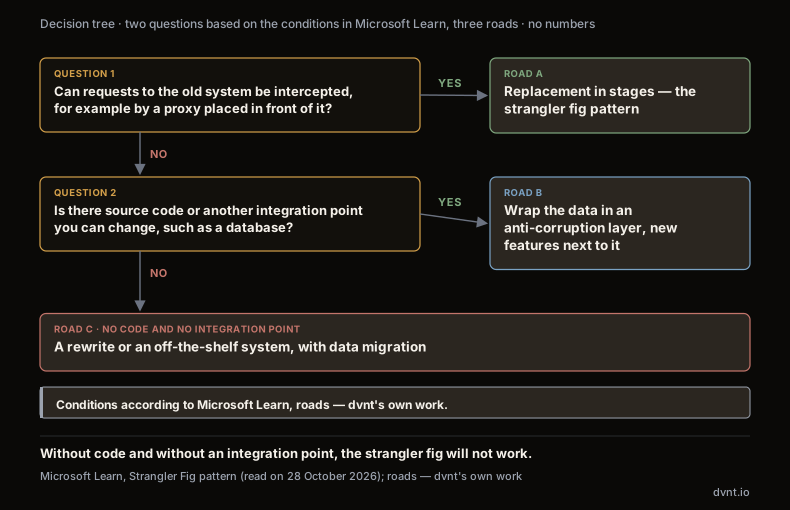
If you cannot intercept requests but you do have the database, wrapping remains: new features next to the system, the old system as the source of data. If you have neither the code nor access to the data beyond the program's screens, what remains is a rewrite, or buying an off-the-shelf solution and moving the data across, even if only through an export.
Rewriting legacy software — what the cost really includes
Rewriting a system from scratch costs much more than writing new code, because the largest part of the work is reconstructing what the old system does and nobody ever wrote down. In its classification, AWS calls refactoring, or re-architecting, an application "the most complex of the migration strategies". For a system with no vendor and no documentation, the cost includes five items:
- Reconstructing the business rules. Every discount, exception and rounding rule has to be found in the old system: in the code if you have it, or by observing how it behaves and talking to people if you do not.
- Data migration. The data has to be cleaned, moved and checked to make sure it gives the same results after the move.
- Running in parallel. For a while two systems run side by side, and people check that the new one calculates the same way as the old one.
- Training. The team learns the new tool during normal work.
- A change freeze. While the rewrite is under way, no new features go into the old system, and the new one does not have them yet.
A variant of rewriting is buying an off-the-shelf system instead of building your own, which the AWS classification calls "repurchase". It makes sense when the process is standard for the industry: accounting, warehousing, sales. How to decide is covered in our articles on custom versus off-the-shelf software and on ERP systems. The arguments against rewriting from scratch, including practitioners' views, are collected in the article on technical debt.
Comparing the three roads over 36 months
Compare the three roads over the same 36-month horizon and the same seven components, and the difference between them stops being a matter of opinion. Three years is long enough for a rewrite to be delivered and for the cost of leaving the system to grow noticeably. Fill each cell with your own numbers: team hours, invoices, an estimate of risk.
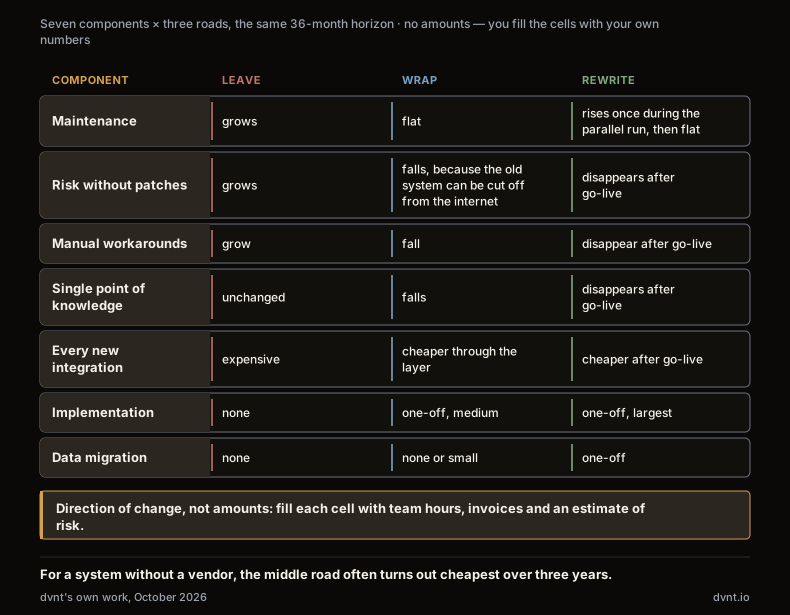
For a system without a vendor, a comparison like this often shows that the middle road is the cheapest over three years: wrap the old system, cut it off from the internet, move out whatever changes most often, and replace the rest only once you find the seams. That is not a rule. If you have no access to the data, or the platform has lost support and cannot be cut off from the network, a rewrite wins.
With decisions like these we start from a diagnosis, not from a technology recommendation: access, rights and feasibility first, then the numbers, and the decision is yours, regardless of who later implements the road you choose.
Frequently asked questions about legacy software
What should we do when the company that built our system no longer exists?
Secure access and knowledge first, not a decision about the future of the system. In the first 30 days, move the server, the domain and the third-party accounts (payments, courier, KSeF) to your company, make a copy of the code, the database and the files outside the contractor's infrastructure and try restoring it, list the software versions with their end-of-support dates, and write down who in the company knows the processes and the workarounds. Only on that basis do you choose between leaving, wrapping and rewriting.
Can we fix bugs in a program without the author's consent?
Usually yes, with conditions. Under Article 75(1) of the Polish Copyright and Related Rights Act, unless the contract provides otherwise, changes necessary to use the program in accordance with its intended purpose, including error correction by a person who has lawfully come into possession of it, do not require the rightholder's consent. Developing new features is the author's right (Article 74(4)(2)), so the contract decides. This is a description of the rules, not legal advice.
May we rewrite a system for which we have no source code?
You may build a new system that does the same job, but you may not copy the form of the old program. The Act lets you observe, study and test how a program works in order to learn its ideas and principles (Article 75(2)(2)), and the ideas and principles of a program are not protected (Article 74(2)). Information obtained through decompilation, however, may not be used to create a program substantially similar in its form of expression (Article 75(3)). Before rewriting, show the contract to a lawyer.
How much does it cost to keep an old system running?
The sum of five items: maintenance (hosting, licences, responding to failures), the risk of running without security patches, the hours spent on manual workarounds, dependence on the one person who knows the system, and the cost of every new integration. You can put your own number against each one. If the total grows from year to year, leaving the system stops being the cheapest road.
What is the strangler fig pattern?
It is a way of replacing a system in stages: new features are built next to the old system, and its behaviour is moved to the new one piece by piece until the old one can be switched off. According to Microsoft, the pattern might not be suitable when requests to the old system cannot be intercepted, or when there is no access to its source code and no other integration point, such as a database.
When does rewriting a system from scratch make sense?
When you have neither the code nor access to the data through which the system could be wrapped, or when the platform has lost support and cannot be cut off from the internet. The cost then covers not only new code but also reconstructing the business rules, data migration, running two systems in parallel, training and a change freeze. A variant is buying an off-the-shelf system when the process is standard for the industry.
Related articles
Costs and working with a vendor
Project discovery before an app repair or extension — why a reliable quote needs a paid analysis
A quote for repairing or extending an app without seeing the code is a wide estimate. What a paid project discovery delivers and why the report is yours.
SaaS and your own product
Code refactoring or a rewrite? What to do with a SaaS MVP that cracks under its first customers
SaaS MVP cracking under its first customers? Code refactoring, staged replacement or a rewrite: what to measure first and what a rewrite really costs.
Costs and working with a vendor
Software audit and application audit — what the diagnosis checks, what the report contains and how long it takes
Software audit of an app or SaaS: what it checks, what the report should contain, how long it takes and how to read the result. How it differs from code review.
Costs and working with a vendor
Taking over a software project from the previous vendor — what to hand over, what to check in two weeks, fix or rewrite
A software handover checklist for taking over a project: what the previous vendor hands over, a two-week review, then fix or rewrite.
Web and mobile apps
Flutter vs React Native — which to choose for a business app, and when to stay native
Flutter vs React Native: how they differ, what they cost in Polish quotes, what Apple and Google force you to update every year, and when native is better.
CRM, ERP and business systems
Warehouse management system (WMS) — what it is, what JPK_MAG(2) changes in 2027 and when you need one
Warehouse management system (WMS) in Poland — what it is, how it differs from stock software and ERP, what JPK_MAG(2) changes in 2027, phone or scanner, cost.