
Costs and working with a vendor16 min read3177 wordsRedakcja dvnt
Project discovery before an app repair or extension — why a reliable quote needs a paid analysis
A quote for repairing or extending an app without seeing the code is a wide estimate. What a paid project discovery delivers and why the report is yours.
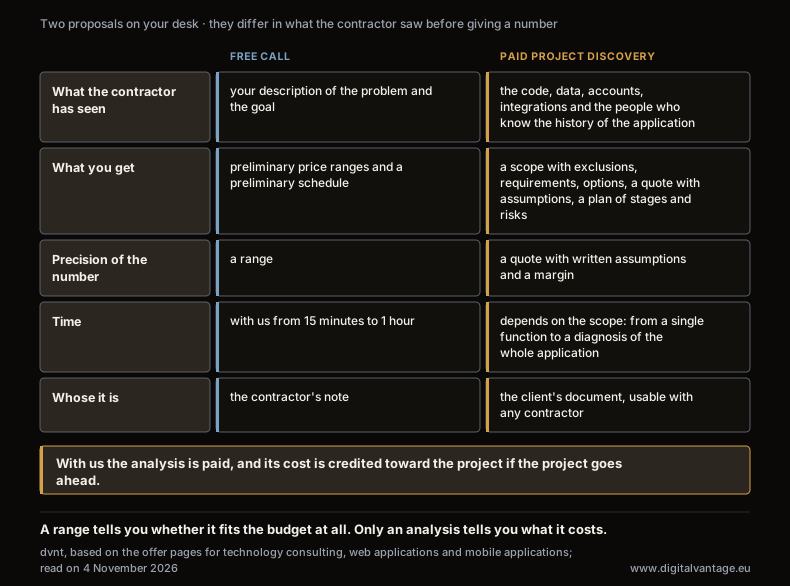
Project discovery is paid work done before an application is repaired or extended: the contractor learns the goal, the current state and the requirements, and hands back a scope, options, a plan and a quote with its assumptions written down. If you have an application or a SaaS product that has to be repaired or extended, there are probably two proposals on your desk: a "free quote after a call" and a "paid analysis before the quote". They are not two versions of the same service. The first gives a range, the second a number the contractor can answer for, and the difference comes from how much is known about the project at the moment of estimating. We write as a software house that proposes a paid analysis itself, so we have an interest in this. Treat two sections as a safeguard for that reason: the one saying the report belongs to you and has to work with any contractor, and the one on when an analysis is unnecessary.
Project discovery — what it is and how it differs from a free quote
Project discovery is business analysis and requirements analysis carried out before a change to a system, while a free quote is an estimate based on what the contractor heard in a conversation. Both end in a number, but only one of them stands on checked facts.
Business analysis has a definition. IIBA defines it in the BABOK Guide as follows: "The practice of enabling change in the context of an enterprise by defining needs and recommending solutions that deliver value to stakeholders". Requirements analysis has a standard: ISO/IEC/IEEE 29148:2018 covers the engineering of requirements throughout the life cycle of systems and software and, in the publisher's description, "defines the construct of a good requirement". Project discovery combines the two before a specific decision: what we change, why, and what it will cost.
In practice you will meet three variants. For a new application, this stage is usually called the discovery phase; what comes out of it is described in our article on how an application is built (stage one). For an extension of an existing application, the analysis establishes how the new function will fit into what already works. For a repair, the analysis starts with a diagnosis of the current state, because without it nobody knows what actually needs repairing. This article is about the last two. If you are looking for a pre-implementation analysis of an ERP system, that is a different kind of project: an off-the-shelf system fitted to the company's processes, which we describe in the article on the ERP system.
The difference between a call and an analysis is easiest to show with our own process. A free call in technology consulting lasts from 15 minutes to 1 hour and ends, among other things, with "preliminary price ranges + schedule". That is an honest result for a call: the contractor knows your description of the problem, but has not seen the code, the data or the accounts. A range answers the question "is this within my budget at all". It does not answer the question "what will it cost", and it should not pretend to.
Why a software development estimate without analysis is wide — the cone of uncertainty
The margin of a software development estimate depends on how much is known about the project itself, not on how long the contractor spent calculating. Steve McConnell described this best in the model known as the cone of uncertainty; the company he founded, Construx, publishes an excerpt from his book "Software Estimation" on it (read on 4 November 2026).
According to the excerpt: "Estimates created at Initial Concept time can be inaccurate by a factor of 4x on the high side or 4x on the low side (also expressed as 0.25x, which is just 1 divided by 4)". The total range from the highest to the lowest estimate is 16x. And if an organisation commits to a price early: "If an organization commits at Initial Concept or Product Definition time, it has a factor of 2x to 4x error in its estimates." The cone narrows as unknowns are resolved. In an iterative approach, moving from an approved product definition to completed requirements and a finished user interface design reduces the variability "from 4x to 1.6x", and a significant narrowing happens "during the first 20-30% of the total calendar time for the project".
Two more sentences from the same page matter most. The first: "The only way to reduce the variability in the estimate is to reduce the variability in the project itself." The second is about who is estimating: the cone shows the error of skilled estimators, and it is easy to do worse, but not better. "It isn't possible to be more accurate; it's only possible to be more lucky."
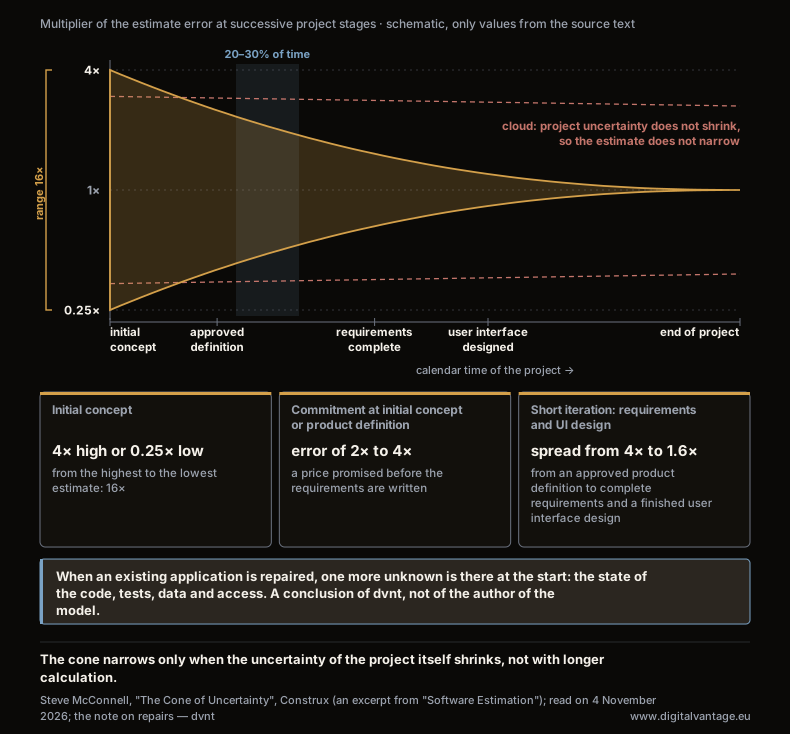
A practical point follows: an extra week spent on the quote changes nothing if nobody resolves the unknowns during that week. What changes the estimate is work that does resolve them: writing the requirements, deciding what we will not do, looking into the code. That is project discovery.
For you as the client, this means that comparing two quotes from calls says little. If both were prepared without access to the code, the difference between them lies within the spread McConnell describes, and the more optimistic quote usually wins rather than the more accurate one. That is our conclusion from his model, but it is easy to test: ask both contractors which assumptions they made. A quote without written assumptions is a range presented as a single number.
So what does a contractor do who quotes a fixed price after one call? There are two ways out. They can add a buffer for the unknowns, in which case you pay for a risk that may not exist. Or they can price the optimistic variant, in which case the difference comes back later as a dispute about what was in scope. Neither is dishonest in itself, but in both you pay for the missing knowledge. How to recognise this in an offer, by the assumptions, exclusions and change procedure, is covered in the article on what building an application costs, in the part on reading a quote.
Estimating the repair of an application — what the contractor does not know until they look
When an existing application is repaired or extended, there is an unknown that a project from scratch does not have: the state of what has already been built. McConnell describes projects from the beginning. Carrying the cone over to a repair is our conclusion, but it is easy to check by looking at what a contractor does not know after a call.
- Whether the code in the repository is the code running in production. If not, the first fix may undo changes that nobody remembers.
- Whether there are automated tests. Without them every fix has to be checked by hand, and a change in one place can break something in another.
- How old the dependencies are. A framework past its end of support means part of the work is an upgrade before the actual repair begins. The bill for that debt is described in the article on technical debt.
- What state the data is in. Duplicates, missing fields and manual corrections in the database change the scope of every function that uses the data.
- What the integrations are. Payments, invoices, couriers, customer systems: each is a separate technical contract, often undocumented.
- Who knows the history. If the author of the code has left, part of the knowledge has to be reconstructed from the code itself.
- Who has access to the accounts. The repository, the server, the domain, the cloud accounts. Without access there is neither a diagnosis nor a repair; how to avoid that situation is covered in the article on vendor lock-in.
Each of these answers changes not only the number of hours but also the way of working. An application without tests needs a different plan from one with tests, and an application without access to production first needs control recovered, which we describe in the article on taking over a software project.
For an extension the same mechanism works on a smaller scale. The cost of a new function depends less on how it sounds in the description and more on the place in the code it touches. "Add an export to a file" can mean one new button or a rebuilt data model if the needed information is scattered over several tables. A call does not show that. What a technical diagnosis checks, and how, step by step, is covered in the article on the software audit.
What you get from a project discovery — the list of deliverables
A project discovery is worth its price only if it ends in documents from which a project can be built; otherwise it is a paid conversation. The pre-implementation documentation is those documents taken together. Here are nine deliverables you can ask for.
- A description of the goal and the problem. Which business decision the project is to enable and how you will know it has succeeded.
- The current state. The result of the diagnosis: what works, what does not and what is a risk, backed by evidence rather than opinions.
- Requirements. Functional and non-functional, written so that they can be verified (examples below).
- A scope with exclusions. McConnell writes that defining requirements, "again, including what you are not going to do", reduces variability further. A list of what we are not doing protects you from a dispute about scope. The method of setting priorities is described in the article on the MVP.
- Options with a calculation. For example: repair point by point, repair in stages, or rewrite part of the application, each with its cost and risk. When a rewrite makes sense is covered in the article on refactoring and rewriting.
- A quote with assumptions. A number plus the list of assumptions it stands on and what would change it.
- A plan of stages and a schedule. What is built in which order and what you receive after each stage.
- Risks. What can go wrong, how large the impact is and what we do to prevent it.
- Technical decisions in writing. In our mobile applications offer this is the ADR (architecture decision record): a short note on what we chose, why, and what the alternatives were.
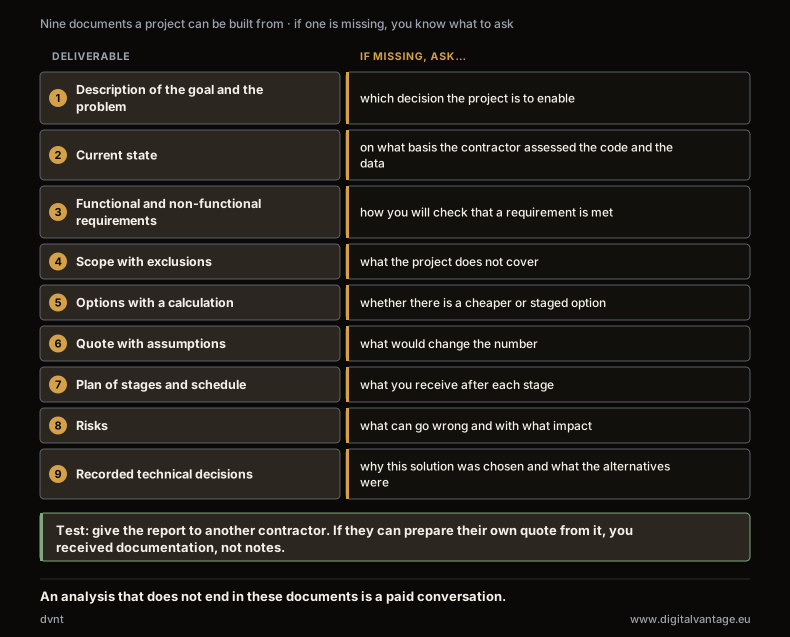
If you are looking for an example of a pre-implementation analysis, this list is one, in the form of a table of contents. Its content depends on the application, but when an item is missing, you know what to ask about.
Requirements analysis — functional and non-functional requirements, with examples from a repair
A functional requirement says what the system does; a non-functional one says how well it does it. An example of a functional requirement (ours): "After an order is approved, the system issues an invoice and emails it to the customer." An example of a non-functional one (ours): "The order list opens in under X seconds with Y records in the database." Non-functional requirements also cover accessibility, security, maintainability and compliance. A few more examples from a repair, also ours: "Deploying a fix does not interrupt the application during customers' working hours" (availability), "User passwords are stored only as cryptographic hashes" (security), "A new developer runs the application locally by following the repository's instructions within one day" (maintainability).
In a repair, the problem is usually the non-functional requirements. The functions mostly exist (the invoice is issued, the list opens), only too slowly, with errors or not always. Requirements analysis of the functions alone therefore says little, and "the application should run faster" is not a requirement, because it cannot be checked. A good requirements specification states the target in numbers: how much time, under what load, in what conditions. Only such a requirement can be priced and accepted.
The report is yours — and should work with any contractor
You pay for the analysis, so its result should be yours and usable with any contractor, including a competitor of the one who prepared it. Only then is a paid analysis not a way of tying you to one firm.
This is how we write it into our own offer. For the audit in technology consulting: "You can use the report independently of further cooperation." For mobile applications: "The client can go with the documentation to another developer - it's a discipline, not a trap." The conflict of interest is built in here, though, and it is better to name it. A contractor who prepares an analysis wants the project afterwards. They have a reason for the scope to come out large and the solution to suit their own team. With us the analysis is paid and its cost is credited toward the project if the project goes ahead. That reduces your risk but does not remove the conflict. What removes it is a report that works without us.
A simple test: give the report to another contractor and ask whether they can prepare their own quote from it. If they have to start from scratch, you received notes, not documentation. That is why you should ask for requirements written in measurable terms, a scope with exclusions and the assumptions of the quote, not just a number.
A promise in an offer is one thing, a clause in a contract another. Under the Copyright and Related Rights Act (ustawa o prawie autorskim i prawach pokrewnych) (consolidated text, Journal of Laws (Dziennik Ustaw) 2025, item 24), a contract transferring economic copyright "requires written form on pain of nullity" (art. 53), and a contract transferring economic copyright, or a licence, "covers the fields of exploitation expressly listed in it" (art. 41(2)). The quotations are our translation; only the Polish text is binding. What follows in practice: if the report is to be yours, the clause about the rights to it should be in writing and should say what you may do with it, for example copy it, change it and pass it to another contractor. We do not decide whether a particular report is a work under copyright law; a clause in the contract removes that doubt from your side.
The same applies to the code that will be written after the analysis. What to check in the contract with the contractor is covered in the article on choosing a software house, and what to do when the rights to an old system are unclear, in the article on legacy software after the vendor is gone.
When a paid project discovery is not needed
A paid analysis is unnecessary when the uncertainty simply is not there: the change is small, well described and the contractor knows the application. Then a quote after a call is accurate enough, and the analysis would cost as much as the change itself.
Three questions help you judge. Is the change small, and can it be described in a few sentences with a criterion by which you will know it works? Does the contractor know this application because they built or maintain it? Would the cost of the analysis be comparable to the cost of the change itself? If you answer "yes" to the first two, an ordinary quote is enough. If the change is small but the contractor is new, the third question decides. If the change is large, unclear or concerns an application nobody new has seen yet, the analysis pays for itself.
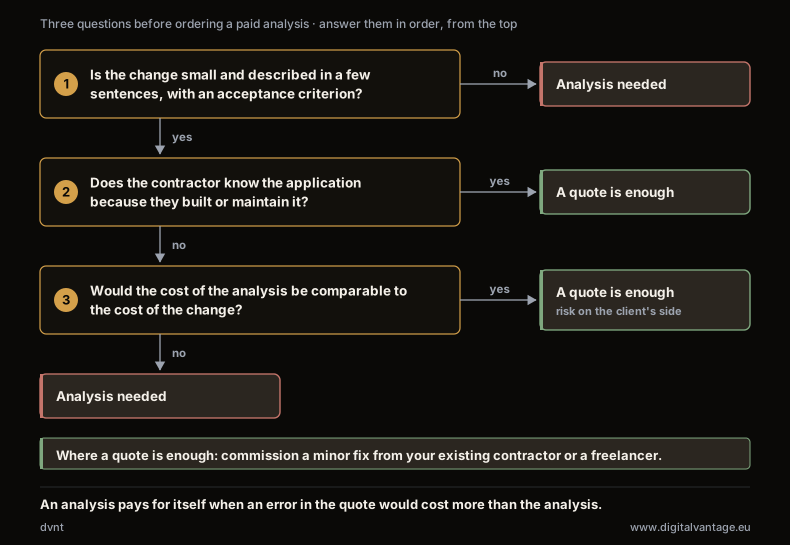
An honest word about our own boundary: we do not take single fixes in an application built by another firm. In the web applications offer we say plainly that we work on a project basis rather than hourly for minor jobs. If you need to fix one form, your existing contractor or a freelancer who knows the technology will do it better. An analysis makes sense where the change is large enough that an error in the quote would cost more than the analysis.
There is one more situation in which an analysis will not help: when the decision has already been made and you only need a contractor for a written, closed scope. Then it is enough to compare offers for that scope. If, on the other hand, a project is already under way and slipping, the question is more about the contract with the current contractor; we write about it in the article on a delayed IT project.
How to order a project discovery — five questions for the offer
A good offer for an analysis answers five questions before you pay. If any of them has no answer, you do not know what you are buying.
- Which decision is the analysis meant to enable? Repair or rewrite, extend or replace the system, how much it will cost. An analysis without a question ends in a report without a conclusion.
- What is the scope, and what access does the contractor need? Which parts of the application, which integrations, and whether access to production, a copy of the database, the repository and the logs is needed. Every day of waiting for access moves the deadline.
- How long will it take? There is no single norm. The time depends on whether you are analysing one function or diagnosing the whole application, on the number of integrations and on how fast the contractor gets access and people to talk to. Ask for a deadline and for what would extend it.
- What exactly will I receive? Compare the answer with the list of nine deliverables above.
- Whose will the documents be, and can I take them elsewhere? The answer should be in the contract, not only in the conversation.
One more question is whether the analysis is the first stage of the project. We describe this in our software development offer: the first stage is "a closed scope, a separate price, a working result". Such a stage is also the cheapest way to test a contractor before you entrust them with the whole budget, as we write in the article on choosing a software house. A software development estimate made after such a stage stops being a bet on who guessed better.
Where to start
Start with one sentence about the symptom and one about the goal. For example: "The customer panel loads more and more slowly and customers are leaving" and "We want to handle twice as many orders without a new team". Then check whether you have access to the repository, the server, the domain and the cloud accounts, and write down who knows the history of the application. If you have documentation, a contract with the previous contractor or a list of customer reports, have them ready: part of the knowledge will not need to be reconstructed from the code, and the analysis can start from what is unknown.
You can bring this to a call. We will tell you whether an analysis makes sense in your situation, what scope would be reasonable, and whether an ordinary quote is enough. There is more on web applications in our guide to web and mobile apps for businesses.
Frequently asked questions about project discovery
What is project discovery?
It is paid work before the repair, extension or building of an application: the contractor learns the goal, the current state and the requirements, and hands back a scope with exclusions, options, a quote with written assumptions and a plan of stages. It combines business analysis, which the BABOK Guide defines as defining needs and recommending solutions, with requirements analysis.
Why is a project discovery paid?
Because it is work that changes the accuracy of the quote. In McConnell's cone of uncertainty an estimate narrows only when the uncertainty of the project itself shrinks, and that takes writing the requirements, setting the scope and looking into the code. A free call gives a range. With us, the cost of the analysis is credited toward the project if the project goes ahead.
How long does a project discovery take?
There is no single norm. The time depends on the scope (one function or a diagnosis of the whole application), the number of integrations and how quickly the contractor gets access to the code, data and accounts and to the people who know the system's history. Ask the contractor for a deadline and for a list of what would extend it.
Can I commission the implementation from a firm other than the one that did the analysis?
You should be able to. A good analysis is written so that another contractor can prepare their own quote from it. To make sure of that, put the rights to the report in the contract in writing and list what you may do with it, including passing it to another contractor. Under the Polish Copyright Act, a transfer of economic copyright needs written form (art. 53) and the fields of exploitation have to be listed (art. 41(2)), so settle the contract details with a lawyer.
What is the difference between functional and non-functional requirements?
A functional requirement says what the system does, for example that it issues an invoice after an order is approved. A non-functional one says how well it does it: how fast, under what load, how securely and how easily it can be maintained. In a repair the problem is usually the non-functional requirements, and they are the ones to write down in numbers.
What is the discovery phase?
That is what a project discovery before building a new application is usually called. For a repair or an extension of an existing application, the analysis also starts with a diagnosis of the current state, because without it nobody knows what actually needs repairing.
Related articles
Costs and working with a vendor
Legacy software after the vendor is gone — rewrite, wrap or leave it
The vendor is gone, the system stays. What to do in 30 days, what Polish law lets you change in the code, and when to wrap or rewrite — a 36-month comparison.
SaaS and your own product
Code refactoring or a rewrite? What to do with a SaaS MVP that cracks under its first customers
SaaS MVP cracking under its first customers? Code refactoring, staged replacement or a rewrite: what to measure first and what a rewrite really costs.
Costs and working with a vendor
Software audit and application audit — what the diagnosis checks, what the report contains and how long it takes
Software audit of an app or SaaS: what it checks, what the report should contain, how long it takes and how to read the result. How it differs from code review.
Costs and working with a vendor
Taking over a software project from the previous vendor — what to hand over, what to check in two weeks, fix or rewrite
A software handover checklist for taking over a project: what the previous vendor hands over, a two-week review, then fix or rewrite.
Web and mobile apps
Flutter vs React Native — which to choose for a business app, and when to stay native
Flutter vs React Native: how they differ, what they cost in Polish quotes, what Apple and Google force you to update every year, and when native is better.
CRM, ERP and business systems
Warehouse management system (WMS) — what it is, what JPK_MAG(2) changes in 2027 and when you need one
Warehouse management system (WMS) in Poland — what it is, how it differs from stock software and ERP, what JPK_MAG(2) changes in 2027, phone or scanner, cost.