
Artificial intelligence24 min read4677 wordsRedakcja dvnt
AI chatbot for website — when it makes sense and what it costs
AI chatbot for website: when it makes sense, what one conversation costs in zloty, what the AI Act requires it to say, and GDPR and UODO guidance for Poland.
An AI chatbot for a website makes sense when customers ask about things already described on your site, and you have someone who takes over the harder conversations and regularly reads what the chat answered. The model's reply itself costs next to nothing. A wrong reply costs more, because the company answers for it — just as it does for the text on its website.
This article walks through the decisions behind an AI chatbot for website visitors: how an AI chat differs from an old rule-based bot, when it pays off and when a form is enough, how it draws on your own content, what one conversation costs, what it has to say about itself since 2 August 2026, and what can go wrong. The worked example is "Vi", the chat that has run on the Polish-language version of this site, digitalvantage.pl, since October 2026 and answers in Polish. Prices and price lists in the text are as of 29 October 2026.
What is a website chatbot — and how an AI chat differs from an old rule-based bot
A chatbot is a program that holds a text conversation with a visitor in a window on the page and replies on its own, with no person on the other end — at least until a consultant takes the conversation over. Under that one name, though, sit two different tools.
- A rule-based bot is a tree of buttons and ready-made answers: "Pick a topic → Delivery → How long does shipping take?" It answers only with what someone wrote in advance, so it will not make anything up, but it will not understand a question from outside the tree either. In its guidelines on Article 50 of the AI Act the European Commission excludes exactly such simple mechanisms from the duty to tell people about AI: "simple non-AI automated response mechanisms (e.g., traditional out-of-office emails, rule-based quick message answers)" (paragraph 30).
- An AI chat replies in its own words because a language model writes the reply. It understands a question asked a hundred different ways, but it can also write something you never published. That is why a good AI chat on a website answers from the company's own content — pages, price list, FAQ — and not from the model's general knowledge. This way of working is called RAG, and we describe the mechanism in our article on RAG.
Alongside both stands live chat, where a person replies. An AI chat increasingly blends the two: a bot starts the conversation and a consultant finishes it when the matter needs one.
Two other things are easy to confuse with a chat on a website. AI assistants for staff, such as ChatGPT, Copilot or Gemini, help a team with work inside the company; we compare them in our article on ChatGPT, Copilot and Gemini for business. An AI agent carries out actions in systems itself — creates an order, changes a booking, sends a document; how it differs from a chat is covered in our article on the AI agent. A chat on a website talks to customers and answers their questions. How these kinds of AI fit together in a company is shown in our guide to AI in business.
The Polish Ministry of Digital Affairs (Ministerstwo Cyfryzacji), describing the obligations under the AI Act, lists these tools together: the duty to tell people they are dealing with a machine applies to "among others chatbots, virtual assistants and automated user-service systems" (gov.pl, 3 August 2026, our translation). The European Commission's Q&A on Article 50 likewise names "chatbots, AI agents, and avatars" (Commission Q&A). So the label — chatbot, virtual assistant, AI chat — does not change the obligations. What changes them is who replies: a person, a rule or a model.
AI chatbot for website: when it makes sense, and when a form is enough
An AI chat makes sense when four conditions hold at once; if any is missing, a form, a good FAQ page or live chat will serve you better. These conditions are our own decision frame, not an industry standard.
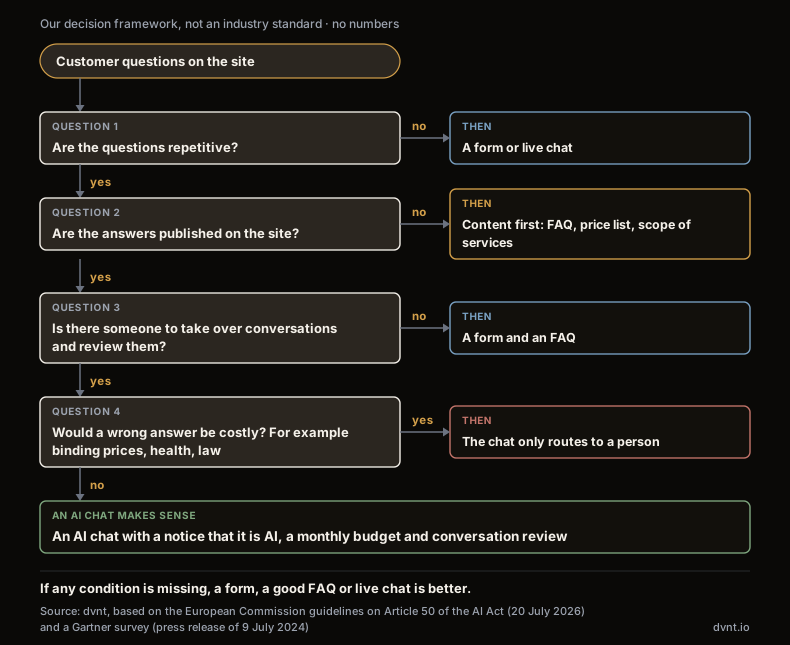
- The questions repeat. An AI chatbot for customer service earns its keep when the same question comes up dozens of times: scope of services, lead times, prices, how to get to you, paperwork. In Gemius's "E-commerce in Poland 2026" survey, 43% of online shoppers found chatbots particularly useful for quick answers to simple questions such as opening hours or delivery status (online survey, July 2026). That is data about shops and consumers; more in our article on customer service in e-commerce.
- The answers are already published. The chat answers from your content. If the price list, scope of services and terms of cooperation are not on the site, the chat has nothing to answer from — it will say "I don't know" or start guessing. Then content is the first step, not a chat.
- There is a person to take over and someone to review. In December 2023 Gartner asked 5,728 customers about AI in customer service. 64% would prefer that companies didn't use AI in customer service, and the top concern was that it would get more difficult to reach a person (press release, 9 July 2024). The release does not name the countries in the sample, and the answers are declarations, not behaviour. The conclusion is not "AI puts customers off" but this: the route to a person must be visible and real.
- A wrong answer is not costly. A chat that gets the opening hours wrong is a nuisance. A chat that quotes a binding price, a diagnosis or legal advice is a risk. On such topics the chat should only direct people to a person.
When an AI chat does not make sense: there are a few questions a month, each needs individual analysis, or the content is missing from the site. Then a form with well-chosen fields and a quick reply from a person will do more. If the problem is repetitive work behind the scenes of customer service — retyping data, reminders, order statuses — start with process automation, because a chat will not solve that. A customer service chatbot complements a good website; it does not replace one.
How an AI chat answers from your site: the RAG chatbot
An AI chat does not "learn" your company: for each question it searches your content for a few matching passages and writes the reply only on that basis. That is good news, because no model has to be trained — your content just has to be up to date. And it is bad news, because the chat is exactly as good as your texts. An out-of-date price list on the site is an out-of-date answer in the chat, delivered politely and with confidence.
In our chat the rules for what enters the knowledge base are written into the site's code:
- Only what the visitor can see goes in. Published articles, pages and glossary entries, not hidden from search engines and not redirected elsewhere. Drafts never go in — a draft autosaved every few seconds cannot reach the chat.
- Unpublishing removes the knowledge. When you withdraw a page, redirect it or hide it, the chat stops using it. Without this rule the chat would quote an offer that no longer exists.
- An update on every publication. Nobody "trains" the chat by hand. A change on the site reaches the knowledge base in the background, and publishing does not wait for the chat.
- Only the Polish edition goes in. Our site has editions for other markets, with different prices and different law. If all of them went into one knowledge base, the chat could quote one market's price list to a customer in another. For now the chat covers the Polish edition only — which is also why you will not find Vi on this English edition.
Where it makes sense, a reply contains a link to the source page. The visitor can check where the chat got the information, and in the conversation log you can see which page it used — the fastest way to find a text that needs fixing. Technically this is RAG: content is split into passages and a search picks the ones closest to the question. The details, including chunking and document permissions, are in our article on RAG.
The takeaway for anyone considering a chat: before you choose a tool, go through your content through a customer's eyes. Are the price list, scope of services, lead times and terms of cooperation described on the site, or do they live only in emails and in salespeople's heads? A question the site does not answer is one the chat should not answer either — otherwise it guesses.
Our chat "Vi": how we built an AI chatbot for a website
Vi is an AI chat we built ourselves and launched on the Polish-language version of this site, digitalvantage.pl, in October 2026: it answers questions about our services from published content, books calls and hands the harder matters to a person. It answers in Polish, so you will not see it on this English edition. We do not report results yet, because there are none. For at least four weeks we read every conversation each week and check where the chat made something up, where it found no answer in the knowledge base, and where it handed a conversation to a person too late or too early. We will add our conclusions after that period. Below are five decisions that anyone putting up a chat has to make — including on a ready-made tool.
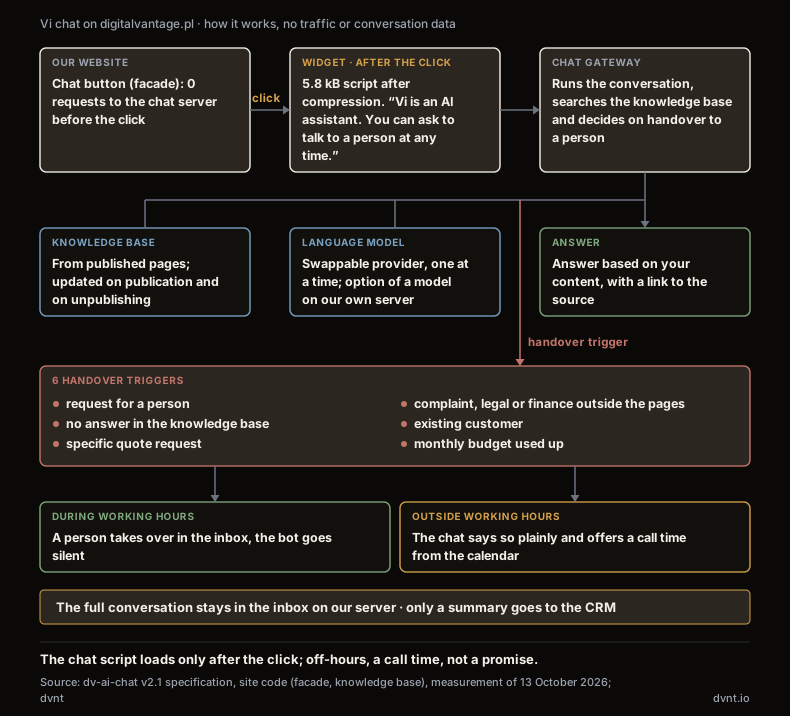
1. The chat script loads only after a click. The page loads just a button that looks like the chat button — same place, size, colour and icon. We fetch the real script only when someone clicks. We measured this on 13 October 2026 on the home page of the Polish edition: before the click the browser sent not a single request to the chat server, and after the click it sent two (the script and the widget configuration). The script itself weighs 5.8 kB compressed. This pattern is called a facade. Google describes it in the Lighthouse documentation, naming chat widgets explicitly; the audit itself was removed in Lighthouse 13, and the page dates from 2020. It also describes the cost: until someone clicks, features such as a badge with the number of new messages do not work. On the site's side this is about 100 lines of code.
2. The chat introduces itself as AI before the first question. A permanent notice sits above the conversation: "Vi to asystent AI. W każdej chwili możesz poprosić o rozmowę z człowiekiem." ("Vi is an AI assistant. You can ask to talk to a person at any time.") Why exactly this wording is covered in the AI Act section below.
3. Six situations in which the chat hands over to a person. The user asks for a person; the chat finds no answer in the knowledge base or is not sure of one; the conversation looks like a specific quote request; a complaint comes up, or a legal or financial matter that our pages do not describe; the user is already our customer; the monthly model budget has run out. Once a person takes over, the bot goes silent and does not answer alongside the consultant.
4. Outside working hours the chat does not pretend someone will reply soon. It answers around the clock, but outside working hours it does not hand the conversation over automatically and says so plainly. Instead of "someone will be in touch" it offers a specific free call time from our calendar. A conversation at 11 p.m. ends with a calendar entry and an email confirmation, not a promise.
5. The full conversation stays in the inbox, and a summary goes to the CRM. Conversations land in a Chatwoot inbox — open-source software for handling conversations — which runs on our own server, like the chat application itself (OVH in the EU — we pick the location that fits the project). A consultant replies from there, from a phone too. Only a summary goes to the CRM, because that is enough for further work with the customer.
The language model is swappable. Vi is not tied to one model vendor. We use different vendors depending on the situation — not all at once, but one at a time, switched in configuration — and, when data should not leave our server, a language model running on our own server. This is an architectural decision, not a technical detail: prices, model quality and the vendors' data-processing terms change every few months, and a chat hard-wired to one vendor would have to be rebuilt each time.
These five decisions are the same whether you build a chatbot from scratch or configure a ready-made tool. With a ready-made tool you check that the vendor allows them; with a custom build you make them yourself.
Chatbot cost: a subscription, a fee per outcome or tokens
The market bills an AI chat in three ways — a subscription with a conversation allowance, a fee per resolved case, or model tokens in a self-built chat — and the largest costs lie outside any price list anyway: in content, conversation review and people's time. Below is one example of each from the price lists we read on 29 October 2026. They illustrate billing models; they are not a comparison of offers or a ranking. Vendor prices are given in the currency the vendor showed us; our own per-conversation figures are converted to zloty (zł) at the National Bank of Poland (NBP) average rate of 19 October 2026 (table 203/A/NBP/2026), and the exchange rates are named where they are used.
- A subscription with a conversation allowance. Smartsupp sells its Mira AI agent at zł 68 a month, excluding VAT, on annual billing (zł 85 if paid monthly); the price includes 100 conversations a month, and the allowance can be raised to 5,000. Tidio shows a visitor from Poland its Lyro agent from €32.50 a month on annual billing for 50 conversations; the first 50 conversations on an account are free, one-off.
- A fee per resolved case. On the Intercom page, Intercom Fin pricing is $0.99 per "outcome", at most one per conversation: a case the customer confirms is resolved, one where they ask for nothing more after Fin answers, or one Fin hands to your team because a procedure you defined says so. When the customer asks for a person, or Fin cannot help, there is no charge. Seats for your human agents are billed separately.
- Tokens in a self-built chat. You pay the model vendor for tokens, the fragments of text into which a model splits input and output (more in our article on the LLM): for the instructions, the passages of content attached to the question, the conversation history and the answer. Anthropic publishes its prices in US dollars.
We worked out one conversation with six questions and answers on the Claude Sonnet 5.5 price list — $2 per million input tokens and $10 per million output tokens — with the conversation scored on the cheaper Claude Haiku 4.5 ($1 and $5). It is an example; on another model the result will differ. The assumptions: 1,500 tokens of fixed instructions, 4,000 tokens of content from the knowledge base with each answer, 250 tokens per answer. The result is about $0.09 per conversation, which is about zł 0.36 at the NBP rate of 19 October 2026 (zł 3.8974 to the dollar). 500 such conversations a month come to about zł 178 for tokens alone. A prompt cache helps with the fixed part of the instruction: for Sonnet 5.5 a cache read costs 5% of the standard input price, that is $0.10 per million tokens. The calculation leaves out reasoning tokens, which newer models use before answering. We do not know their number in our configuration, and they can raise the cost noticeably.
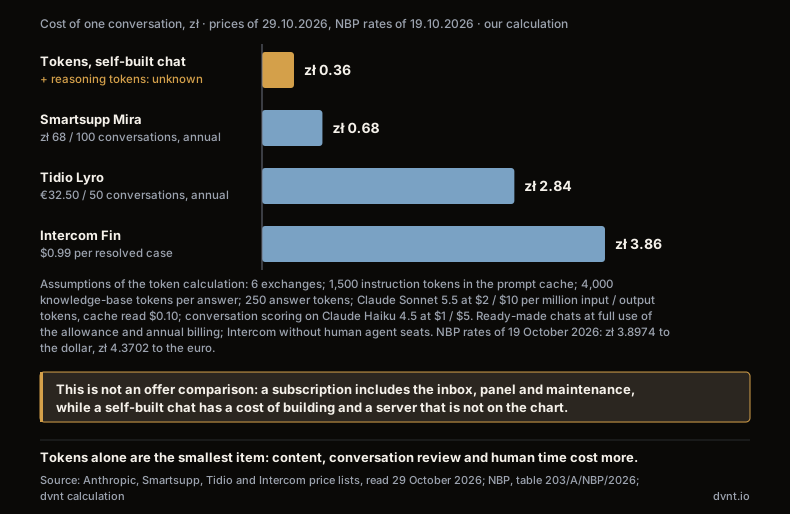
Converted to one conversation at full use of the allowance and on annual billing, Smartsupp comes to about zł 0.68, Tidio about zł 2.84 (at zł 4.3702 to the euro) and Intercom about zł 3.86 per case — that is our arithmetic. The chart does not say that a chat of your own is several times cheaper. A subscription covers the inbox, the panel, updates and maintenance; a custom build adds the cost of building and of a server, which the chart does not show.
What no price list shows (our assessment): preparing and updating the content the chat answers from; reviewing conversations, especially in the first weeks; the time of the person who takes conversations over; setting up the inbox, working hours and handover paths; updating the privacy policy. At a few hundred conversations a month these items cost more than tokens. What a chatbot built to order costs depends on integrations — with the CRM, calendar, order system — and on the scope of content, so a single "from" figure would tell you little.
One more thing about cost: the public chat window can be flooded with messages on purpose to run up the bill. A monthly model budget is therefore not only cost control but also a safeguard — we return to this under risks.
AI Act transparency: does an AI chat have to say it is AI?
Yes: since 2 August 2026 a person talking to an AI chat has to be told they are talking to AI — at the latest at the first interaction, unless it is obvious. That is what Article 50(1) and (5) of the AI Act says: providers must ensure people "are informed that they are interacting with an AI system, unless this is obvious from the point of view of a natural person who is reasonably well-informed, observant and circumspect", and the information must be given "in a clear and distinguishable manner at the latest at the time of the first interaction or exposure" and conform to the applicable accessibility requirements. The 2026 amendments to the Regulation (Regulation (EU) 2026/1744) gave this obligation no transitional period — the grace period to 2 December 2026 covers only the marking of AI-generated content under Article 50(2) — and the Commission says the "it is obvious" exception is to be interpreted restrictively (paragraph 45 of the guidelines). National market surveillance authorities will mainly enforce the rules.
The obligation falls on the provider of the AI system. A company that built a chat itself and put it into service under its own name is, according to the Commission's guidelines, a provider (paragraph 11) — that is our case. Whether a company that configures a ready-made chat under its own brand is also a provider has not been settled. With a ready-made tool, check whether it displays the AI notice itself, and in doubtful cases ask a lawyer. Our advice is simpler: the notice should appear anyway. Roles, penalties and supervisory authorities are covered in our article on the AI Act.
The most practical part is the list in the Commission's guidelines on Article 50 of 20 July 2026. The guidelines are non-binding — an authoritative interpretation can only be given by the Court of Justice of the European Union — but they show how the Commission reads the provision:
- Sufficient: a chatbot that starts a conversation by mentioning that it is based on AI technology (paragraph 36).
- Not sufficient (paragraph 38): a disclosure only in the terms and conditions, behind a URL or in documentation — such disclosures may complement, though not replace, in-context disclosure; an unclear signal, for example a generic reference to "assistant"; a general disclosure such as "Services on this website use AI"; a statement that refers only to the underlying technology, for example "this system uses LLMs".
The advice often found in guides — "just add to the terms that we use AI" — is therefore insufficient according to the Commission. Where a bot and a person take turns answering in one conversation, the guidelines require AI-generated outputs to be marked, unless a person has properly reviewed them and sent them as the main interlocutor (paragraph 30).
Here is how it looks with us, on the Polish edition: after the window opens, before the first message, a permanent notice sits above the conversation — "Vi to asystent AI. W każdej chwili możesz poprosić o rozmowę z człowiekiem." ("Vi is an AI assistant. You can ask to talk to a person at any time.") — with a link to the privacy policy. By the Commission's list, the name "Vi" and the word "assistant" would be too little; only the word "AI" in a notice visible before the conversation matches the example in paragraph 36 — that is our assessment. The second half of the sentence does not come from the AI Act but from what customers fear most: that they will not reach a person. We have not yet audited the notice against the accessibility requirements.
AI Act transparency for a chatbot on a company website comes down to one sentence the visitor sees before they start typing — and that does not hide in the terms.
Chatbot GDPR: personal data in conversations, model vendors and where a conversation goes
People type personal data into a chat window, including data you did not ask for — an order number, an address, a description of a health problem, a passage of a contract — so a chat processes personal data from day one. The AI Act does not replace the GDPR: Article 2(7) of the AI Act says the Regulation "shall not affect Regulation (EU) 2016/679", and the Ministry of Digital Affairs says outright that both sets of rules apply in parallel.
The Personal Data Protection Office (UODO, Urząd Ochrony Danych Osobowych), in its GDPR checklist for SMEs deploying AI (August 2026), lists four things you need before a tool is used on customer data: a contract with the vendor, an established basis for processing, information for the people whose data go into the tool, and knowing where that data is stored. A data processing agreement (Article 28 GDPR) is, according to UODO, mandatory when the vendor processes data on your behalf, which covers most cloud AI services (our translation of the checklist). Keep the completed list: in an inspection or a complaint it is evidence that you checked these questions before launch. The checklist is not a binding interpretation of the law and, according to UODO, it is not enough where, among other cases, data go outside the European Economic Area (EEA).
What happens to a conversation at the model vendor depends on the vendor and the way you access the model. As of 29 October 2026, when used through the API:
- OpenAI. Data sent to the API is not used to train or improve models unless you explicitly opt in; abuse-monitoring logs are kept for up to 30 days (OpenAI, Your data). A data-residency endpoint for Europe (EEA and Switzerland) is available to eligible customers, with a 10% uplift for models released from 5 March 2026 — and OpenAI notes that availability in a region does not imply that inference is performed in that region, so check where the endpoint you pick actually processes.
- Anthropic. API inputs and outputs are deleted within 30 days, with exceptions — among them longer retention if a conversation is flagged as violating the usage policy (Anthropic Privacy Center). The Anthropic API runs globally by default, with an option of US-only processing (data residency); on cloud platforms such as Amazon Bedrock or Google Cloud, the processing region depends on the endpoint you pick.
With a ready-made chat you ask its vendor the same questions: where it stores conversations, which models it uses and whether it will sign a data processing agreement.
Data minimisation looks like this with us: the chat asks for no more than the contact details needed to continue the conversation, the full conversation stays in the inbox on our server, and a summary goes to the CRM. Article 5(1)(c) of the GDPR asks for exactly that — data "limited to what is necessary in relation to the purposes for which they are processed". A swappable model adds one more option: a conversation whose content should not leave the company can be handled by a model running on our own server.
The privacy policy must describe the chat: who you are and how to reach you, the purposes and the legal basis, the recipients, including model vendors, whether data go to a third country, and how long conversations are kept (GDPR Article 13(1)(a), (c), (e), (f) and 13(2)(a)). We had to add this ourselves. While preparing this text we noticed that the privacy policy of our Polish site did not mention the chat, although the widget had linked to it from the start. We completed it before this article appeared. This is not legal advice: the policy text for your chat is worth preparing with a lawyer.
What can go wrong with an AI chat — and how to limit it
An AI chat on a website can make up an answer, be manipulated, run up a bill, keep a customer away from a person, slow the site down or repeat a mistake nobody sees — and each of these risks has a concrete remedy.
- A made-up answer you are responsible for. In 2024 the Civil Resolution Tribunal of British Columbia held in Moffatt v. Air Canada that an airline was responsible for wrong information its website chatbot gave: "It should be obvious to Air Canada that it is responsible for all the information on its website. It makes no difference whether the information comes from a static page or a chatbot." (paragraph 27). It awarded a total of CAD 812.02. That is a Canadian tribunal, not Polish law, and we found no Polish ruling in a similar case. A fuller discussion is in our article on AI hallucinations. Remedy: the chat answers only from published content, hands the conversation to a person when it has no answer instead of guessing, and makes no price or legal commitments from outside the knowledge base.
- Prompt injection. A public chat window is a place where anyone can type a command like "ignore your instructions and…". OWASP writes in its description of the threat (LLM01) that it is unclear if there are fool-proof methods of prevention. Remedy: a chat with no access to non-public data and no actions that cannot be undone, and the user's text treated as data, not as commands. The damage is limited to what is on the site anyway. More in our article on how to build an AI agent.
- The bill. OWASP describes "Denial of Wallet" (LLM10): an attacker initiates a high volume of operations to exploit the cost-per-use model of cloud-based AI services and burden the owner with costs. Remedy: request limits and a monthly model budget. With us, once the budget is used up the chat hands the conversation to a person, and outside working hours it sends one message written in advance, with no model involved, and goes silent.
- The customer is stuck with the bot. This is customers' main concern in the Gartner survey. Remedy: the route to a person in the notice visible before the conversation and at every moment of it, and outside working hours a real call time instead of a promise.
- A slower site. According to Google, loading third-party scripts straight away on page load can needlessly slow the page down, and every visit pays for the chat script, including visits in which nobody opens the chat. Remedy: a facade, a script loaded only after a click. How to measure site speed is covered in our article on Core Web Vitals.
- Nobody reads the conversations. A chat with no review repeats the same mistake hundreds of times before anyone notices. Remedy: review every conversation weekly for the first month and regularly after that; fix each mistake you find at the source — in the content on the site or in the chat's instructions.
Frequently asked questions about an AI chatbot for a website
A ready-made chatbot or build your own?
A ready-made chat (for example Smartsupp, Tidio or Intercom) goes live quickly, and you pay for an allowance of conversations or for resolved cases, but you have limited influence over where the chat gets its knowledge, where the data goes and how the handover works. Your own chat gives you control over the knowledge base, the data and the integrations — with the CRM, calendar and order system — at the price of building and maintaining it. For a few dozen simple questions a month a ready-made tool is usually enough; building your own makes sense when the chat has to connect to your systems or the data must not go to an external service.
Can a chatbot quote prices and take orders?
Prices — yes, but only those published on your site, with no negotiation and no commitments from outside the knowledge base. A company is responsible for information its chatbot gives just as for the content of its site; that is what the Canadian tribunal held in the Air Canada case. Taking orders and other actions in systems is a job for an AI agent, with different safeguards — we describe them in our article on the AI agent.
Will an AI chat slow down my website?
It can, if the chat script loads on every visit — then every visitor pays for it, including the one who never opens the chat. The solution is a facade: the page loads only a button and fetches the real script after a click. On the Polish edition of our site the browser sends no request to the chat server before the click. With a ready-made tool, ask the vendor whether it supports this kind of loading.
Does the chat have to run around the clock?
No. It matters more that it tells the truth about when a person will reply. Our chat answers around the clock, but outside working hours it does not promise that someone will reply soon — it says so plainly and offers a specific call time from the calendar.
Are chat conversations used to train models?
When used through the API, according to the vendors, no. OpenAI says data sent to the API is not used to train models unless the customer opts in, and keeps abuse-monitoring logs for up to 30 days. Anthropic deletes API inputs and outputs within 30 days, with exceptions described in its privacy centre. With a ready-made chat, ask the vendor which models it uses and check the data processing agreement (as of 29 October 2026).
How do I test a chat before launch?
Collect a few dozen real questions from emails and phone calls, including some the answer to which is not on your site — the chat should then say it does not know and hand the conversation to a person rather than guess. Test every handover path, including outside working hours. After launch, read all conversations every week for the first month; that is what we do with our chat. How to recognise made-up answers is covered in our article on AI hallucinations.
Related articles
Artificial intelligence
Prompt engineering — what it is and how to write prompts at work
Prompt engineering at work: how to write prompts, templates for business processes, and when a Polish company needs RAG or an AI agent instead.
Artificial intelligence
Claude vs ChatGPT vs Gemini — our test on 10 business tasks in Polish
Claude vs ChatGPT vs Gemini on 10 business tasks in Polish: blind-rated, with repeat spread, made-up facts and cost per task. Test of 27 October 2026.
Artificial intelligence
Model Context Protocol (MCP) — what it is and what it means for a business
Model Context Protocol (MCP) connects AI assistants and agents to company systems. How an MCP server works, its risks, GDPR and when to build your own.
Automation and integrations
What is n8n — and when does it make sense for a business
What is n8n? An automation tool with AI nodes, in the cloud or on your own server. Licence, prices with a PLN guide, GDPR, and n8n vs Make and Zapier.
Artificial intelligence
How to build an AI agent for your business — from process to first working version
How to build an AI agent for your company step by step: process, tools and permissions, human in the loop, cost limits, evaluation and prompt injection.
Artificial intelligence
AI hallucinations — why AI makes things up and how a business can catch it
AI hallucinations are confident but false answers from a language model. Why they happen, where they cost a business in Poland and how a process catches them.
Where would AI really pay off for you?
Tell us which tasks take up most of your time today. We will check whether an off-the-shelf assistant is enough or whether you need an implementation on your own data. If ChatGPT on a business plan will do, we will say so plainly.